
Unbiased headlines. Facts, not spin.
Unbiased Headlines is an independently owned news organization. We bring you the facts, not opinions, written fresh from 110+ named sources. Sources linked so you can verify it yourself.
 energy
Major Story (7/10)
Event date: November 17, 2026 ·
Data Center Power Demand Keeps Straining U.S. Grid as Harvard Study Puts Hyperscale Use at 82 TWh
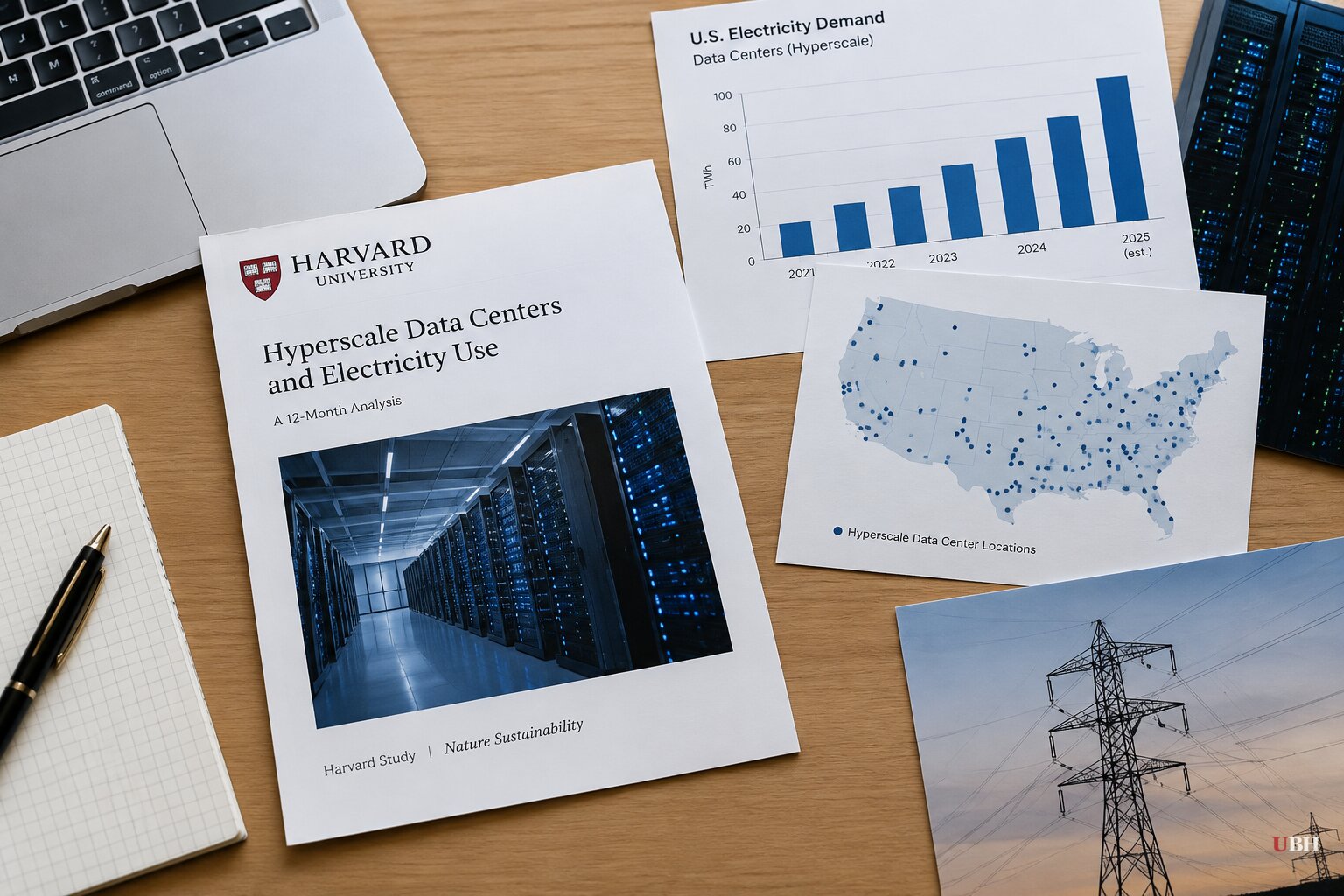
The U.S. data center buildout is now being measured, and the numbers are large. A Harvard study published Monday, Nov. 16, in Nature Sustainability estimates that 403 hyperscale facilities consumed about 82 terawatt-hours of electricity between May 2024 and April 2025. That is roughly 1.8% of all U.S. electricity.
The researchers, working from satellite imagery and EPA data, put the plausible range at 68 to 99 TWh. The top of that range matches what states like Indiana, Michigan and Tennessee use in a year. The facilities also produced an estimated 25.7 million metric tons of carbon dioxide, about what Denmark emits annually.
More than half of the power came from fossil fuels, mainly natural gas and coal. Half of the total use was concentrated in four states: Virginia, Oregon, Ohio and Iowa.
The study is already out of date, its author says
Lead author Gianluca Guidi told CBS News the data "stops in April 2025, which in AI time is basically ancient history." He said more than twice as many large-scale facilities are operating now, with another 2,000 planned or under development.
"The industry is growing faster than anyone can track it," Guidi said. He describes himself as a proponent of AI. He wants the evidence and public input to come before the buildings do, and he asked hyperscalers such as Amazon, Meta and Microsoft to "prove that we can build it right."
Senior author Francesca Dominici, director of the Harvard Data Science Initiative, said there was "very little, if none, peer-reviewed data" on facility-level impact when the work began.
Voters are acting before regulators do
In this month's midterms, voters in 40 of 41 local ballot initiatives on data centers chose to limit or block development, according to TIME's tally. Bloomberg tracked 46 such municipal measures, and nearly all ended in restrictions, moratoriums or bans, Utility Dive reported.
NBC News polling found 69% of Americans oppose an AI data center in their neighborhood.
The politics also cross party lines. Texas Gov. Greg Abbott, a Republican, announced a pause on new data center interconnections this summer pending an audit of the queue. He then lost reelection to Democrat Gina Hinojosa, who has pledged to keep pressure on the industry after taking office next year. New York Gov. Kathy Hochul, a Democrat, has also pushed back.
Energy analytics firm Orennia estimates 191 GW of planned data center capacity faces new risk, concentrated in Texas, Ohio and Georgia, where incoming Democratic governors campaigned on pausing or restricting construction. Texas holds nearly half of the U.S. pre-construction pipeline. Orennia also cautions that the effect of a slowdown on power prices "varies widely across technologies and markets."
Investors see the exposure in dollars. Andrejka Bernatova of Dynamix Capital Partners told Utility Dive that prolonged uncertainty will raise the cost of capital and make investors reluctant to commit before power is secured. Utilities could be stuck with billions in infrastructure built for projects that are delayed, downsized or canceled, the industry observers said.
Winter reliability and who pays
The North American Electric Reliability Corporation's winter assessment says demand is expected to rise in 21 of the 23 regions it tracks. NERC names data center growth, other large industrial loads and electrification as drivers. No region is rated high risk. Quebec, the Canadian Maritimes and parts of the U.S. Southeast are rated elevated. New England faces limited natural gas supply, and parts of the central U.S. face localized transmission constraints.
"We anticipate operators will need everything in their tool kit—including requests for emergency support—to maintain reliable operations," NERC CEO Jim Robb said. In an emergency, operators in areas with large loads can ask the Department of Energy for authority to direct those customers onto backup generators.
The cost question is playing out in rate cases. In Arizona, Arizona Public Service is asking regulators for a 14% residential increase and a 45% increase for extra-large users such as data centers. APS says data centers made up 7% of its peak demand last summer. Greg Bernosky, the company's director of large customer strategy and development, says the utility's "growth pays for growth" approach uses long-term contracts so residential and small commercial customers do not fund the buildout. Asked what share of power data centers would take in 5 to 10 years, he said, "I don't know right now."
Phoenix homeowner Ricardo Reyes showed a $1,100 September bill, $300 more than the same month in 2025. Two proposed projects west of Phoenix, Tract in Buckeye and Hassayampa Ranch, could draw up to 3,300 MW combined, according to their developers.
Grid operators and Congress respond
PJM Interconnection, which says it serves about 10 GW of data center and large-computing demand and could add up to 30 GW by 2030, filed two proposals at FERC on Nov. 16. One would cut the study time for new generation and large-load connections from two years to one. The other would require large facilities of at least 50 MW to ride through voltage and frequency disturbances, after a July 22 fault in Northern Virginia pushed nearly 3.9 GW of demand onto backup power.
Data center and buyer groups dispute that a one-year study means a shorter wait. The Data Center Coalition and the Corporate Energy Buyers Association told PJM's board in October that a project missing the annual cutoff could wait almost a year to enter the next cycle, then spend another year in the study.
In Congress, a Congressional Research Service report notes competing bills. H.R. 9442 would pause AI data center construction at a 20 MW threshold until regulations are set. H.R. 9183 uses 50 MW, and the RECLAIM Act (S. 5689) uses 100 MW.
PJM wants the ride-through rules effective Jan. 16, 2027. It asked FERC for a 60-day comment period and a decision within 120 days of filing. The first application window under the new study process is expected in late November 2027, subject to approval.
Sources used for this briefing
8 links from 8 independent newsrooms (syndicated copies of the same report count once)
These are the sources it draws on, linked so you can verify.


