
Unbiased headlines. Facts, not spin.
Unbiased Headlines is an independently owned news organization. We bring you the facts, not opinions, written fresh from 110+ named sources. Sources linked so you can verify it yourself.
 energy
Major Story (8/10)
Event date: November 6, 2026 ·
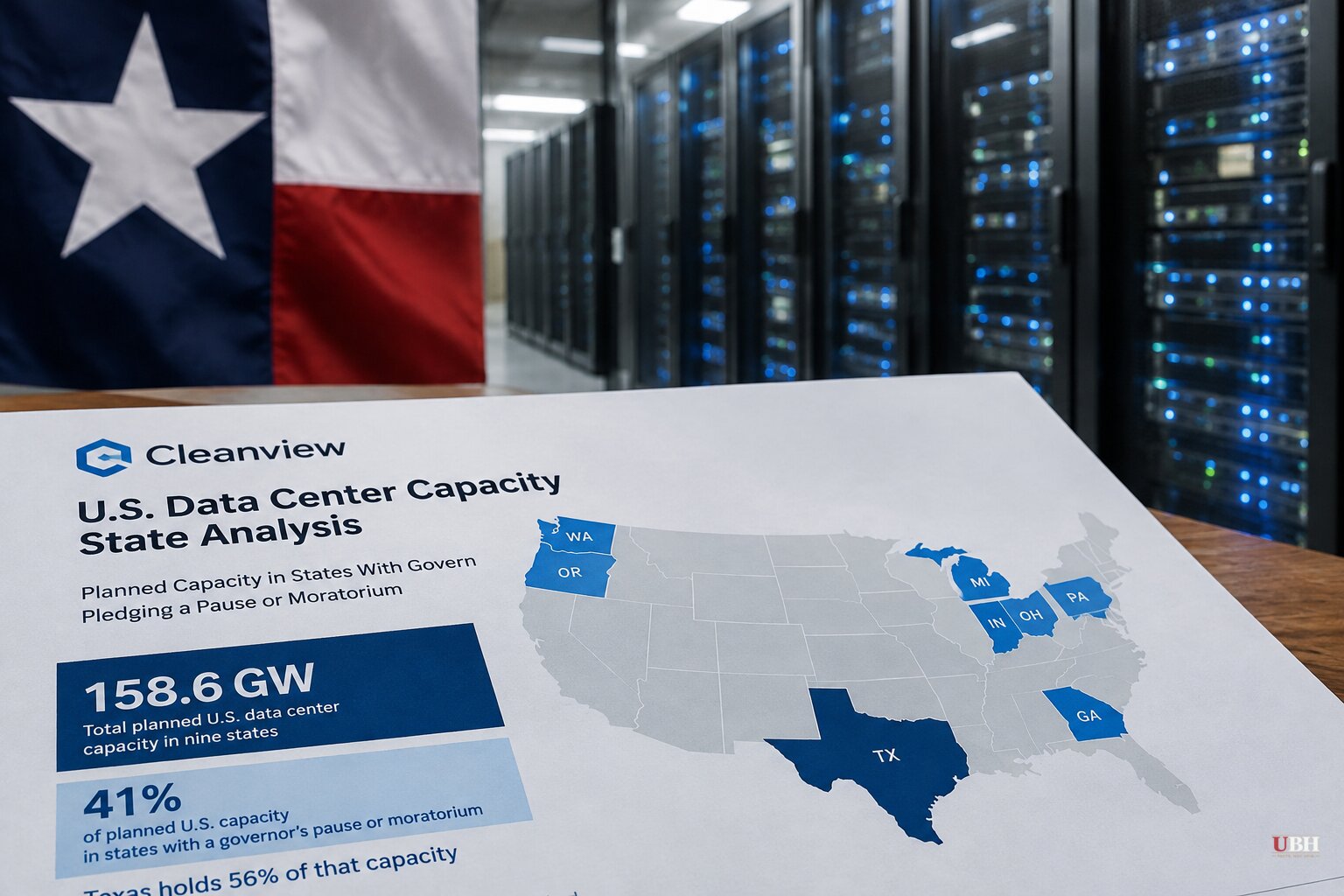
Cleanview Puts 41% of Planned U.S. Data Center Capacity in States With Governors Pledging a Pause, and Texas Holds 56% of It
Since voters went to the polls on Nov. 3, the question hanging over the AI buildout has shifted from whether the backlash is real to how much planned capacity it can actually touch. The first hard numbers are in, and they point to delay far more than cancellation.
The exposure estimates
Market intelligence firm Cleanview says 158.6 GW of planned capacity sits in nine states where a governor or governor-elect has promised or already imposed a pause. That is 41% of the national pipeline.
Texas accounts for 88.4 GW of that total, or 56%. That is four times the exposure in Ohio, the next state on the list. Oregon, Michigan, Wisconsin and Maine are the four smaller pause states. Another 69.2 GW, 18% of the pipeline, sits in states where the winner wants to change tax breaks or other rules but has not backed a pause.
Cleanview stresses that its number is planned capacity, not built or under-construction capacity. It puts 56.7 GW under construction nationwide and calls that portion less exposed, because most pledges target new approvals.
Cleanview says OpenAI's entire planned pipeline is in states with a new governor who backed a pause on the campaign trail.
Other estimates land in the same neighborhood. Goldman Sachs economists predict Democratic wins will likely lead to "short-term data center moratoria, potentially affecting about 45% of planned US data center capacity expansion." Barclays found that 80% of the roughly 300 GW it rates high probability will sit in states with a Democratic governor next year. Bloomberg Intelligence estimates up to 10 GW may not come online in 2027 as planned.
The Texas share differs by yardstick. Axios cited SemiAnalysis as expecting Texas to host 41% of new U.S. capacity coming online in 2028. Bloom Energy's estimate, as relayed by Fortune, is nearly 30% by 2028.
What voters and governors-elect did
In Texas, Democrat Gina Hinojosa won the governor's race on a pledge to freeze data center approvals until the legislature passes new protections and to end subsidies for large developers. In Ohio, Amy Acton backed a conditional moratorium that would allow new facilities if developers cover all utility costs, use union labor and meet environmental standards. In Georgia, Keisha Lance Bottoms promised a temporary suspension while the state assesses effects on power bills, communities and the environment.
Local ballots told the same story. Ballotpedia counted 41 data center measures in 10 states, and initial returns showed every proposal aimed at restricting or blocking development passing. Trade press tallies since then put the number of approved local measures at roughly 40. Ohio hosted the largest share. A statewide Ohio initiative to restrict larger data centers missed the 2026 ballot but could land on the 2027 ballot.
"What we just witnessed was an AI earthquake," said Brad Carson, co-founder of Americans for Responsible Innovation. "Voters just sent a clear message that they want rules for AI and data centers." In Georgia, Sen. Jon Ossoff won reelection and used his victory speech to accuse tech executives of building human-extinction risk while digging bunkers for themselves.
The politics are not purely partisan. Alabama's Republican governor-elect Tommy Tuberville campaigned for data center developers to pay their own electricity, infrastructure and water costs, and for local communities to be able to reject projects. Republican governors in Nevada and North Dakota, and Democratic governors in Michigan and New Mexico, whose states have major projects under construction, see an economic opportunity.
Texas moved before the election
The Texas pause is not purely a creature of the campaign. On Aug. 3, outgoing Republican Gov. Greg Abbott told the Public Utility Commission and grid operator ERCOT to stop approving new data center connections until every project in the queue, up to 300 of them, was audited. On Sept. 21 he directed the Texas Commission on Environmental Quality to halt data center permits until the audit is done.
Abbott said ERCOT is weighing more than 474 GW of connection requests, more than five times the state's record peak demand. Hinojosa called Abbott's tougher stance "nothing more than an election year stunt."
Delay, not a halt
Most analysts see a speed bump. Bernstein expects project fundamentals, such as tenant credit and developer experience, to outweigh political risk in deciding which projects proceed. Trade coverage of the analyst consensus describes pauses, extended reviews and added conditions rather than an end to the boom. Axios reported that most political analysts do not expect Democrats to block construction permanently, and that most data centers due in 2027 are already under construction.
Dan Ives, an analyst, argues the results could force tech companies to slow expansion and seek compromises on AI regulation.
A hold longer than six months in Texas, though, would cause extended delays across the state, according to Axios.
The calendar that decides it
Hinojosa's room to act alone is limited. Democrats flipped the Texas House, but Republicans kept the state Senate 19-12, so any lasting framework needs a deal with them.
ERCOT plans to file its audit reports Dec. 10 and present them to the Public Utility Commission on Dec. 17. The legislature then sits from Jan. 12 to May 31. Hinojosa takes office after the audit presentation, and what the audit finds will shape whether her moratorium pledge or Abbott's existing freeze governs the state's queue.
Sources used for this briefing
8 links from 8 independent newsrooms (syndicated copies of the same report count once)
These are the sources it draws on, linked so you can verify.


