
Unbiased headlines. Facts, not spin.
Unbiased Headlines is an independently owned news organization. We bring you the facts, not opinions, written fresh from 110+ named sources. Sources linked so you can verify it yourself.
 energy
Notable (6/10)
Leaked EU draft would let industry keep 80% of free carbon permits after filing an investment plan
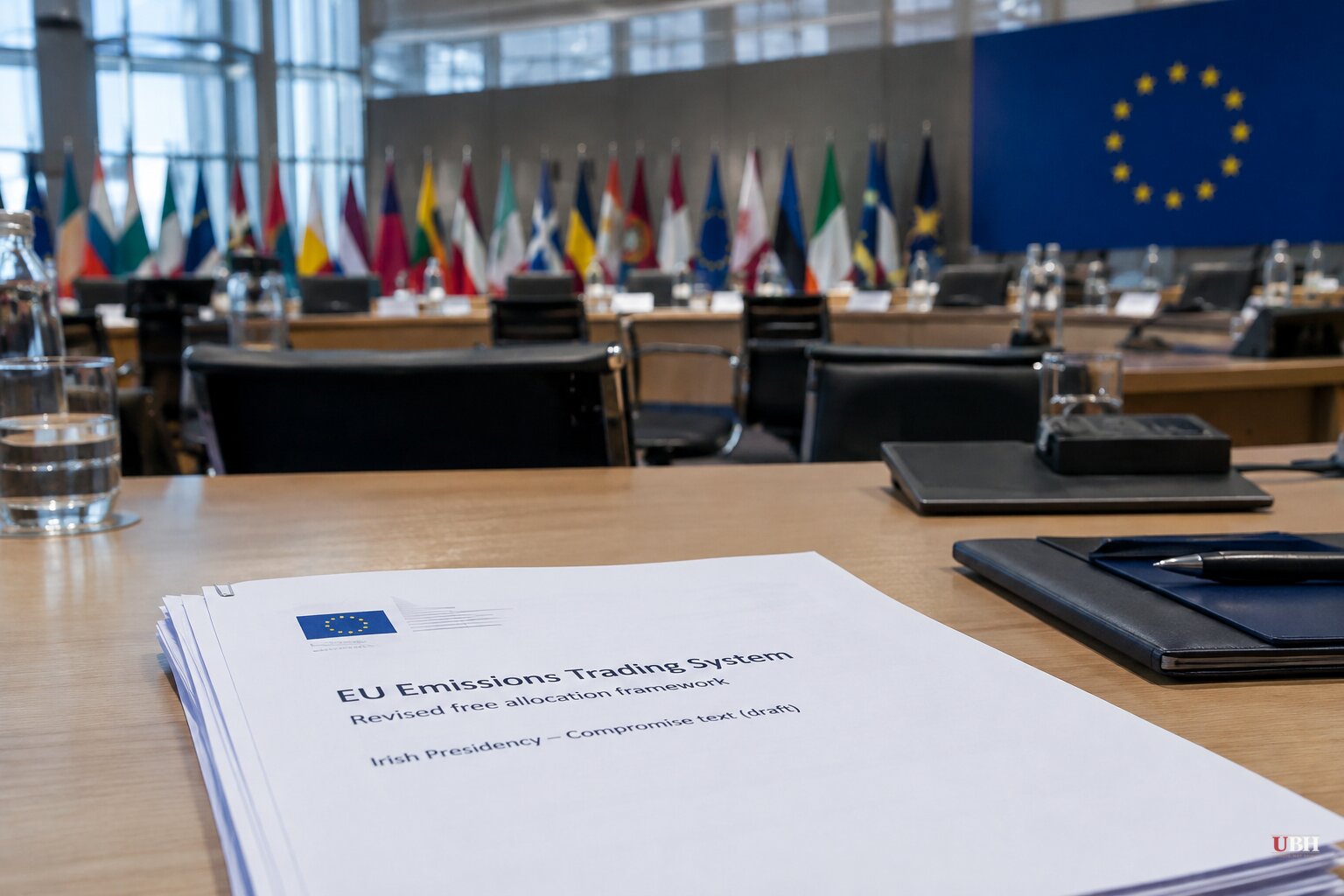
The EU's carbon market is being loosened again, and the 2040 climate target is where the strain shows.
A compromise text from the Irish Presidency of the EU Council, seen by Euronews, is due before EU ambassadors on Wednesday, Nov. 18. It softens the European Commission's July proposal to reform the Emissions Trading System (ETS), the bloc's main carbon pricing tool.
What the draft says
Under the text, industrial companies keep 80% of their free allowances simply by submitting an investment plan. They keep them even if they later fail to deliver the decarbonisation investments in that plan.
The other 20% depends on starting construction of eligible projects.
Free allowances are permits companies receive without buying them at auction. They exist to protect EU producers from competitors in countries with looser climate rules, such as China and the United States.
The Council text keeps the Commission's plan to slow the decline in the emissions cap after 2030 and to extend free permits for industry. It also keeps the plan to let international carbon credits count toward EU goals, so some domestic emissions are offset by projects abroad.
The 2040 math
The credit provision carries the most weight. The Council kept the Commission's proposal to set aside allowances equivalent to 260 million tonnes of CO2 to finance credit purchases. It leaves open a pilot phase from 2031 to 2035.
The 2040 target requires at least an 85% domestic net emissions reduction, with international credits covering the remaining 5% of the 90% goal. The Council kept strict quality and integrity requirements for those credits. That makes the ETS reduction path increasingly dependent on credits being available. If industries can't buy them, the 2040 target could be in jeopardy.
Climate advocates say the concessions to industry could leave other sectors to make up the shortfall.
The earlier warning
An analysis by the Öko-Institut, commissioned by WWF Germany, found the Commission's original proposal incompatible with the 90% target. The institute says it would raise the supply of allowances by up to 10% above projected demand. That would weaken the carbon price signal and reduce the incentive to invest in clean technology.
The analysis also criticises the plan to allow emissions above the cap in exchange for future permanent carbon removals. It says the capacity for those removals does not exist today and that their cost is likely to stay above the carbon price in the medium term.
"The Commission would rather gamble on climate protection than safeguard the future of European industry," said Lisa Okken, industrial policy expert at WWF Germany.
The analysis says the likely outcomes are missing the 2040 target or pushing a bigger share of the cuts onto buildings, transport and agriculture.
The competitiveness case
The presidency's stated aim is to secure political support for the carbon market beyond 2030. Governments are trying to square emissions targets with industrial competitiveness and high energy costs.
Pressure is also coming from the other direction. German Chancellor Friedrich Merz wrote to Commission President Ursula von der Leyen, in a letter seen by Der Spiegel, urging her to hold the line on ETS2. That separate system puts a carbon price on petrol, diesel and heating fuels, and its start is set for 2028.
"I reject further changes," Merz wrote. "I am counting on the European Commission to stay the course on emissions trading and thereby give European companies and households planning certainty."
ETS2 was originally due in 2027. EU countries pushed it back a year as part of the deal on the 2040 target, over fears of steep energy price rises hitting low-income households hardest. With fossil fuel prices rising again because of the Iran war, pressure for a further delay is growing among member states.
Merz also defended the existing system for power plants and heavy industry, ETS1, as "a well-functioning, market-based system that we must not call into question." That is a shift from February, when he said the EU should be "very open" to revising or postponing the ETS if it hurt industrial competitiveness.
Handelsblatt noted the letter was the first clear public German stand against postponing or substantially changing the schemes. Der Spiegel said Merz's push is likely driven less by climate concerns than by fear that German firms would face a lasting disadvantage. Germany has had its own carbon price on transport and heating fuels since 2021, set at 55 to 65 euros per tonne of CO2 this year, and many other member states have none.
A group of countries around Poland and Italy has called for weakening ETS1 to avoid pushing up power costs from gas and coal plants. Merz pointed instead to existing electricity price compensation schemes. The Commission says ETS1, in place since 2005, has helped cut emissions in the sectors it covers by more than half.
Meanwhile, in Antalya
At the UN climate summit in Turkey, Australian Climate Change Minister Chris Bowen, the COP31 president of negotiations, released an 18-page draft. It proposes that developed nations reach net zero by 2030 and net-negative emissions by 2040. Bowen stressed it is a first draft and "won't be the final draft."
Greenpeace Australia Pacific's Simon Bradshaw called it "some of the strongest language we've seen in a draft COP decision." He added: "The question now is how much of it will survive the tough days of negotiations ahead."
What comes next
The Council text is a working compromise, not a final law. EU ambassadors take it up Wednesday, and the European Parliament and member states are still negotiating the Commission's July proposal. Whether the 80% free-allowance guarantee and the 260 million tonne credit set-aside survive those talks will determine how much of the 2040 target rests on credits that, under the Council's own integrity rules, may be hard to obtain.
Sources used for this briefing
6 links from 6 independent newsrooms (syndicated copies of the same report count once)
These are the sources it draws on, linked so you can verify.


