
Unbiased headlines. Facts, not spin.
Unbiased Headlines is an independently owned news organization. We bring you the facts, not opinions, written fresh from 110+ named sources. Sources linked so you can verify it yourself.
 energy
Notable (6/10)
Khanna Proposes $1,700 Iran War Refund Checks as Gas Averages $3.81 and DOE Closes $480 Million Gulf Oil Loan
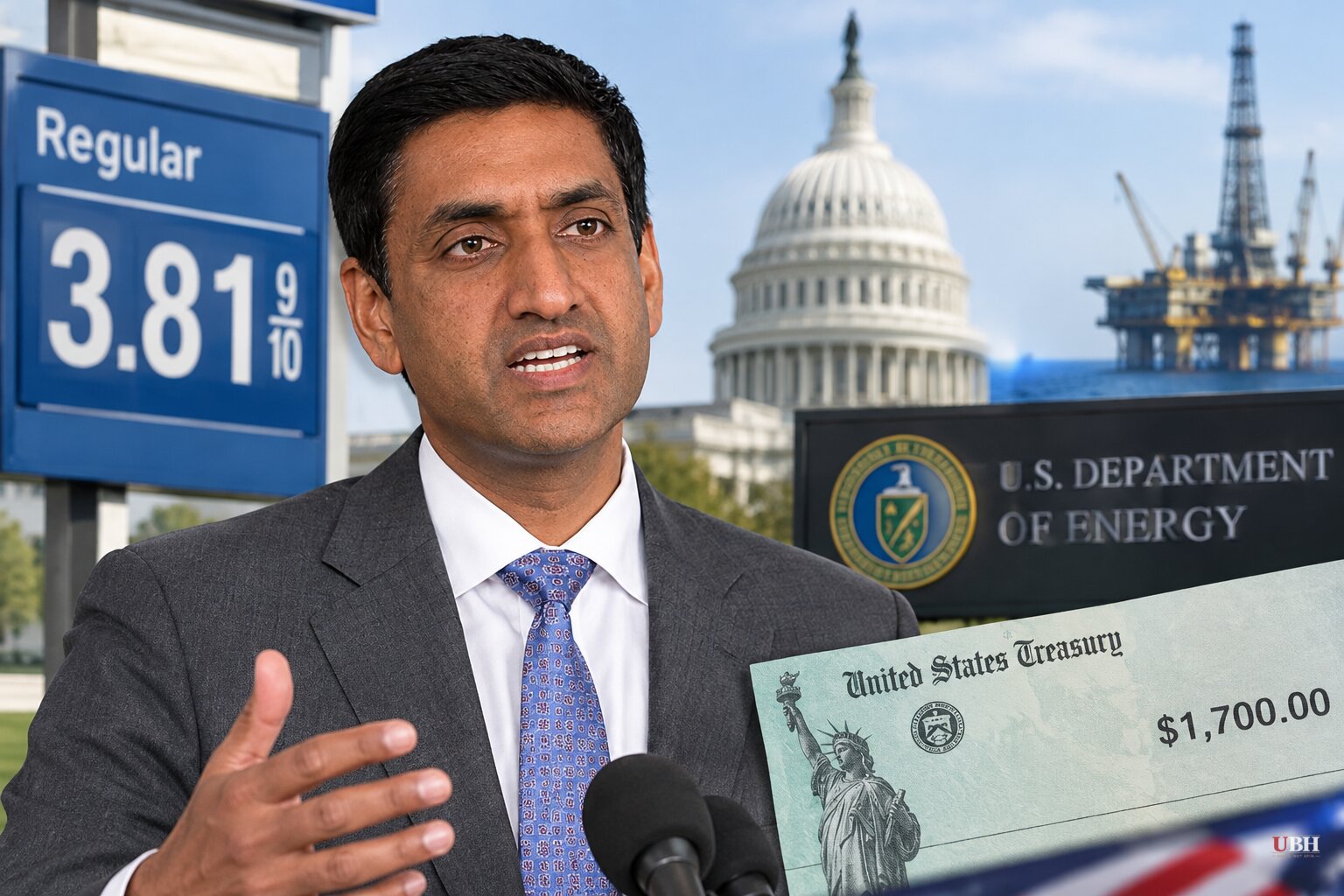
Rep. Ro Khanna, D-Calif., proposed on Monday, Nov. 16, that every American family get a $1,700 refund check to offset higher costs tied to the war in Iran. He wants the House and Senate to pass it the first week of January.
"I want to give every American family a $1,700 check to make them whole for the war in Iran," Khanna said in a video posted to X. He said the money would cover higher gas, food and electricity prices.
"Now Democrats have a chance to deliver," he said, pointing to the party's sweeping midterm victories earlier this month.
What the numbers show
The war began in February. The national average for gasoline rose above $4 a gallon, then eased in recent weeks. AAA put it at $3.81 on Monday, about 75 cents above a year ago.
Diesel is still near $6 a gallon, roughly $2.23 higher than a year earlier.
Mark Zandi, chief economist at Moody's Analytics, estimated last month that the conflict had cost the average household about $2,000, or $265 billion nationwide. His figure includes higher energy costs, borrowing costs and military spending.
That is an estimate, and it bundles several categories. Khanna's $1,700 figure falls short of Zandi's $2,000, and Khanna has not tied it to a specific calculation in the video.
The legislative reality
Khanna introduced a bill in September that would redirect certain unused Pentagon funds to compensate taxpayers and dependents for the war's economic costs. That bill does not specify a $1,700 payment. It has not moved past referral to committee.
Khanna previously urged Congress to block all funding for the war. The new proposal has no announced cosponsors or scheduled vote in the material he released.
President Trump has repeatedly argued that higher prices are worth paying to keep Iran from getting a nuclear weapon. At the same time, Trump, Vice President JD Vance and other Republican leaders have acknowledged the party's midterm losses were at least partly driven by voter frustration over prices.
Washington's energy money is going elsewhere
On Nov. 10, the Department of Energy announced it had closed a $480 million loan to Arena Energy's Project Elkhorn. The project would modernize 22 offshore platforms off Louisiana.
At peak, DOE said, it would add up to 38,600 barrels of oil per day and 77 million cubic feet of natural gas per day. Arena currently produces roughly 30,000 barrels of oil per day offshore.
The department described it as the first loan it has closed in support of domestic oil and gas production. The project is expected to yield about 125 million barrels of oil and 250 billion cubic feet of gas over its lifetime, with 400 operational jobs and 2,400 construction jobs.
Arena estimates the added output would generate $1.6 billion in federal royalties, more than three times the loan.
"The United States is the world's largest producer and exporter of oil and natural gas, and thanks to President Trump, American energy production will continue to grow," Energy Secretary Chris Wright said. DOE says the loan reflects its commitment to deliver "reliable, affordable energy to families and businesses."
No source in the announcement connects Elkhorn's output to pump prices, and the added barrels arrive only at peak production.
The loan comes through the Energy Dominance Financing program. According to an April 2026 report from the Energy Information Administration, the law behind it removed the requirement that financed energy infrastructure reduce, use or sequester greenhouse gases and air pollutants.
A Trump-allied pipeline loses U.S. bank support
Not every federal energy bet is moving forward. The Export-Import Bank of the United States and the U.S. International Development Finance Corporation are distancing themselves from a Bosnia-Herzegovina gas pipeline and infrastructure plan, according to Bloomberg. That puts $2.3 billion in potential U.S. federal funding for energy and airport projects in doubt.
The company behind it, AAFS Infrastructure and Energy, had named both banks as primary investors. It is led by Jesse Binnall, a former Trump attorney, and Joseph Flynn, brother of former national security adviser Michael Flynn.
An EXIM spokesperson said the bank "has not approved or committed any financing to this company at this time." Bloomberg, citing an unnamed person familiar with the matter, reported the project has stalled at DFC.
Amer Bekan, who runs AAFS operations in Bosnia, said discussions with EXIM have stopped. He said AAFS has lined up as much as €450 million ($504 million) from other backers and expects a contract with the government of the Muslim-Croat federation, where the work is planned. "The projects are continuing," he said.
AAFS said in April it was committing €1.5 billion ($1.7 billion) to a gas pipeline, three gas-fired power stations and expansions of the Sarajevo and Mostar airports. Wright called the pipeline part of the Trump "Peace Pipeline Agenda" that same month. The pipeline is meant to link Bosnia to Europe's gas grid through Croatia, ending its total dependence on Russian gas.
What comes next
Khanna's target is the first week of January, and his September bill is still sitting in committee. Whether either chamber schedules a vote on any war-refund payment is an open question.
In Bosnia, the test is whether Bekan's €450 million in alternative financing turns into a signed contract with the federation government.
Sources used for this briefing
3 links from 3 independent newsrooms (syndicated copies of the same report count once)
These are the sources it draws on, linked so you can verify.


