
Original briefings. Zero spin.
Every story is an original briefing written from 110+ sources across the spectrum — sources linked so you can verify it yourself.
 energy
Major Story (8/10)
Event date: September 8, 2026
energy
Major Story (8/10)
Event date: September 8, 2026
China's New Five-Year Plan Targets 70% EV Sales by 2030, But an Oil War, Not Green Policy, Is Doing the Heavy Lifting
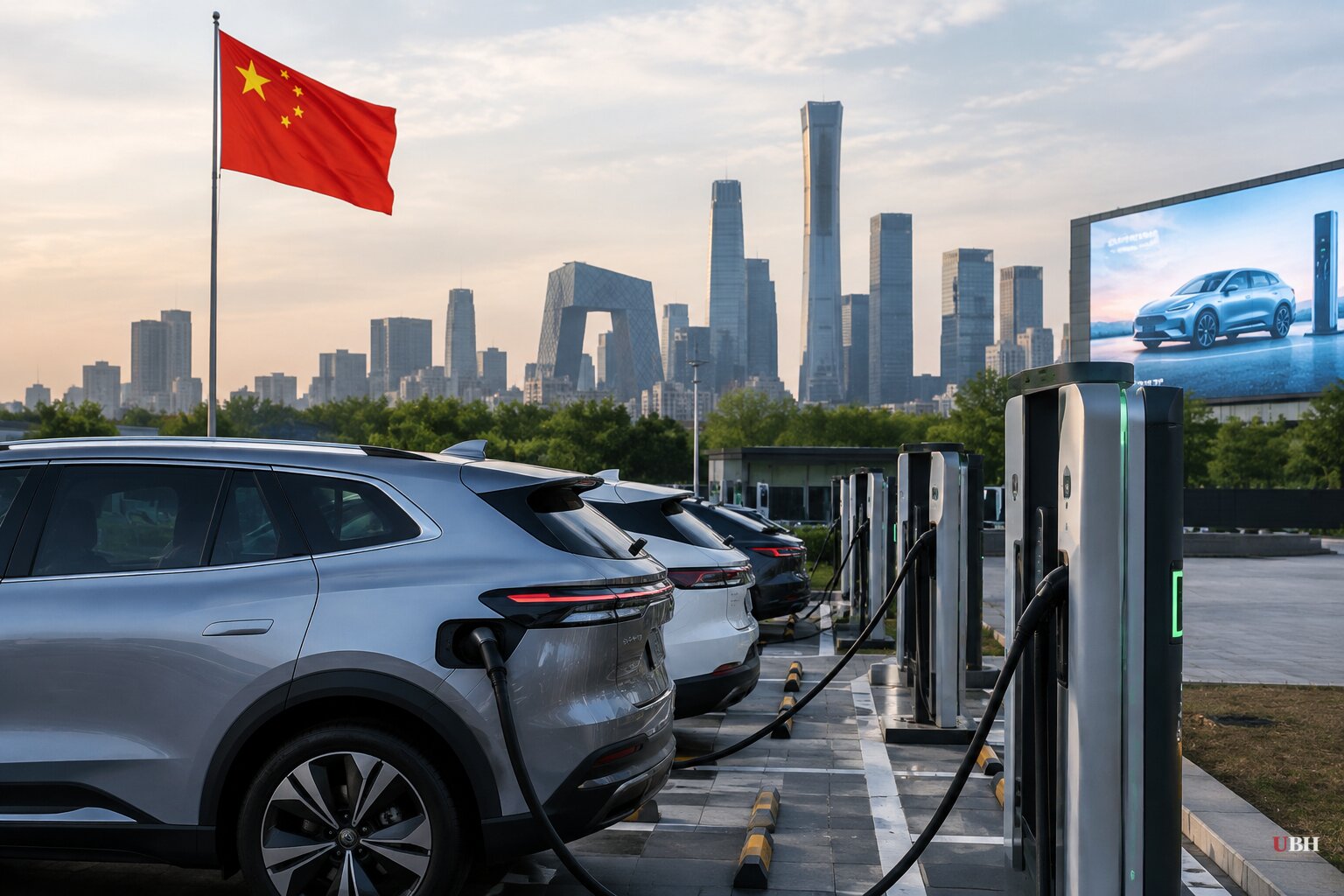
China's central planners have set a new target: 70% of all passenger car sales should be electric or hybrid by 2030. The goal comes from a new five-year plan for the auto industry, compiled by nearly a dozen Chinese government agencies, according to OilPrice.com and ZeroHedge. A parallel target calls for 40% of new commercial vehicle sales to run on electric power by the same year.
China isn't far off. New energy vehicles made up 54% of passenger car sales at the end of last year. By August 2026, that share had already climbed to 65%, according to data from the Passenger Car Association cited by Bloomberg. Analysts told OilPrice.com the 70% target could be hit ahead of schedule.
The Real Driver Is a War, Not a Mandate
The timing matters. China's EV surge is happening alongside a global oil shock triggered by the US-Israeli war on Iran, which began with airstrikes in late February 2026, according to The Guardian. The Strait of Hormuz, which once carried roughly a fifth of the world's oil and LNG, has been effectively shut since March, according to reporting dated September 12, 2026. Brent crude has been trading above $100 a barrel, with OilPrice.com pricing data showing Brent near $104 and WTI near $100.
That price shock is doing more to reshape Chinese driving habits than any five-year plan. Analysis of China's National Bureau of Statistics data by the Centre for Research on Energy and Clean Air, published through Carbon Brief, found China's overall oil use fell 9% in the second quarter of 2026, and 16% specifically in transportation. China's oil imports dropped 32% in the same quarter. Two-thirds of that import drop came from running down strategic stockpiles rather than actual demand destruction, per Carbon Brief's analysis, but the remaining third reflected a genuine consumption decline of roughly a million barrels a day.
Sinopec, China's state refiner and the world's largest refiner by capacity, expects the pattern to deepen. The company's Economics & Development Research Institute projects Chinese oil demand will fall 8.9% in 2026 versus 2025, with gasoline down 8.7% and diesel down 11.4%, according to ZeroHedge's citation of Sinopec's own research.
Kpler's commodity analysts go further, estimating that EVs and alternative-powertrain trucks will displace 1.3 million barrels a day of Chinese road fuel demand in 2026 alone. Kpler's September 8 analysis found that gasoline losses look structural. Even as prices normalize, gasoline demand is forecast to fall another 70,000 barrels a day in 2027, on top of this year's 210,000 barrel decline. Diesel tells a similar story. Road freight volume actually grew 3% year-over-year through July, but diesel demand is still projected to fall 230,000 barrels a day in 2026 as LNG and electric trucks cut fuel intensity out of the freight sector entirely.
The Part the Green Narrative Skips
The Guardian and Electrek both frame this as a decarbonization milestone, and the numbers back that up on the oil side. Carbon Brief's analysis, led by CREA's Lauri Myllyvirta, found China's overall CO2 emissions fell 1% in the second quarter of 2026, the first time in the country's history that a drop in oil consumption, rather than coal, drove the decline. Myllyvirta called it validation of China's energy security strategy and said electrification is winning as insurance against oil shocks.
But that same Carbon Brief analysis contains a detail that complicates the clean-energy narrative. Coal-fired power generation rose during the quarter. Carbon Brief attributes this to shifting economic incentives and delays in adapting China's grid, which caused wind and solar power to be wasted rather than used. China's emissions fell because a war cut off imported oil, even as the country burned more coal at home. That's a demand-destruction story married to a coal-expansion story, not a clean sweep for renewables.
This is a government in Beijing ordering automakers, through nearly a dozen state agencies, to hit a sales quota. That's industrial policy, not a market discovering EVs are better on their own terms. The war-driven price spike, not Communist Party targets, is the variable actually moving the needle this year, and Sinopec's and Kpler's own forecasts credit high prices, not mandates, for most of the acceleration.
What's Unresolved
The open question is whether any of this reverses. Kpler's own modeling suggests most of the gasoline and diesel losses will stick even if oil prices come down, because the vehicles being displaced aren't coming back once drivers and fleets convert. Separately, OilPrice.com's headline board notes the International Energy Agency now expects the Gulf supply recovery to slip into 2027, meaning the price pressure driving China's shift may not ease anytime soon. Whether China's 70% target becomes a self-fulfilling floor, or whether a Hormuz reopening and falling prices slow the EV math back down, is something only next year's sales data will settle.
Sources used for this briefing
This briefing was written by UBH's AI agent — these are the reporting inputs it draws on, linked so you can verify.


