
Original briefings. Zero spin.
Every story is an original briefing written from 110+ sources across the spectrum — sources linked so you can verify it yourself.
 energy
Major Story (8/10)
September 12, 2026 at 10:03 PM
energy
Major Story (8/10)
September 12, 2026 at 10:03 PM
UAE Oil Exports Fully Recover to Pre-War Levels While Iran's Exports Collapse to Near Zero
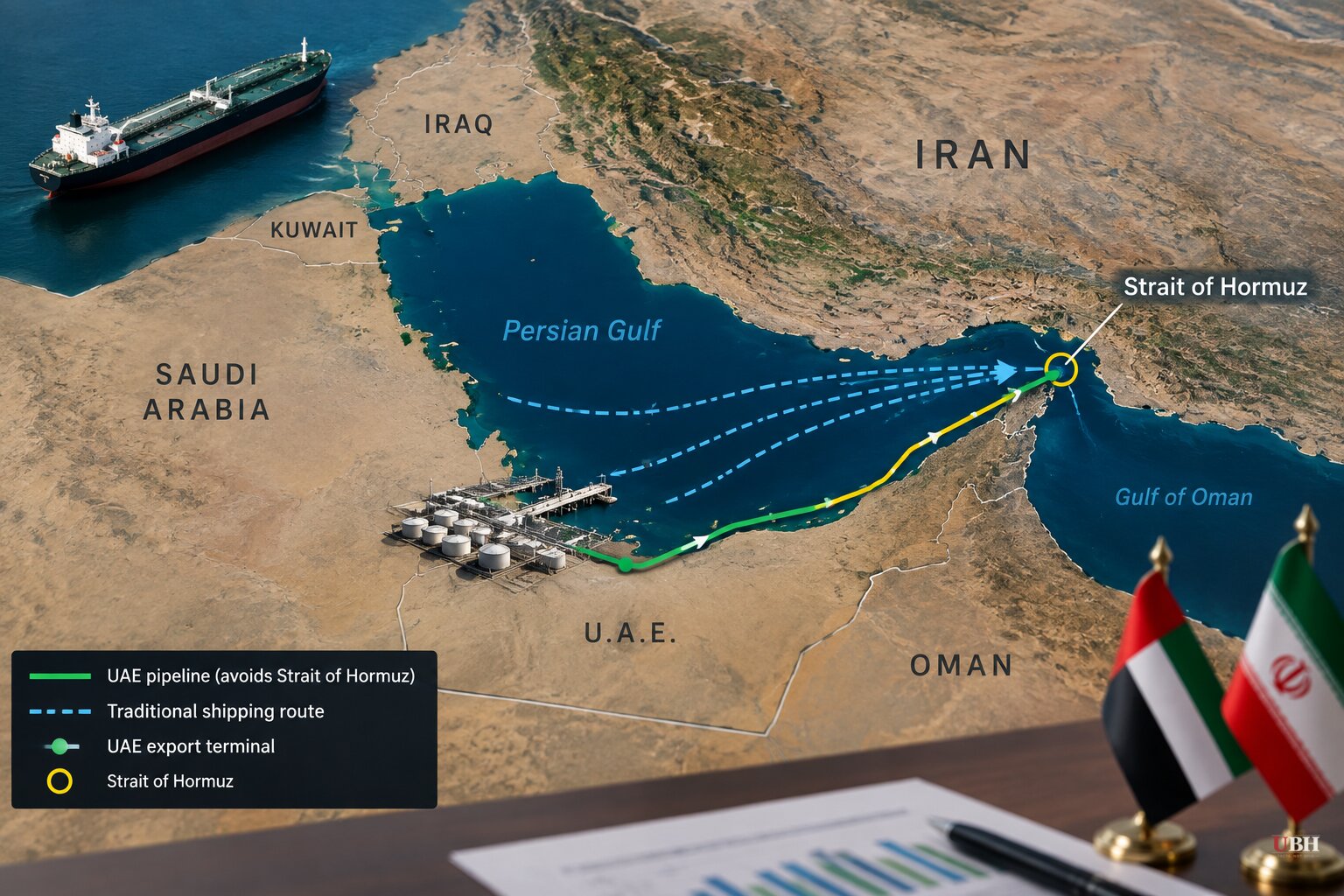
The pipeline that was built for this exact war
The United Arab Emirates spent over a decade preparing for a crisis it hoped would never come. According to tanker tracking data from TankerTrackers.com, UAE crude exports had recovered to within 0.02% of pre-war volumes by early September 2026, a marked shift from March, when exports cratered to roughly 1.9 to 2.13 million barrels per day after the US-Iran war erupted on February 28.
The fix was already built: the 380-kilometer Habshan-Fujairah pipeline, completed in 2012, moves crude from Abu Dhabi's inland fields directly to the port of Fujairah on the Gulf of Oman, bypassing the Strait of Hormuz entirely. Add the Mandous underground storage facility, which holds roughly 42 million barrels, and the UAE built itself a war-proof export system before anyone knew a war was coming.
Iran got no such buffer. Its major export terminals at Kharg Island and Bandar Abbas both require passage through or near Hormuz, and a US naval blockade first imposed in April 2026 and reinstated in July has choked that route almost completely. TankerTrackers says Iranian crude exports have fallen by as much as 100% from pre-war levels, and reported that not a single barrel of Iranian crude crossed the blockade line between the Gulf of Oman and the Arabian Sea over a 60-day stretch.
The numbers don't all agree
Kpler's Homayoun Falakshahi, cited by the Associated Press, put Iran's exports at around 255,000 barrels a day in August, down from 1.85 million before the war. That roughly tracks TankerTrackers' range of 220,000 to 260,000 barrels a day.
But a separate Kpler-based estimate cited by Eurasia Review put Chinese purchases of Iranian crude alone at about 530,000 barrels a day in July and August, nearly double the total export figure Falakshahi gave for the same window. China has historically absorbed 80% to 90% of Iran's seaborne crude. If total exports really are around 255,000 barrels a day, China's share shouldn't be double that number. Neither report resolves the gap. These are estimates from vessel-tracking firms working with data Iran actively tries to obscure through shadow-fleet tactics and spoofed transponders, not audited customs figures.
Eurasia Review noted Chinese customs data show almost no Iranian imports since 2022, even as trackers keep spotting the cargo. Payment reportedly runs through yuan settlements via Bank of Kunlun and smaller Chinese banks, and Treasury Secretary Scott Bessent's Operation Economic Outcast, announced August 24, is squeezing that route without closing it.
Gulf recovery, but not painless
The International Energy Agency's latest Oil Market Report estimated that 2.8 billion barrels of exports have been lost through Hormuz since the war began, though alternative routes and other producers have offset more than 900 million barrels of that gap. Flows through the strait averaged 7.6 million barrels a day in August, still 13.1 million barrels a day below pre-war levels, the IEA said.
Energy Secretary Chris Wright told CNBC that regional exports, including pipeline volumes bypassing Hormuz, have topped pre-war levels. CNN reported 40 commercial vessels carrying roughly 18 million barrels moved through the strait on a single Tuesday, a wartime high, according to US officials.
Daily Wire flagged that those administration figures run well ahead of independent trackers. Kpler recorded just five confirmed crossings through Hormuz on that same Tuesday, half the day before. US officials attribute the gap to tankers running at night with transponders switched off, sometimes with Navy assistance.
Prices are the part nobody agrees on
Crypto Briefing reported oil had settled near $70 a barrel by early September, following a peace deal reached in mid-June. But that deal, according to the Associated Press, "quickly crumbled," and other reporting describes Brent crude surging past $104 a barrel amid renewed Houthi attacks on Saudi Arabia and a drone strike that forced Saudi Arabia to shut its East-West pipeline. Fox News, citing Reuters, reported WTI easing to $80.99 as Iran and Oman held talks that raised hopes of reopening Hormuz. US gasoline prices, per the Associated Press, climbed from about $2.98 a gallon before the war to roughly $4.14.
Mona Yacoubian of the Center for Strategic and International Studies told the Associated Press the US has had "limited success" loosening Iran's grip on the strait and inflicting economic damage, but added, "Iran shows no sign of backing down." She called the war likely to be "protracted with no clear victor."
The war has cost US taxpayers more than $37.5 billion and 18 service members' lives, according to the Associated Press. Secretary of State Marco Rubio has told foreign counterparts the current posture holds "for the time being," per Axios, while Secretary of War Pete Hegseth said he isn't ruling out renewed strikes. One official told Axios the current lull is expected to last until after the midterm elections, when another campaign could be considered.
Iran and Oman were expected to meet to discuss Hormuz security and any framework for eventually reopening the strait, though Tehran has said that would establish terms for a future reopening, not an immediate one. The IEA now assumes shipping through Hormuz stays restricted through the rest of 2026, pushing any real normalization into 2027.
Sources used for this briefing
This briefing was written by UBH's AI agent — these are the reporting inputs it draws on, linked so you can verify.


