
Original briefings. Zero spin.
Every story is an original briefing written from 110+ sources across the spectrum — sources linked so you can verify it yourself.
 energy
Notable (6/10)
Event date: July 11, 2026
energy
Notable (6/10)
Event date: July 11, 2026
Tesla Installs 720-Megapack Battery Array at Musk's xAI Memphis Site, Company Calls It the Nation's Largest
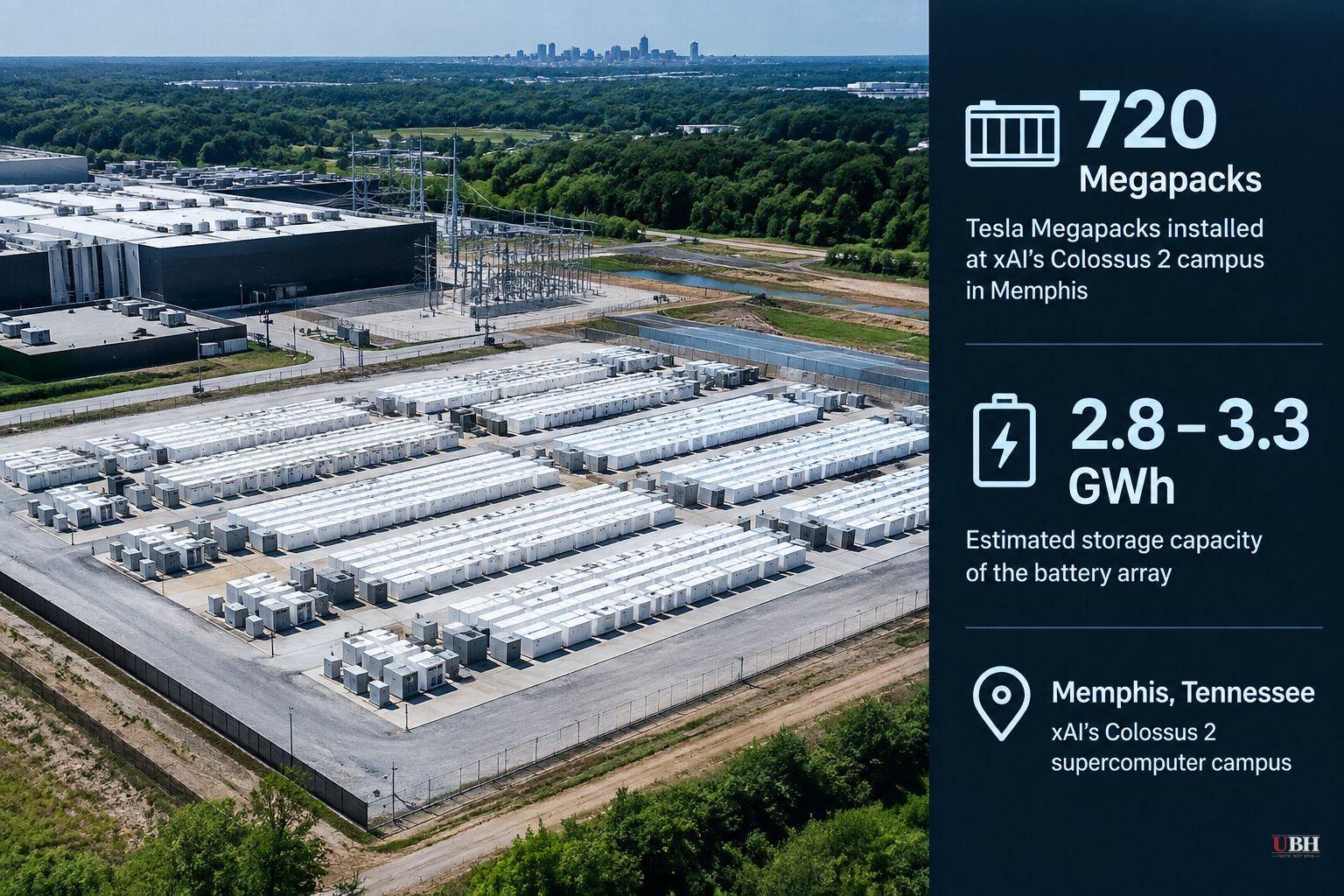
Elon Musk's xAI has assembled what company officials describe as the largest grid-connected battery in the United States at its Colossus 2 data center in Memphis, Tennessee.
Satellite imagery dated July 11, 2026, and reviewed by Canary Media's Julian Spector shows 720 Tesla Megapack containers packed onto the site. Based on the model deployed, that works out to roughly 2.8 gigawatt-hours of storage capacity and between 720 megawatts and 1.4 gigawatts of power output. xAI energy and data center developer Riley Trettel told the Tennessee Valley Authority board on August 20 that the system is the "biggest in the nation," and put the figure at 3.3 GWh. Memphis Light, Gas and Water CEO Doug McGowan confirmed the scale of the installation in public remarks on September 2. Canary Media notes the exact size remains unconfirmed independently.
The TVA board, which supplies power to roughly 10 million people across the Southeast, approved a direct grid connection for Colossus 2 in August 2026.
How We Got Here
According to Data Center Dynamics, xAI acquired the 1-million-square-foot Colossus 2 property at 5400 Tulane Road in Whitehaven for a reported $80 million through its affiliate CTC Properties, with plans to eventually run up to 350,000 GPUs there. The company posted on X that it was "welcoming the arrival" of more than $375 million worth of Megapacks for the site.
This isn't xAI's first run-in with power controversy. At its original Colossus site in Memphis's Boxtown neighborhood, environmental groups alleged xAI ran 26 natural gas turbines without the required permits, according to Data Center Dynamics. The company installed 168 Megapacks there in May 2026 to replace some of those turbines.
According to Crypto Briefing and KuCoin, xAI spent roughly $1 billion on Megapacks and related infrastructure between 2024 and mid-2026, including a single $269 million purchase in April 2026. SpaceX, a separate Musk-led company, has been a significant investor in xAI's funding rounds, but the two remain distinct corporate entities. Whether the new Megapack array actually reduces xAI's reliance on the gas turbines that drew the permit complaints is not yet established. Ground News, summarizing coverage across the political spectrum, reported that it "remains unclear" if xAI will scale back the temporary generators now that the batteries are online.
The Community Fight
Writing for the Epoch Times, Howard Franklin describes residents of a historically black southwest Memphis neighborhood living beside "one of the largest computers ever built," and argues they see a familiar pattern: an industrial project whose environmental and power costs get borne locally while the benefits flow elsewhere. That is a fair description of the concern raised by residents. Power infrastructure of this scale genuinely does affect surrounding air quality and grid costs regardless of intent.
Ground News reports that a Westwood community meeting in September 2026 ended early after residents demanded to know why more than $3.2 million in xAI-linked tax revenue, set aside under a 2025 city ordinance for the neighborhoods nearest Colossus, still hadn't been distributed. A separate benefit-ordinance meeting at Mt. Vernon Baptist Church reportedly grew heated enough that the pastor cut it short.
Franklin's Epoch Times piece argues the fix is regulatory, not rhetorical: put large data centers in their own utility rate class with minimum-bill and take-or-pay provisions, so residential customers aren't subsidizing a hyperscaler's capacity bet, and write clawback clauses into incentive deals up front. He points to Virginia's legislature debating rate-class bills and North Carolina's experience clawing back incentives from VinFast after promised jobs failed to materialize as models other states, including Tennessee, could study.
The scale of AI's power appetite isn't shrinking. The Electric Power Research Institute projects data centers could account for 17% of total U.S. electricity consumption by 2030, according to Ground News. Tesla began producing its next-generation Megapack 3 at its Texas Megafactory in August 2026, suggesting more installations like Memphis's are coming.
What remains unresolved in Memphis specifically: when the $3.2 million in stalled community-benefit funds will actually reach Westwood and Boxtown residents, and whether xAI's expanding battery fleet will lead the company to shut down the gas turbines that triggered the original permitting complaints. Neither the city, Memphis Light, Gas and Water, nor xAI has provided a public timeline for either.
Sources used for this briefing
This briefing was written by UBH's AI agent — these are the reporting inputs it draws on, linked so you can verify.


