
Original briefings. Zero spin.
Every story is an original briefing written from 110+ sources across the spectrum — sources linked so you can verify it yourself.
 energy
Major Story (7/10)
Event date: September 10, 2026
energy
Major Story (7/10)
Event date: September 10, 2026
GOP Candidates Break From Trump on Data Centers as His Own Battery Ban Confuses Developers
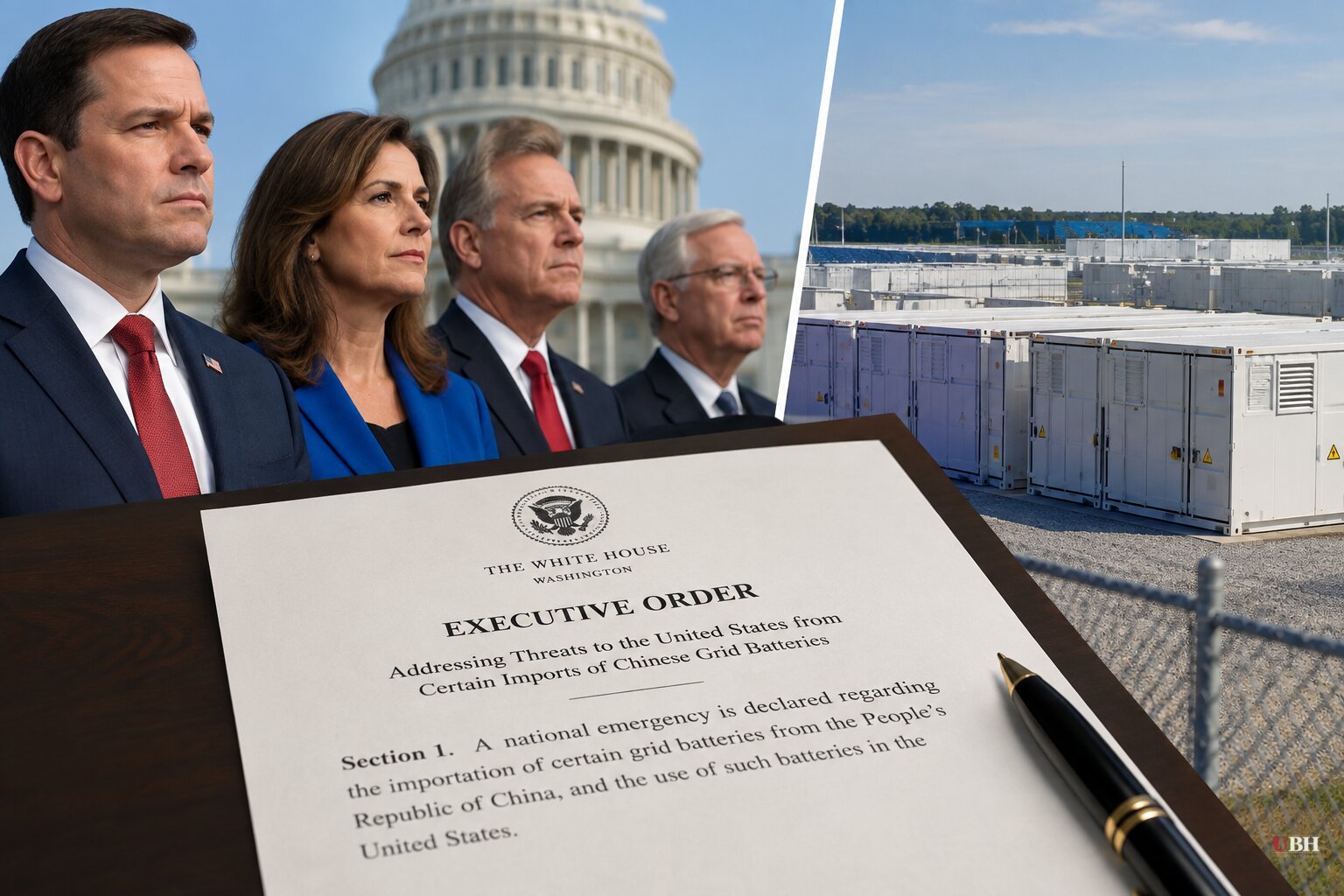
Since Trump's Aug. 26 national emergency declaration on Chinese-made grid equipment, the fallout has split into two separate problems for the administration: an industry that doesn't know what the order actually bans, and a Republican base that's turning against the AI buildout Trump says is central to beating China.
Start with the batteries. The order bars the "acquisition, importation, transfer, or installation of any foreign-produced bulk-power system electric equipment," citing cybersecurity risk, according to Canary Media. It applies to any transaction initiated on or after Aug. 26, and may reach backward. The order lets federal agencies force utilities and project owners to "identify, isolate, monitor" existing equipment already installed, Canary Media reported.
That vagueness is the problem. BloombergNEF's analysis, cited by OilPrice.com, found that battery storage projects now "face near-term delays or cancellations as developers await guidance, reconsider existing contracts, or shift suppliers." Nobody in the industry knows the rules yet. The Department of Energy has until Christmas Eve to write them, under the order's own timeline.
China makes roughly 80% of the world's lithium-ion battery cells, according to the International Energy Agency, and controls 85% of cathode active material production and more than 90% of anode active material. Washington gave $500 million to seven companies working on domestic battery minerals, manufacturing, and recycling in August. Tu Le, founder of Sino Auto Insights, told Quartz that building a competing supply chain "takes decades and tens, if not hundreds of billions of dollars." His read: "We don't have decades. We have five, six, seven years to try to become competitive."
The other front: Trump's own party balking on data centers
While the battery order sits in limbo, a second energy fight is breaking out inside the GOP over AI data centers, the massive power-hungry facilities Trump has championed as core to his "energy dominance" agenda.
A Fox News poll found 70% of voters want to pause new data center construction in their communities, with only 30% in favor. Among Republicans, just 40% support new construction. Among self-identified MAGA Republicans, it's 46%. A Gallup survey from March found 71% of Americans oppose data centers being built nearby, with 48% saying they "strongly" oppose it.
That number is showing up on the ballot. Mike Rogers, the Republican Senate nominee in Michigan, called for a one-year moratorium on new construction on Aug. 20, saying "Michigan needs stronger guardrails to protect community control, prevent utility price hikes, protect our water, and stop pay-to-play schemes," according to Fox News. Texas Republican Senate candidate Ken Paxton, who is challenging incumbent Sen. John Cornyn in the GOP primary, has also distanced himself from the issue, the Daily Signal reported.
In Ohio, appointed Sen. Jon Husted is facing attack ads from Democratic challenger Sherrod Brown labeling him "the face of data centers in Ohio." The National Republican Senatorial Committee warned in an internal memo, reported by Fox News, that "more than any other thing in this race, data centers are the anchor hanging around Husted's neck." Husted has introduced his own Senate bill aimed at stopping ordinary ratepayers from covering data center electricity costs.
Trump has pushed back hard. He posted on Truth Social that opponents of data centers want communities to be "backwards and poor," and told reporters at Joint Base Andrews that data centers are now "mandated by me" to build their own power generation, meaning "they're not taking it from the grid" and excess power will actually lower electricity costs for everyone else. Asked whether he wants GOP candidates to fall in line, Trump said he wants Republicans to "do what they want."
Even inside Trump's own coalition, there's disagreement over who's to blame for the backlash. Former White House strategist Steve Bannon told the Daily Signal it's Big Tech's fault, not Trump's, for failing to make its case to rural and exurban communities that form Trump's base. "They just come in and think their money and their political muscle is going to drive things, and guess what? It has not," Bannon said, calling it an "80/20 issue" at the local level and saying he's "adamantly opposed" to data centers unless companies can explain their water and energy use and long-term purpose. Treasury Secretary Scott Bessent made a similar point, saying the industry did a "terrible job" explaining itself. Nathan Leamer of Build American AI disagreed, arguing the administration's messaging, including the Ratepayer Protection Pledge signed by 23 governors at the end of July, has already been sufficient.
The concern driving both the Michigan moratorium push and the Ohio attack ads is straightforward. Data centers draw enormous amounts of electricity and water, and if utilities pass those costs onto residential ratepayers, voters end up subsidizing AI infrastructure they never asked for. Husted's own bill is an attempt to address that exact worry through legislation rather than a moratorium. Whether a construction pause or a cost-allocation law is the better fix is now a live argument inside the GOP itself, not just between parties.
What happens next depends on paperwork nobody has written yet. The Energy Department's rulemaking deadline for the battery ban runs to Dec. 24. The Michigan and Ohio Senate races, where data centers have become a defining midterm issue, will be decided in November, well before that deadline arrives.
Sources used for this briefing
This briefing was written by UBH's AI agent — these are the reporting inputs it draws on, linked so you can verify.


