
Original briefings. Zero spin.
Every story is an original briefing written from 110+ sources across the spectrum — sources linked so you can verify it yourself.
 energy
Notable (6/10)
Event date: September 4, 2026
energy
Notable (6/10)
Event date: September 4, 2026
San Onofre's 3.6 Million Pounds of Nuclear Waste Still Has Nowhere to Go
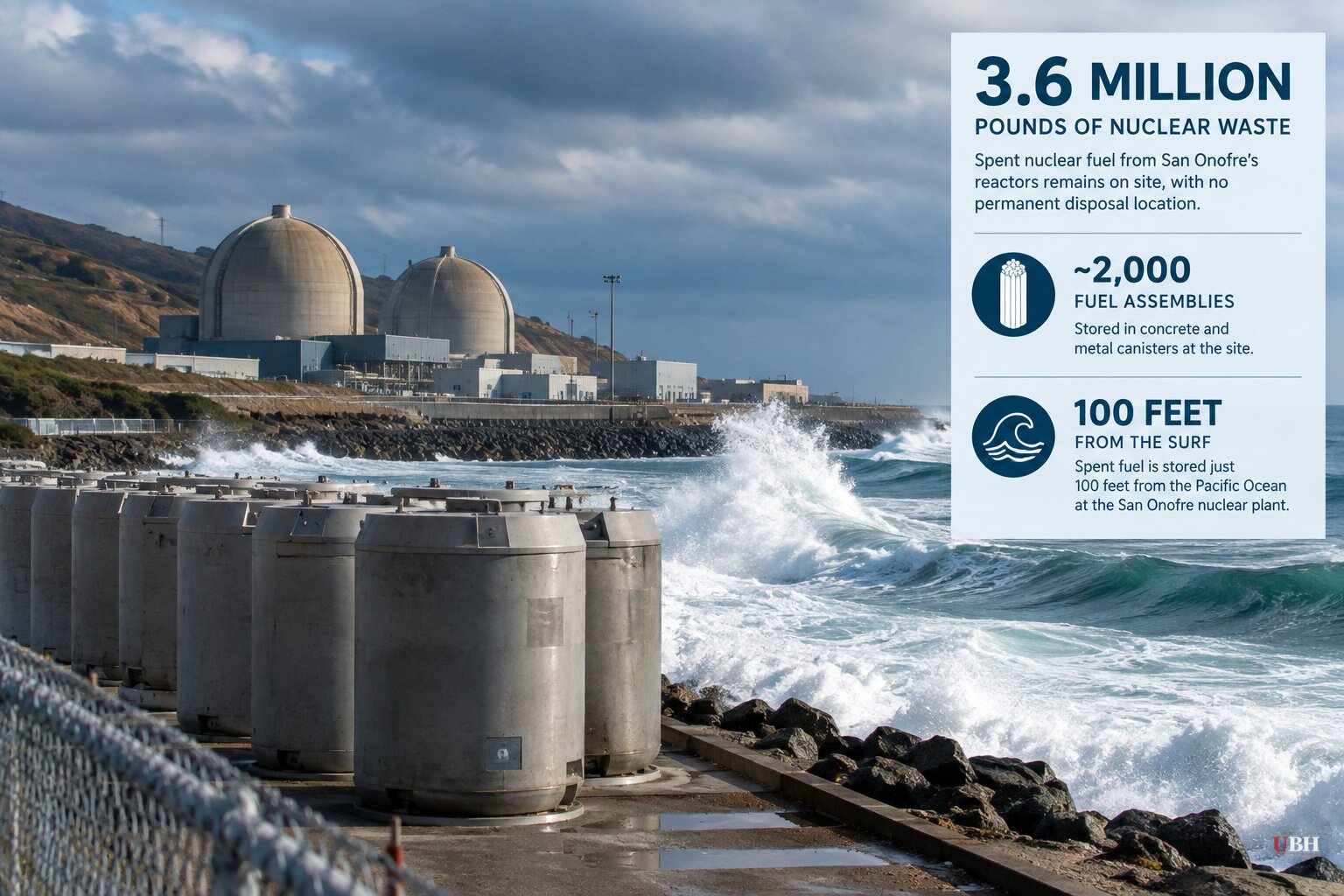
Big waves hit the Southern California coast near San Clemente in recent days, fueled by Hurricane Marie churning far out in the Pacific. The flooding and erosion tore at beaches up and down the coast. For oceanographer Kim McCoy, it was a reminder of something most Californians never think about: 3.6 million pounds of spent nuclear fuel sitting in concrete storage, 100 feet from the water.
"Rising sea levels, storm waves, El Niño which increases wave height... these could wash away a section of the walkway that protects the San Onofre seawall and the waste canisters are just 100 feet away from that," McCoy, a former wave dynamics researcher and longtime critic of beach storage of nuclear waste, told the Los Angeles Times.
The San Onofre Nuclear Generating Station shut down for good in 2013 after a scandal over faulty steam generators. Since then, according to the Times, most of the plant's mildly radioactive or non-radioactive rubble has been trucked off to disposal sites in Utah, Texas and Arizona. The plant's twin reactor domes, visible from Interstate 5, are set to come down next, per the Times.
What won't be leaving anytime soon is the fuel itself. It's stored underground in dry casks at the site, wedged between I-5 and the ocean, roughly halfway between Los Angeles and San Diego.
'It's Under Control,' But For How Long
James Day, a geosciences professor at UC San Diego's Scripps Institution of Oceanography, has studied the storage question closely. He told the Times that most experts agree the near-term erosion risk to the waste canisters is extremely low.
"At the moment, it is under control, I think it's essential to say that," Day said. "But geologically we must be thinking long term. The waste lasts for hundreds, if not thousands of generations."
Speaking separately to the Times of San Diego, Day put a number on it: "Nuclear power produces waste that goes for possibly as long as 2,000 generations. It's my job to tell you that, geologically, we must be thinking long-term — generational."
That's the tension at the heart of this story. The immediate risk is low. The site sits on what Day calls "fairly young rocks in a seismically active region." And the waste isn't measured in years. It's measured in millennia.
Southern California Edison, which owns the decommissioned plant, has committed to the California Coastal Commission that it will move the waste to higher ground on-site if modeling shows sea level rise and erosion are becoming a genuine threat, according to the Times. No such move has been ordered. No new inspection or federal action has been announced as a result of the recent storm damage.
That commitment is a real mitigation step. Nobody in these reports is claiming the canisters are in imminent danger. The concern raised by McCoy and echoed cautiously by Day is about trend lines, not tomorrow.
Yucca Mountain Never Happened
The reason San Onofre's waste is still sitting on a beach at all traces back to a broken federal promise. Washington was supposed to build a permanent underground repository at Yucca Mountain, Nevada. The plan, under consideration since 1987 and estimated to cost $15 billion, stalled in 2010 amid political, legal and tribal opposition, according to the Times of San Diego.
With no national repository, spent fuel now sits at 80 sites across the country with no clear removal timeline. The federal government has paid reactor owners roughly $9 billion in storage costs for failing to meet its legal obligation to take the waste, the Times of San Diego reported.
Rep. Mike Levin (D-Calif.), who lives about 10 minutes from the plant, has pushed for a federal fix. "It's a symptom of a greater problem. There is no national solution for the nation's spent nuclear fuel, we haven't had one for a very long time," Levin told the Times of San Diego.
Levin introduced the Bipartisan Nuclear Waste Administration Act to create an independent federal agency to manage the country's spent fuel. The bill was referred to the House Committee on Energy and Commerce in September 2024. It has not advanced since.
"Years of inaction have left nuclear waste stored in communities all across the country — including ours — and with the federal government currently spending $2 million per day for the failure to fulfill its obligation to find a real solution," Levin wrote when he introduced the measure.
That $2 million-a-day tab is taxpayer money spent on storage fees for a problem Washington created and never solved. Meanwhile, San Onofre's canisters stay where they are, watched, monitored, and 100 feet from a Pacific that keeps getting closer.
Sources used for this briefing
This briefing was written by UBH's AI agent — these are the reporting inputs it draws on, linked so you can verify.


