
Original briefings. Zero spin.
Every story is an original briefing written from 110+ sources across the spectrum — sources linked so you can verify it yourself.
 economy
Major Story (7/10)
Event date: August 26, 2026
economy
Major Story (7/10)
Event date: August 26, 2026
China's Economy Shows Weak Consumer Prices, Falling Property Sales and a Tough Job Market Even as Xi Bets Big on AI
A Shanghai marketing professional who asked to be identified only as Lynn Dong to avoid retaliation from Chinese authorities has spent seven months looking for work since being laid off in February, according to The Epoch Times. She has done 22 interviews with 11 companies. Three times she made it all the way to salary negotiations before the position vanished entirely because the hiring company had frozen new hires or gone through restructuring.
"The job market this year has been truly surreal," Dong told The Epoch Times. She has two young children and says she cannot afford to disengage from the job hunt no matter how discouraging it gets.
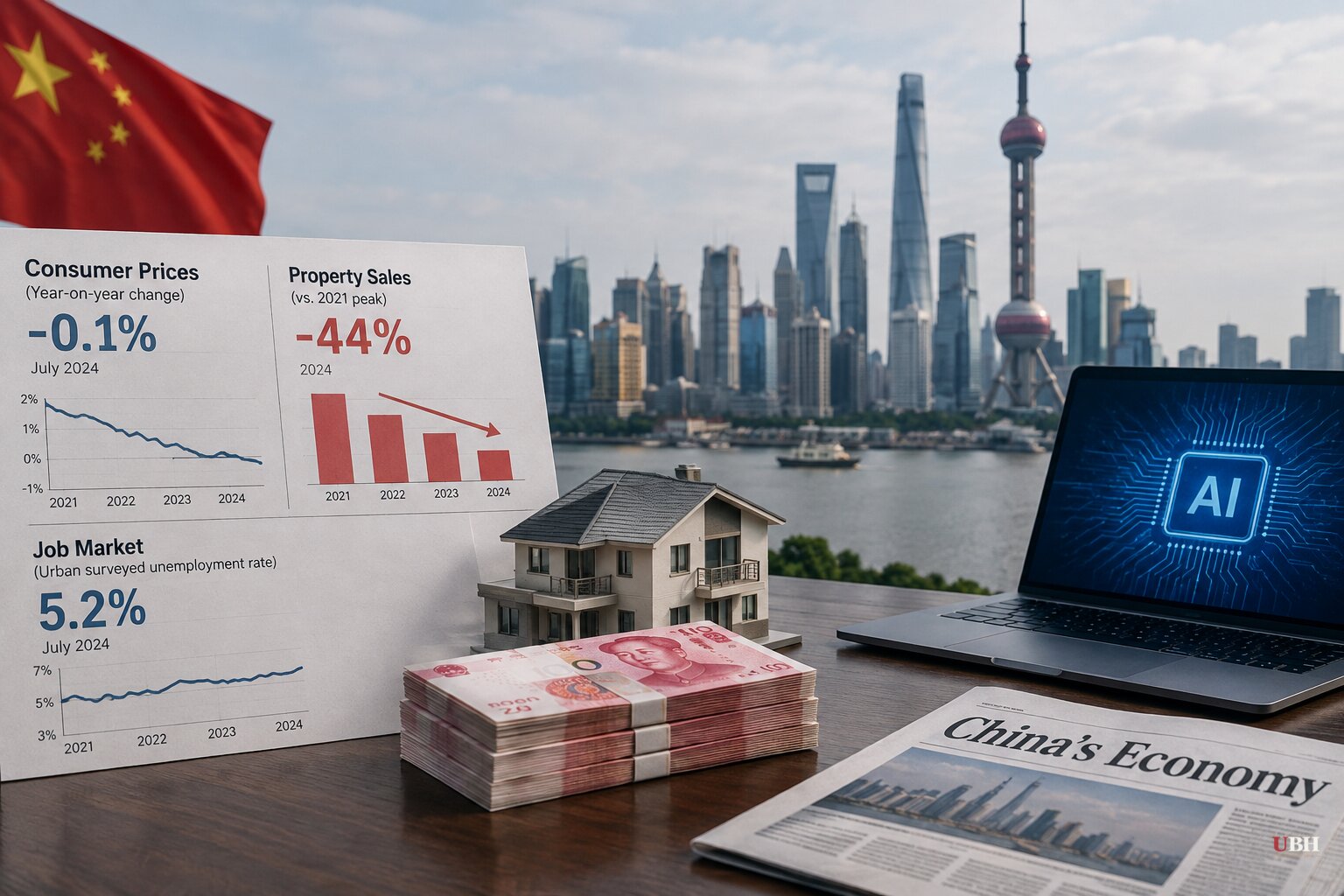
Dong's experience aligns with broader economic data out of China for the first seven months of 2026. Consumer prices rose an average of just 0.9 percent year-over-year from January through July, according to World Bank figures cited by The Epoch Times. That's barely above flat, and the increase wasn't even driven by consumers spending more. It came from higher energy prices tied to the Iran war, the World Bank found, not from stronger domestic demand.
Beijing has rolled out trade-in subsidy programs meant to get households to upgrade cars and big-ticket home appliances. Consumption has stayed sluggish anyway, per The Epoch Times' reporting.
The Property Market Still Hasn't Bottomed
Real estate, long the backbone of Chinese household wealth, keeps sliding. Investment in real estate has fallen 44 percent since its 2021 peak. The market for new housing has been cut roughly in half by both sales area and sales value over that same period.
Beijing tracks home prices across 70 medium- and large-sized cities. Every one of those markets is showing declines, ranging from 2 percent to 9 percent, according to the data reported by The Epoch Times. There's no single city bucking the trend.
For a household economy where a large share of family wealth is tied up in real estate, a broad-based price decline like this squeezes consumer confidence and spending well beyond the housing sector itself.
Xi's AI Gamble
While overall investment in China is declining, spending on advanced technology has actually gone up, according to The Epoch Times. That divergence is deliberate. Xi Jinping used a July 17 appearance at the World AI Conference in Shanghai to tout China's low-cost AI capabilities and pledge that Beijing would export AI services to the rest of the world.
Mike Sun, an analyst cited by The Epoch Times, framed the strategy in blunt terms: "Xi is all-in on AI. He's gambling with all of China's resources. If he wins, he can arm-wrestle with the United States. Beijing can be an equal of Washington."
There's a reasonable case for that bet. If China's AI sector produces breakthroughs that reduce costs and create new export markets, the investment could eventually generate the jobs and consumption that current data show are missing. Governments routinely front-load capital into strategic sectors before returns show up in employment numbers, and a five-to-seven-year lag between tech investment and broad economic payoff isn't unusual in industrial policy.
But so far, that AI investment hasn't shown up in the numbers that matter to people like Lynn Dong. It hasn't produced more jobs. It hasn't lifted consumption. The imbalance between where Beijing is putting its money and where its economy is actually hurting, in real estate and in hiring, is getting more pronounced, not less, according to the data reviewed by The Epoch Times.
What happens next depends largely on whether China's AI push starts converting into commercial revenue and jobs, or whether it remains a state-directed spending priority disconnected from the deflationary pressure squeezing ordinary households. The next data points to watch are China's August and September consumer price and property price releases, along with whatever hiring numbers Chinese firms report as they head into the fourth quarter of 2026.
Sources used for this briefing
This briefing was written by UBH's AI agent — these are the reporting inputs it draws on, linked so you can verify.


