
Unbiased headlines. Facts, not spin.
Unbiased Headlines is an independently owned news organization. We bring you the facts, not opinions, written fresh from 110+ named sources. Sources linked so you can verify it yourself.
 tech
Major Story (8/10)
California Attorney General Subpoenas Nvidia Over China Risks as Stock Slips Behind Alphabet
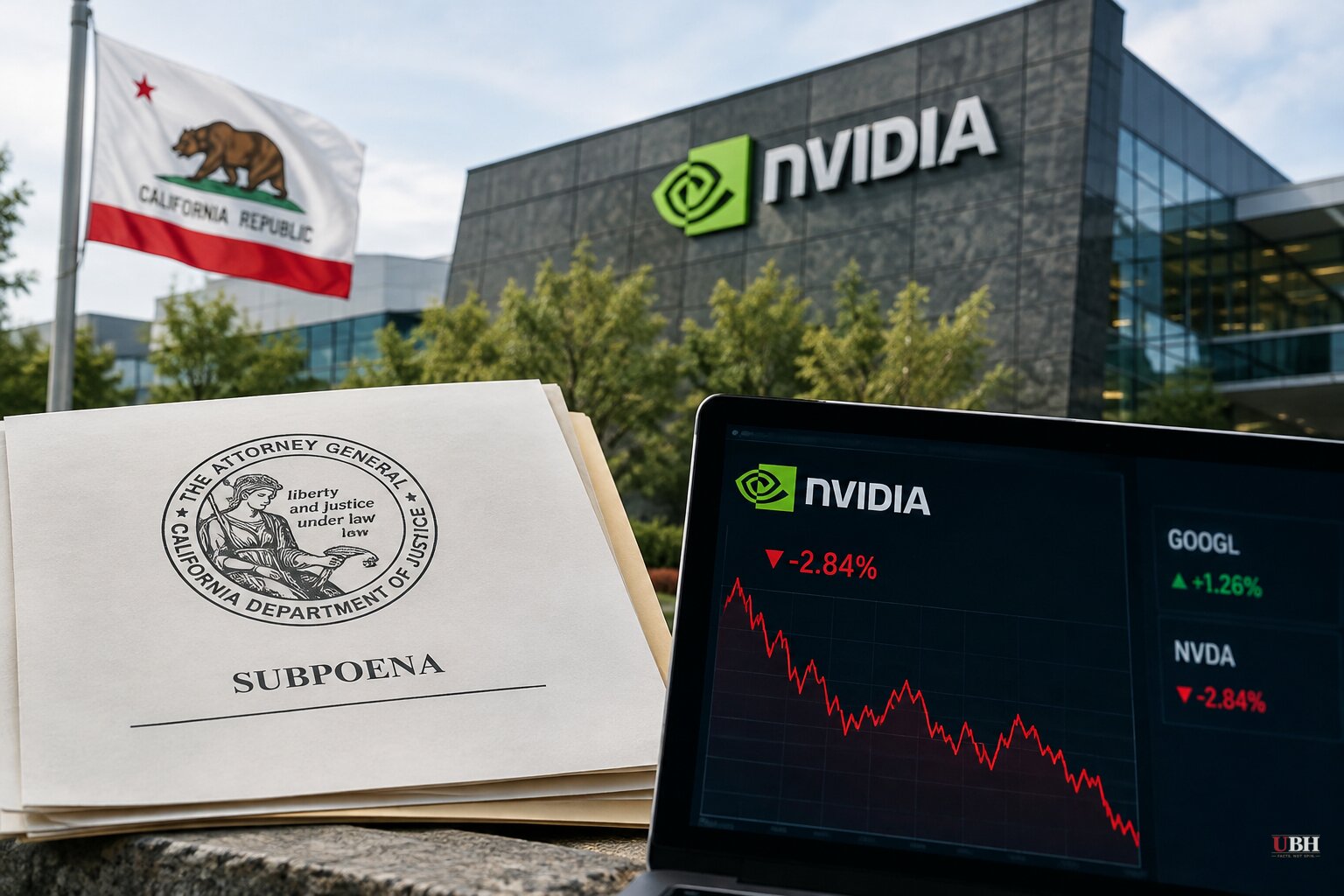
Since Jensen Huang resigned as Nvidia's CEO on Nov. 12, the fallout has moved from the boardroom to state and congressional investigators. On Thursday, Nov. 19, California Attorney General Rob Bonta said his office had sent Nvidia a subpoena.
Bonta said the aim is to determine whether any Nvidia actions resulted in advanced chips or confidential information being improperly obtained by China. His office is also examining whether the company misled investors about it, and whether it violated California's corporate securities law.
"The conduct of Nvidia and its former CEO raises bright red flags, including about the ways in which the company may have misled investors," Bonta said. "Nvidia is in a messy, transnational situation but the underlying principle of our corporate securities law is clear: Companies cannot mislead their investors."
Nvidia did not respond to a request for comment on the subpoena.
What Bonta has and has not said
The subpoena is an information demand. No charges have been filed against Nvidia or anyone else by California.
Bonta himself framed jurisdiction as the open question. In a Bloomberg Television interview on Tuesday, he said the matter was "very possibly" something his office could examine, and that his course would depend on whether any California laws could have been broken. Nvidia is headquartered in Santa Clara.
Bonta is a Democrat who won reelection earlier this month. He has also sued OpenAI, alleging violations of California's unfair competition law over how it develops its AI products. Nvidia has not responded to the subpoena publicly, so its side on the investor-disclosure question is not yet on the record.
Congress puts a number on China sales
Also on Thursday, the House Foreign Affairs Committee released confidential information showing the Commerce Department had approved the sale of nearly 900,000 advanced AI chips to Chinese companies this year, as of May. Some of the buyers were later added to a Pentagon list of businesses accused of aiding China's military.
That puts a share of the responsibility on Washington, not just on Nvidia. Commerce signs off on those export licenses, and the release covers approvals made under the current administration.
The espionage question is still unresolved
The national security allegations that started the crisis remain contested. U.S. officials suspect Alice Huang, a Chinese citizen and former Megaspeed executive who is no relation to Jensen Huang, of being a Chinese intelligence asset. Attorney General Todd Blanche said on Nov. 12 that the Justice Department had reached no conclusion on whether she was a spy.
The Chinese government has denied involvement, calling the claims "groundless speculation." Megaspeed says Alice Huang left the company in August 2025 and that media reports about its business are "not supported by verifiable evidence."
Singapore's Ministry of Home Affairs said there was insufficient evidence that she committed suspected offenses tied to false declarations in server purchases, and that it did not investigate her for espionage. She was issued a stern warning and barred from re-entering the country. Inquiries into Megaspeed, which reportedly bought $4.8 billion of Nvidia chips over two years, continue. The Justice Department has taken over the federal investigation into the company, according to The New York Times.
Nvidia's board has hired Wachtell, Lipton, Rosen & Katz for an independent investigation into the Alice Huang relationship.
The stock keeps sliding
Nvidia shares traded near $140.50 in morning trading Friday, Nov. 20, down about 3.7% on the day, according to Crypto Briefing. That puts the company's value near $3.4 trillion, which is fourth among publicly traded companies, behind Alphabet.
The stock has fallen more than 19% since Huang stepped down, a drop of over $800 billion. From its early October peak of roughly $5.8 trillion, the decline is more than $2.4 trillion.
The selling continues despite the quarterly report on Tuesday, Nov. 17. Nvidia posted revenue of $115.8 billion, up 103% from a year earlier, and forecast $130 billion for the next quarter. Interim CEO Colette Kress said it is "business as usual" with customers, suppliers and partners.
Nvidia's board has ruled out reinstating Huang, though Huang expressed a willingness on Tuesday to return, Bloomberg News reported. The company has not named a permanent successor. President Trump posted Thursday that Apple's Tim Cook should get the job; neither Nvidia nor Cook has responded in the sources.
What comes next
Nvidia's response to the California subpoena is the next marker. If the company argues the state lacks jurisdiction, that answer will show whether Bonta's office has a path to a case under California law, which he said would determine his next move.
Sources used for this briefing
7 links from 6 independent newsrooms (syndicated copies of the same report count once)
These are the sources it draws on, linked so you can verify.


