
Unbiased headlines. Facts, not spin.
Unbiased Headlines is an independently owned news organization. We bring you the facts, not opinions, written fresh from 110+ named sources. Sources linked so you can verify it yourself.
 tech
Major Story (8/10)
NYU's Buckmaster and Anthropic's Alpöge Post AI-Aided Navier-Stokes Proof, Say It Closes OpenAI's Loophole
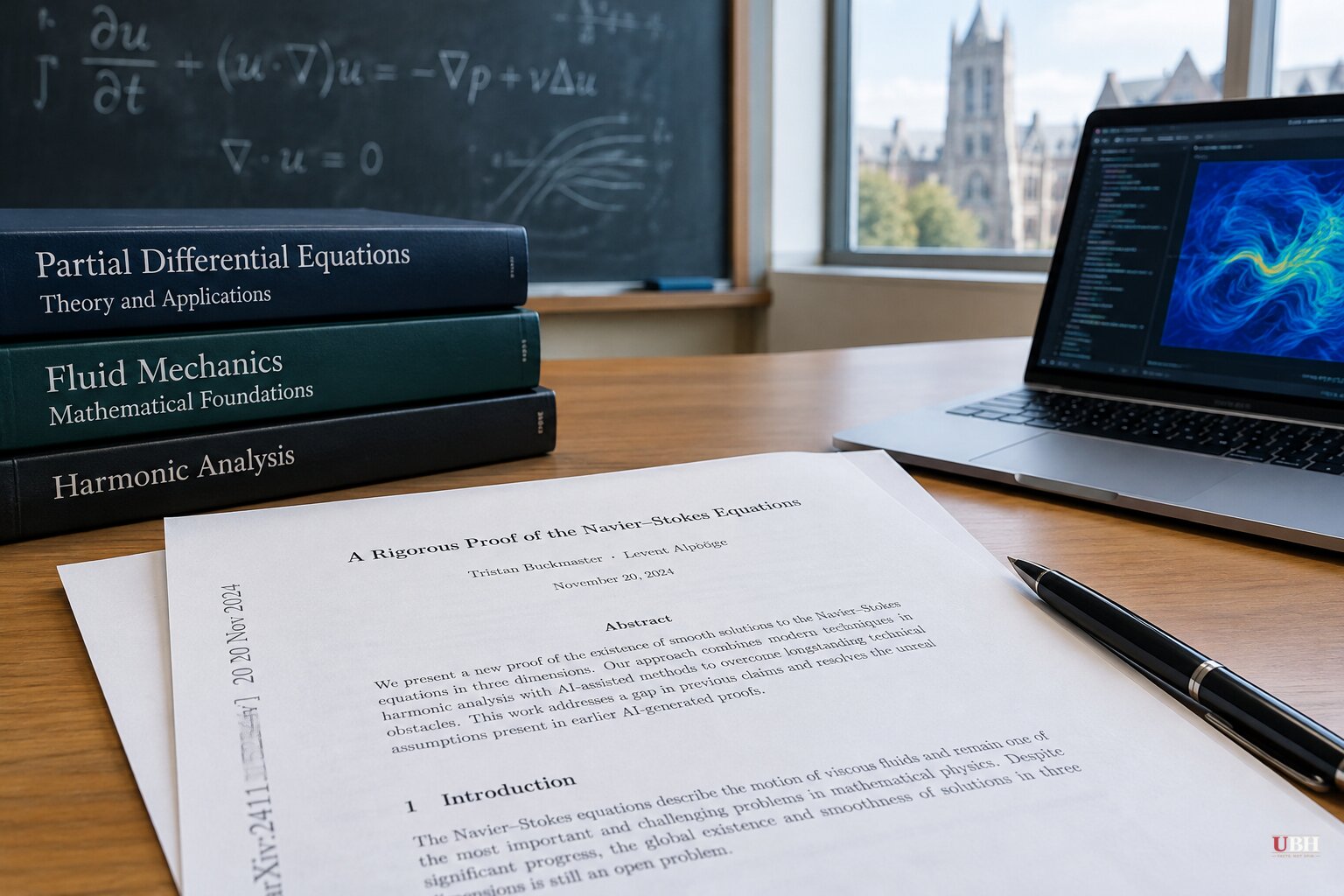
A new claim landed in the Navier-Stokes race this morning. At 8:37 a.m. EST today, Nov. 20, NYU mathematician Tristan Buckmaster posted a dense, AI-aided proof on Mastodon. He and Anthropic employee Levent Alpöge say it closes a loophole in OpenAI's September solution.
The post is rough on purpose. Buckmaster wrote that the document was unpolished so the pair could avoid getting scooped "after last time." They also did not release the certificate of the result, though they said it would come soon.
This is a claim, not a verified result. Nobody outside the authors has publicly confirmed it.
What OpenAI claimed in September
On Sept. 8, OpenAI published a writeup and a Lean formalization of a proof that the Navier-Stokes equations can develop a singularity in finite time. The company said an internal model "significantly more capable than GPT-6 Astra" produced it.
The setup is a smooth fluid at rest with a smooth force applied. Its energy stays finite throughout, until speeds grow without bound. OpenAI said this "resolves the Navier–Stokes Millennium Prize problem."
The Clay Mathematics Institute named the problem one of seven Millennium Prize Problems in 2000, with a $1 million prize attached. The equations date to the 19th-century work of Claude-Louis Navier and George Gabriel Stokes. Jean Leray showed in 1934 that solutions exist in a generalized sense. Whether they always stay smooth has been open for roughly 90 years.
The loophole
The sticking point is the force. Scientific American reports that OpenAI's proof technically meets the wording of the Clay conditions, but many experts were unsatisfied. The proof relies on a finely tuned force that "stirs" the fluid in just the right way to produce infinite velocity. Many mathematicians consider that a loophole in how the problem is worded.
Buckmaster and Alpöge now say they have a version that does not lean on it. Whether their argument closes the gap is what reviewers will have to test.
A dispute over how the race was run
The September announcement came with a fight attached. Buckmaster publicly aired suspicions that OpenAI deliberately raced to beat him and Alpöge, and that the company may have taken his user data to do it. OpenAI denied any foul play. No investigation or legal action over the allegation has been reported.
Early reports suggest OpenAI's proof took a different route to its solution than Buckmaster and Alpöge's work. That undercuts the idea of a copied approach, though it does not settle the data question. That remains an allegation from one side and a denial from the other.
Alpöge also announced a claimed proof of the Riemann hypothesis today, according to Scientific American. That claim is separate and likewise unverified.
Math is being upended in real time
The timing fits a field already reeling. At an MIT panel titled "AI and Society: The Future of Math," which included Buckmaster, Northwestern's Bryna Kra said: "Math has changed more in the last two months than in the last 100 years." She called it "a really exciting moment … and also scary."
MIT's account of the panel describes AI agents deployed by the thousands on a single problem, solving questions that stood for decades in hours.
UCLA's Terence Tao has been blunter. After OpenAI's announcement, he wrote on his math blog: "I am horrified by the many person-years . . . being casually disrupted or destroyed." The New York Times reported on Oct. 16 that Tao had put himself on a "war footing." A draft report by mathematicians meeting at Harvard, as the Times described it, spoke of a sense of loss among people drawn to math for the thrill of working a problem through.
What comes next
The immediate question is the certificate. OpenAI shipped a Lean formalization with its September claim. Buckmaster and Alpöge have promised their certificate but have not delivered it. Until it appears, and until independent mathematicians check the proof, the claim of a non-loophole solution stays unconfirmed.
The Clay Mathematics Institute has the last word on any prize. Whether it treats the September result, the new one, or neither as satisfying its criteria has not been announced.
Sources used for this briefing
4 links from 4 independent newsrooms (syndicated copies of the same report count once)
These are the sources it draws on, linked so you can verify.


