
Unbiased headlines. Facts, not spin.
Unbiased Headlines is an independently owned news organization. We bring you the facts, not opinions, written fresh from 110+ named sources. Sources linked so you can verify it yourself.
 tech
Major Story (8/10)
Anthropic Mathematician Levent Alpöge Claims Claude-Assisted Proof of the Riemann Hypothesis, No Outside Verification Yet
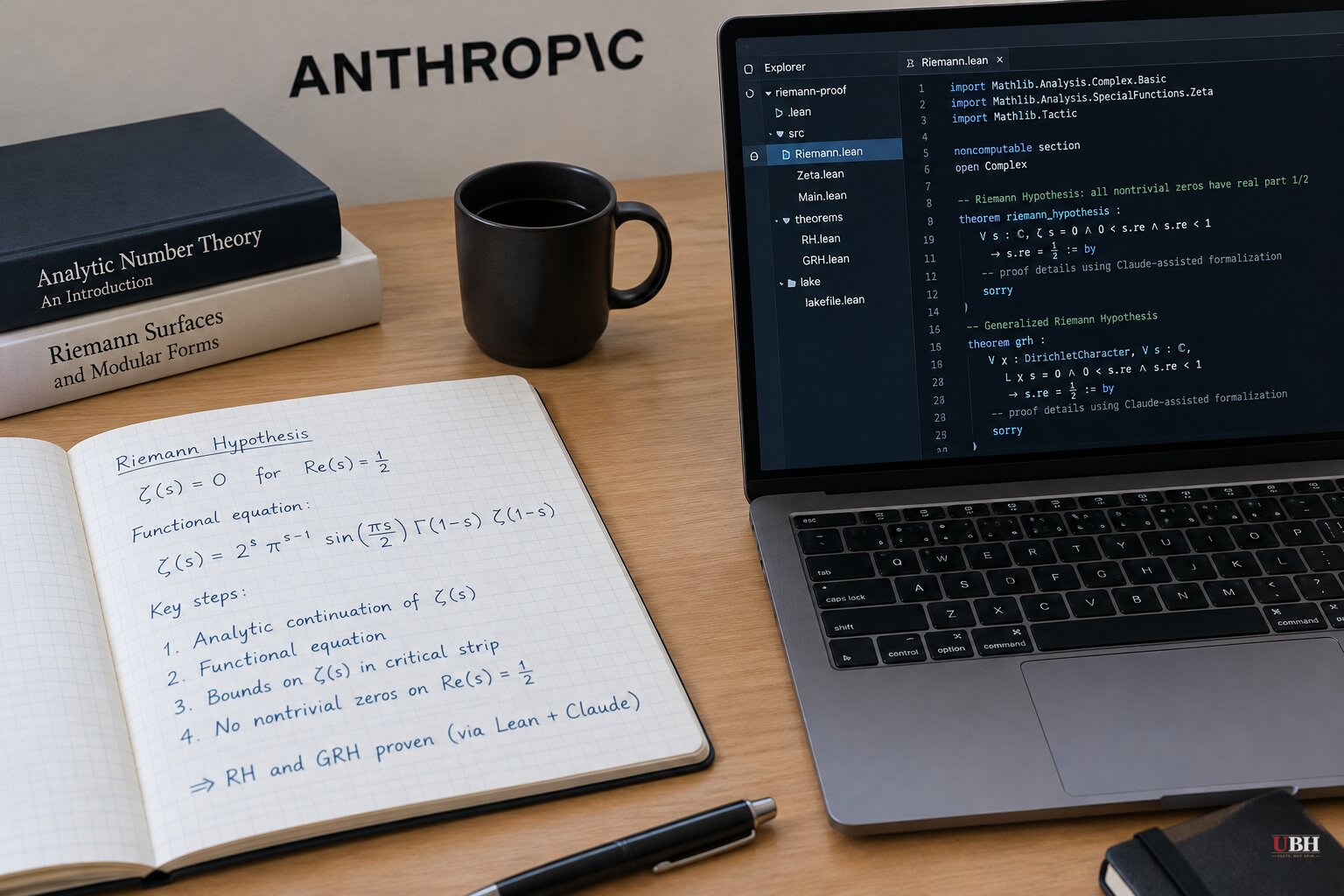
A day after Anthropic's record-setting Nasdaq debut on Thursday, Nov. 19, one of its own mathematicians put forward a far bigger claim than anything in the stock chart. Levent Alpöge, a member of Anthropic's technical staff, said Friday, Nov. 20, that he and Claude have proved the Riemann Hypothesis.
He posted the claim on his personal website in a four-page note. "I believe I have, working with Claude, discovered a proof of the Riemann Hypothesis," he wrote.
He went further. Alpöge says the method "easily extends much further, resolving the so-called Generalized Riemann Hypothesis," and he expects the Extended Riemann Hypothesis to follow "with more time."
What was actually released
There is no conventional paper. Alpöge published the argument in Lean, a language in which software checks every logical step. The files come as 14 downloadable archives.
He explained the choice in his own words. Posting "some massive unreadable travesty of 'slop'" seemed "obviously inappropriate," so he presented only the Lean code. A footnote admits he tried the long version anyway and "hit 250,000+ pages."
Alpöge says he steered the work toward the right setting and that Claude supplied the decisive step. By his account, that step is a chain of theta lifts about as long as the square root of the size of the prime sum being bounded. Each lift stands in for the multiplicity that the classic argument over function fields relies on, which is hard to find over the whole numbers.
A timeline he says Claude compiled runs from Oct. 6, labeled the Stepanov determinant, to Nov. 16, with a single entry: GRH.
"Claude far outpaced me near the finish line," he wrote. "No, Claude flew, and danced, and sparkled near that finish line."
Verification has barely started
Nobody outside Anthropic has confirmed the result. Cornell mathematician Steven Strogatz told Business Insider that the proof has been run through a computer-based verification system. He added that such systems sometimes make mistakes, and said: "it's fair to say that the claimed proof has not yet been independently verified."
An independent verification project reported within hours that the downloaded archive matched Alpöge's mirror. It said the top-level theorem statements compiled cleanly against Lean's standard mathematics library, Mathlib. The full automated replay of the entire proof was still running.
That leaves one question open that a green checkmark cannot answer. Number theorists still have to confirm that the theorem at the end of the code really is Riemann's hypothesis as mathematicians understand it, and not a subtly different statement.
Strogatz called the claim, if it holds up, "an extremely big deal" and "the 'Moby Dick' of Mathematics, the great white whale." Sergei Gukov of Caltech called it a "HUGE deal" and said, "RH was the biggest problem in math."
Anthropic's earlier forecast
Anthropic has not commented on Alpöge's announcement. Alpöge says in his document that he texted CEO Dario Amodei about the solution "late Sunday night," and he suggests he held off publishing until after the IPO.
In August, Anthropic said it was working on the Riemann Hypothesis with Claude. It added at the time: "We don't expect that the techniques Claude used will lead to proving the Riemann hypothesis." Alpöge's claim arrived about three months later.
The claim also comes from an employee of a company that went public one day earlier. Alpöge's note does not frame it as a corporate announcement, and no source ties its timing to Anthropic's share price.
Background to the claim
The hypothesis was proposed by Bernhard Riemann in 1859. It concerns the distribution of prime numbers and the zeros of a function. The Clay Mathematics Institute lists it among its seven Millennium Prize problems, each carrying a $1 million bounty. Clay's own statement notes the hypothesis has been checked for the first 10 trillion zeros.
Scientific American reports that a proof in OpenAI's large release of math results in October made the first significant progress on making sense of the primes. The claim also follows the Navier-Stokes proof that Alpöge co-posted with NYU's Buckmaster.
The prize is a long way off
A website post and a code archive do not qualify for the Clay prize. Under the institute's rules, a proposed solution must be published and withstand at least two years of scrutiny. During that time it must have received general acceptance in the mathematical community.
The immediate test is the Lean replay. If it completes cleanly, number theorists will then check whether the final theorem is the Riemann Hypothesis itself. Neither check has been reported complete as of this afternoon, Nov. 20.
Sources used for this briefing
8 links from 8 independent newsrooms (syndicated copies of the same report count once)
These are the sources it draws on, linked so you can verify.
More coverage: Anthropic and Artificial Intelligence


