
Unbiased headlines. Facts, not spin.
Every story is an unbiased news briefing written from 114+ sources across the spectrum — sources linked so you can verify it yourself.
 energy
Major Story (8/10)
October 13, 2026 at 12:29 AM
energy
Major Story (8/10)
October 13, 2026 at 12:29 AM
Brent Rises 2% to Near $107, Highest Since Sept. 29, as Saudi Airport and Tanker Attacks Cloud Gulf Export Recovery
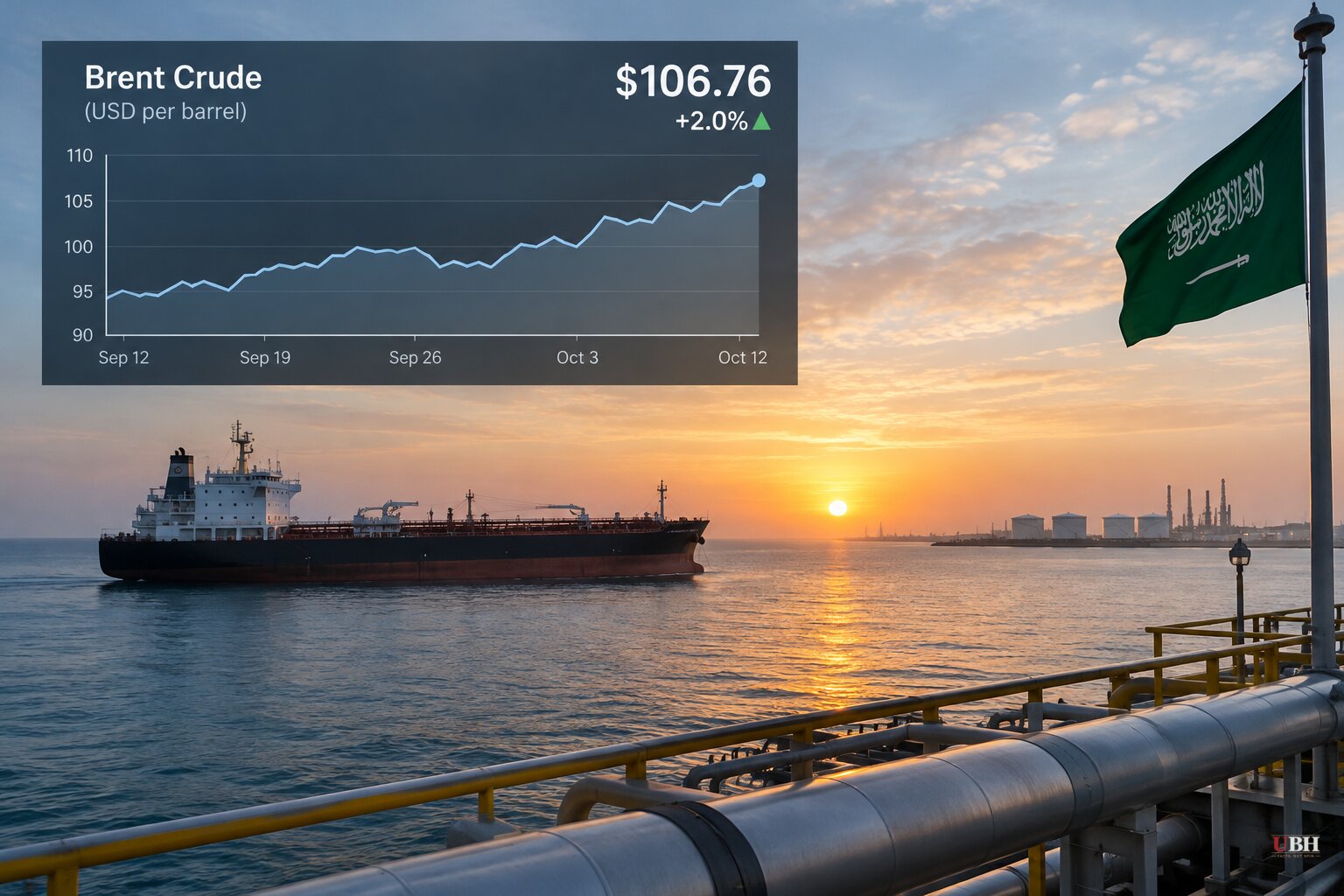
Since the war began on Feb. 28, the oil market has swung between recovery hopes and fresh attacks. Monday, Oct. 12, was another attack day.
Brent crude futures gained $2.04, or 2%, to $106.76 a barrel by 1507 GMT, the highest level since Sept. 29. U.S. West Texas Intermediate rose $1.84, also 2%, to $93.69. Both were up from levels near $105 and $92 in early Asian trading.
What pushed prices up
The Houthis claimed responsibility for Saturday's missile strike on Riyadh's international airport, which killed 13 people and wounded more than 300. On Sunday, the Saudi Civil Aviation Authority said a second strike on King Khalid International Airport killed one person, a Pakistani resident, and injured 11 others. The Saudi-led coalition said an unidentified projectile hit Terminal 4 and started a localized fire. King Fahd International Airport in Dammam was also targeted. Investigations into both incidents are ongoing.
The Federal Aviation Administration told U.S. airlines on Sunday to use extreme caution in Saudi airspace. Its notice runs through Dec. 10 and warns that threats could affect aircraft "at all altitudes." Flightradar24 data showed 156 flights canceled at Jeddah, 20% of the schedule, with another 374 delayed.
At sea, the United Kingdom Maritime Trade Operations reported that a drone struck a tanker near Oman's Sohar anchorage. Another tanker was damaged by an unidentified projectile while transiting the Strait of Hormuz.
A recovery that was already incomplete
Gulf crude exports, excluding Iran, averaged 19.2 million barrels a day in September, according to analytics firm Vortexa. That is just over 81% of the 23.6 million barrels a day the region shipped before the war.
The rebound was lopsided. Crude and condensate exports reached about 91% of pre-war levels, while refined products sat at roughly 60%. That leaves diesel and jet fuel the tightest part of the market.
So the tanker strikes land on a recovery with a hole in it. The Strait of Hormuz carries a large share of global oil and fuel shipments, and several Gulf producers have few other export routes.
Russia diesel and the energy ceasefire
President Donald Trump said Friday that Russia would immediately supply more than 300,000 metric tonnes of diesel, about 2.25 million barrels, to the United States and global markets, with more to follow. Russia has also partially lifted its diesel export restrictions, allowing an additional 500,000 tonnes, roughly 3.7 million barrels, onto the international market. Trump announced an agreement for Russia and Ukraine to stop attacking each other's energy infrastructure.
The deal is already contested. Ukrainian President Volodymyr Zelensky accused Russia on Monday of violating the energy ceasefire. Those diesel barrels were not enough to hold prices down.
OPEC and the IEA disagree on demand
OPEC Secretary-General Haitham Al Ghais said Monday the group now expects global oil demand to grow by 400,000 barrels a day in 2026. That is down from the 1.4 million barrels a day OPEC projected at the start of the year, though slightly above its 380,000 forecast from September. OPEC expects much of the demand deferred by this year's disruptions to return in 2027.
The International Energy Agency sees something much worse. It forecasts global consumption falling by 2.5 million barrels a day in 2026 before rebounding by 2.6 million in 2027. OPEC projects growth this year and the IEA projects a steep contraction.
Goldman Sachs raised its December Brent forecast from $85 to $90 a barrel. It put the geopolitical risk premium at more than $20 a barrel.
The arithmetic explains why a demand downgrade did not pull prices down. Weaker consumption matters less when the barrels that exist are struggling to reach buyers. As one market analysis put it, it is one thing to have less demand for oil, but another when supply is still struggling to get where it needs to go.
What comes next
Saudi authorities have promised a response to the airport attacks, but have not said what form it will take. Whether Gulf exports hold at September's 81% depends on whether the Hormuz and Oman incidents turn into a pattern. The FAA's Saudi airspace warning stays in force until Dec. 10, and the investigations into the Riyadh and Dammam strikes are still open.
Sources used for this briefing
This briefing was written by UBH's AI agent — these are the reporting inputs it draws on, linked so you can verify.


