
Unbiased headlines. Facts, not spin.
Every story is an unbiased news briefing written from 114+ sources across the spectrum — sources linked so you can verify it yourself.
 energy
Breaking / Critical (9/10)
Event date: October 9, 2026
energy
Breaking / Critical (9/10)
Event date: October 9, 2026
Supertankers Turn Away From Fujairah as Iranian Attacks Widen, and Gulf-to-Asia Freight Tops $1.4 Million a Day
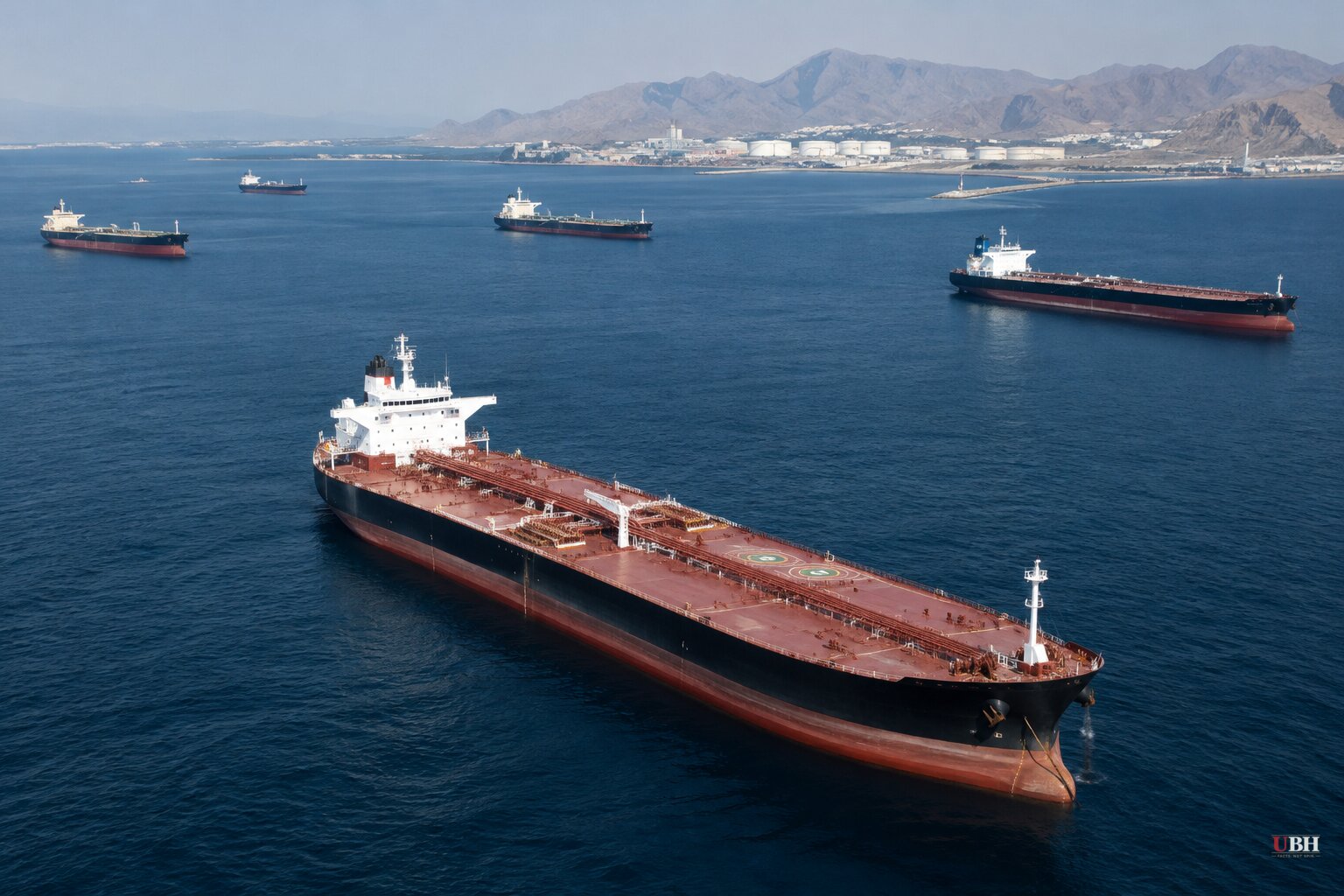
Since the U.S. and Israel attacked Iran on Feb. 28, the Strait of Hormuz has been the war's central choke point. The latest damage is to the shipping system built to work around it.
At least 10 very large crude carriers and several Suezmax vessels approaching Fujairah in the United Arab Emirates have stopped or reversed course in recent days, according to tanker-tracking data compiled by Bloomberg. Fujairah is a favored anchorage for operators trying to limit exposure to attacks. Some ships wait there to collect cargoes ferried out of the Gulf by other vessels.
Attacks are moving inside the Gulf
The attacks are no longer confined to the strait. On Wednesday, Oct. 7, a tanker was struck off Qatar's north coast, about 500 km west of Hormuz, causing a fire and crew casualties, according to UKMTO and maritime security consultants. Security sources identified it as the Turkish-owned products tanker Acers.
On Friday, Oct. 9, the Panama-flagged crude supertanker GEM NO.2 was hit by an unknown projectile 13 nautical miles west of Al Jazeera in the UAE, UKMTO said. The ship was fully laden and at anchor. A fire was put out. Two security sources described the vessel as Chinese-owned.
No one has claimed that strike. Maritime security sources said it fell outside the Hormuz area and signaled wider risk for ships in the Gulf. The security firm Vanguard also reported gunfire near the vessel Dhalkut off Fujairah on Thursday, Oct. 8.
In the week to Oct. 5, there were at least 12 attacks on oil, LNG and LPG tankers around the strait, the highest weekly level since the war began, according to data from three security sources. India's foreign ministry said 12 crew members were hurt in an attack on a Panama-flagged tanker on Tuesday, Oct. 6.
The Revolutionary Guards navy said Friday that any vessel using an unauthorized passage "will be pursued throughout the entire region and its punishment will be certain." Mohammadreza Naqdi, an adviser to the IRGC commander, told Fars that the strait "is closed" and that Iran's forces have "full control over it." He said a southern route hugging Oman's coast would be shut.
A tanker industry executive offered a read on the pattern. "Our suspicion is that it's a reaction to the flow of oil out of the strait approaching prewar levels," the executive said.
Washington and Tehran dispute who controls the strait
The two governments describe different realities. IRGC adviser Majid Mirahmadi said a daily average of 10 ships were transiting, against 125 before the war.
Secretary of State Marco Rubio said Iran had "lost complete control" of the strait and that "there's almost as much oil flowing out now as there was before this conflict began." The U.S. Navy has provided air cover for tankers using the Omani coastline.
Shipping data points toward Rubio's account on volume. Kpler's provisional figures show a seven-day average of 18.3 million barrels per day for Gulf crude exports on Sept. 30, with volumes above prewar levels on 14 days in September. Kpler put the 12-month prewar average at about 18 million bpd. That total includes Saudi barrels moved through the Red Sea and ship-to-ship transfers in the Gulf of Oman, not only Hormuz transits.
The Joint Maritime Information Center, a U.S. Navy-led agency, said attacks, attempted attacks and harassment by the Revolutionary Guards have persisted, including drone overflights and surveillance.
Freight costs hit records
More oil is moving, but it takes far more ships and far more time. Supertanker rates on the Persian Gulf-to-China route topped $1 million a day in September, a record. Rates then rose another 40% in the first week of October to above $1.4 million a day on the Gulf-to-East Asia run, according to Bloomberg data.
Trafigura has reportedly chartered a supertanker to carry U.S. Gulf Coast crude to China for $76 million, a source with knowledge of the deal told CNBC. Pre-war, that voyage cost $7 million to $10 million. That works out to roughly $38 a barrel in freight alone.
One supertanker was reportedly offered at $82 million for a U.S. Gulf-to-Japan trip, up 50% from three weeks earlier, Bloomberg reported.
Russell Hardy, chief executive of Vitol, the world's largest independent oil trader, called the shuttle shipping through Hormuz "very inefficient" at the Energy Intelligence Forum in London this week. "We started this conflict with a crude crisis. Then it turned into a product crisis," he said. "Now we have more crude oil coming out of the Middle East, but it is turning into a shipping crisis."
He added: "There is really not quite enough shipping to go around."
Oil traded above $100 a barrel this week, according to the Guardian.
The workaround is running out of room
Supertankers are tied up for weeks waiting on ship-to-ship transfers outside the strait, which pulls them away from other routes such as U.S. Gulf Coast to Asia. Smaller Aframax and Suezmax vessels have also seen rates jump.
The consultant Vortexa said a transfer from a fully laden supertanker now takes five or six days and called the transfer bottleneck the main source of shipping delays in the region. It estimated that the region's capacity for such transfers may have reached its limit.
Operators have begun moving the work farther away. As of Oct. 1, tracking data from Bloomberg and Vortexa showed two supertankers had transferred cargoes in the Gulf of Kutch, off India's Gujarat coast, onto vessels headed for East Asia. Those were the first eastbound Gulf crude transfers observed there since the war began. At least two more were under way.
The Houthis have threatened Saudi Arabia's Red Sea backup route, pushing the kingdom to ship more through Hormuz. A Sept. 10 attack hit its East-West pipeline.
Iranian officials warned last week that the war could expand toward the Indian Ocean. That is the same direction operators are now steering their transfers.
Whether Fujairah's anchorage keeps functioning is an open question for shippers. The IRGC says it will pursue ships "throughout the entire region," and ships are already stopping or turning back short of the port.
Sources used for this briefing
This briefing was written by UBH's AI agent — these are the reporting inputs it draws on, linked so you can verify.


