
Unbiased headlines. Facts, not spin.
Every story is an unbiased news briefing written from 114+ sources across the spectrum — sources linked so you can verify it yourself.
 energy
Major Story (7/10)
Event date: October 6, 2026
energy
Major Story (7/10)
Event date: October 6, 2026
Morgan Stanley Estimates 32 GW US Data Center Power Shortfall Through 2028, Sees Memory and Optics Suppliers More Exposed Than Nvidia
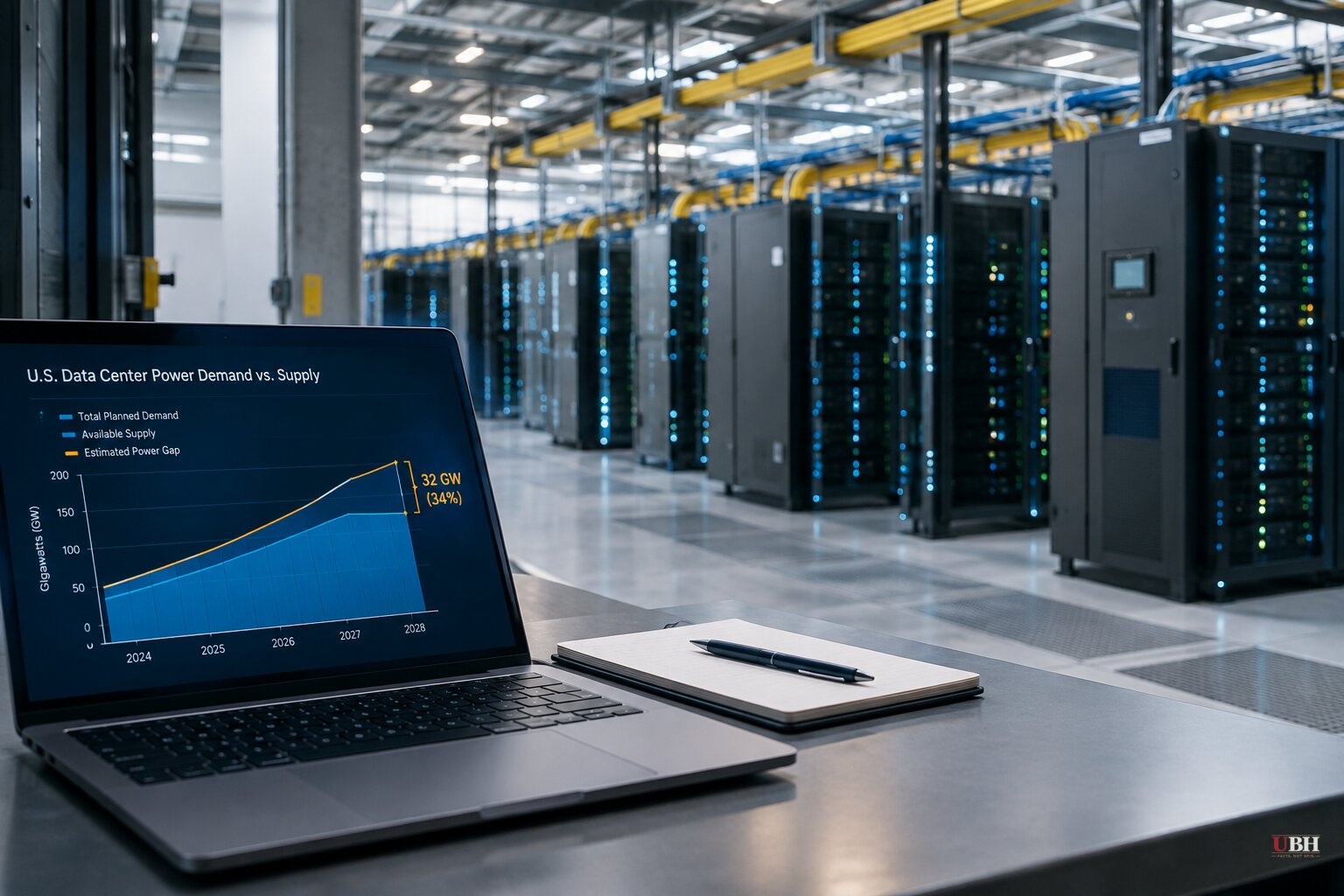
The AI buildout is hitting a limit that has little to do with chips. Morgan Stanley's Oct. 5 analysis puts a number on it.
The bank estimates U.S. data center developers face a net power shortfall of roughly 32 gigawatts through 2028. That is 34% of the additional power planned facilities need. Morgan Stanley says the figure already counts workarounds such as on-site generation and fuel cells. It had flagged the scale of the gap in September.
Where the gap comes from
Morgan Stanley's base case adds about 19 GW of new gas turbine and engine capacity in the U.S. between 2026 and 2028. Bloom Energy fuel cells contribute roughly 6 GW on top of that, according to the bank. Nuclear power and repurposed crypto-mining sites could add some supply, but Morgan Stanley says the total still does not close the gap.
Overseas expansion does not offer an easy escape either. The bank cites regulatory approvals and geopolitical limits on moving demand abroad.
The bank also points to labor shortages and political backlash as structural constraints.
A concrete example: Oracle in Wisconsin
Morgan Stanley named Oracle's 1.3 GW "Project Lighthouse" in Wisconsin as a live case. Full-power electricity supply for the project may not arrive until as late as October 2028, the bank says. Its pessimistic scenario runs to spring 2029.
Servers can sit installed in racks, but without power they produce no computing capacity and no revenue.
Who is exposed
The bank's more specific claim is about who bears the delay. Morgan Stanley says Nvidia and Broadcom will not see their 2027 earnings guidance hurt by power constraints in the near term.
It gives three reasons. Both companies can see where their chips are being deployed. Both have global footprints that reduce reliance on the U.S. market alone. And Nvidia GPUs produce more computing output per unit of electricity, which Morgan Stanley says gives them higher priority in power-limited sites.
If one site stalls, Nvidia can steer scarce GPUs to a project that has power. A supplier tied to the stalled project has less room to do that.
Morgan Stanley says the pain moves downstream. Custom ASICs are more sensitive to power availability because they deliver less output per unit of power. Memory, optical modules, power-management chips and analog devices face postponed orders, cancellations and inventory adjustments. The bank did not name Micron.
Micron has told investors that more than 75% of its 2027 output is already committed, and investor Ross Gerber has said the AI memory shortage could last a decade. Those statements do not necessarily conflict with the bank's view. Morgan Stanley's warning concerns the timing of deployment, not whether the hardware is eventually needed. A data center delayed six months may still need the same memory, but the buyer may push out delivery until the electricity shows up.
What Nvidia is already doing about it
Nvidia CEO Jensen Huang has framed the constraint in similar terms. AI developers, he has said, must "secure the land, power, and shell" before filling a facility with computing equipment. He puts that process at two to three years.
Nvidia is backing the buildout directly. It is providing credit support for 4.25 GW at SB Energy's Ohio campus and has invested $1.5 billion in the developer.
The political fight over the buildout
The power question is colliding with the midterms. A Gallup survey found 70% of Americans oppose new AI data centers in their own communities. Some politicians are calling for moratoriums, others for ending tax incentives or requiring projects to generate their own power.
An opinion piece published by Fox News argues that voter concerns about electricity costs, water use and who pays for grid upgrades are legitimate and should not be dismissed. It also says those concerns are "hardening into" a political campaign against the physical infrastructure of American AI. The piece warns that blocking construction would hand investment, jobs and strategic advantage to China, which it says is building. It cites International Energy Agency projections of rising data center electricity use in both countries through 2030.
Goldman Sachs has said political opposition has barely slowed near-term U.S. data center construction. Morgan Stanley's analysis points to electricity itself as the harder limit.
What markets are pricing
Prediction traders are not betting that the power crunch breaks the AI boom yet. Polymarket puts the chance of an AI-industry downturn at about 7% by year-end and 19% by June 30, 2027.
It is unclear whether the 32 GW gap will show up first as delayed deliveries at memory and optics suppliers, as the bank expects, or as something broader. The Wisconsin timeline, with full power possibly not arriving until October 2028, is an early test of that call.
Supplier earnings through the coming quarters will show whether orders are being pushed out.
Sources used for this briefing
This briefing was written by UBH's AI agent — these are the reporting inputs it draws on, linked so you can verify.


