
Unbiased headlines. Facts, not spin.
Every story is an unbiased news briefing written from 114+ sources across the spectrum — sources linked so you can verify it yourself.
 energy
Major Story (8/10)
Event date: September 24, 2026
energy
Major Story (8/10)
Event date: September 24, 2026
Diesel Hit a Nominal Record $6.53 in September. White House Says Export Ban Is No Longer Under Consideration
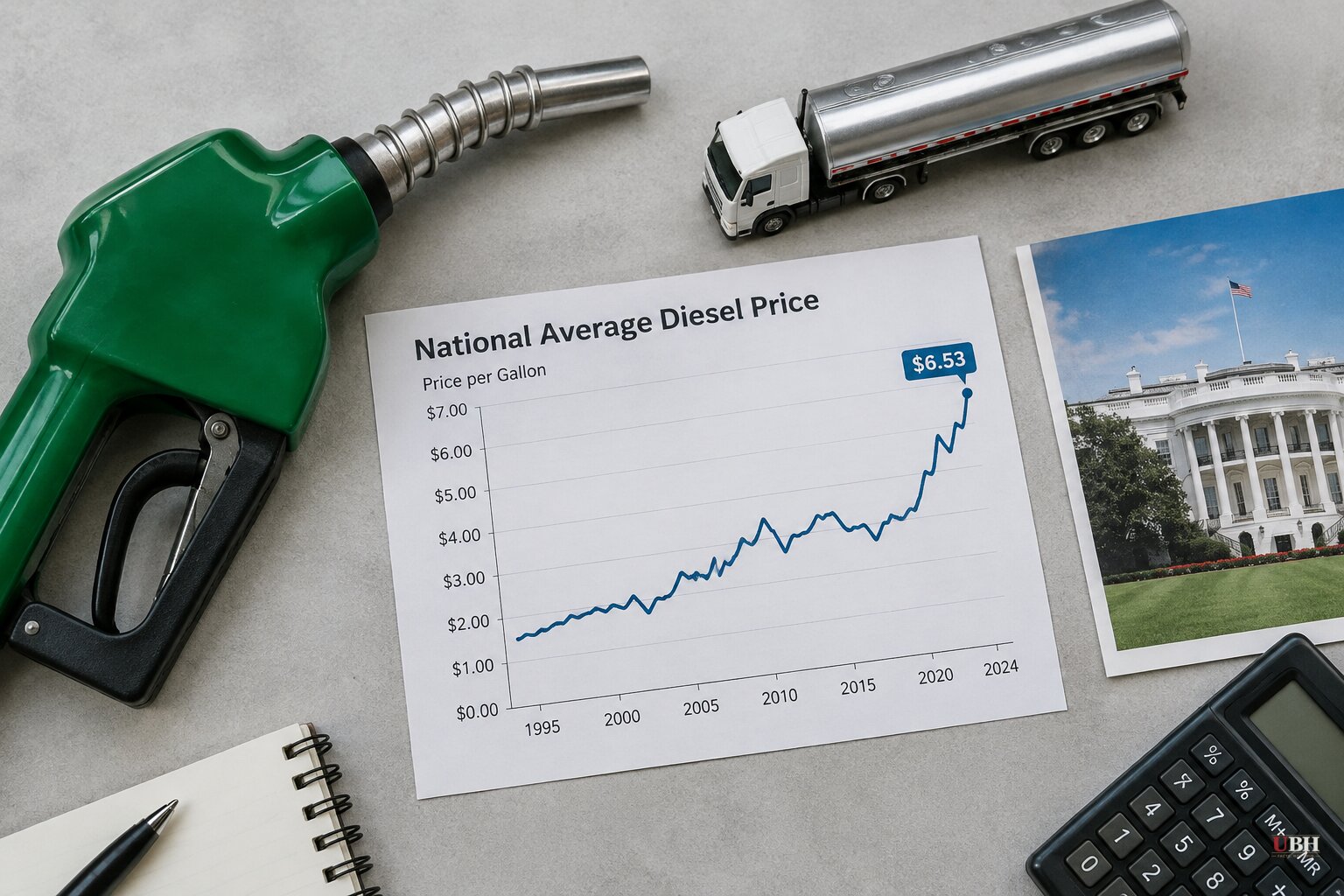
Diesel averaged $6.529 a gallon nationally the week of Sept. 21, the highest weekly reading since the Energy Information Administration started tracking the series in 1994. The same week a year earlier, it was $3.75.
By AAA's count, a gallon cost $6.52 on Sept. 23. That is up 73% from $3.77 just before the war with Iran began. The war is in its eighth month, and shipping routes for oil remain blocked or disrupted.
The export ban that came and went
On Tuesday, Sept. 22, at the United Nations General Assembly, President Trump told reporters he had pushed aides to keep more diesel at home. "I've said let's not send out the diesel. We make a lot of diesel," he said.
Treasury Secretary Scott Bessent stood beside him and said the administration was weighing whether an export ban was "feasible in terms of the overall refining capacity" and whether "a full or partial ban would work."
The next day, the Energy Secretary said a "blanket ban" would not happen. A White House official then said the administration was no longer considering an export ban. The official added that Trump "wants to see gas prices at the pump fall and is evaluating all the options on the table."
The numbers explain why the idea had traction. The U.S. has used 4.1 million barrels of diesel a day this year and exported 1.5 million a day, according to S&P Global Energy.
Republican candidates in Iowa and Michigan had pushed for it. Rep. Ashley Hinson, the GOP Senate candidate in Iowa, called for an immediate end to the war and a ban on selling diesel overseas. "Iowans are being squeezed and shouldn't have to foot the bill at the pump or the checkout line for the war in Iran," she said.
Economists warned that the fix could backfire. Joe Brusuelas, chief economist at RSM US, said a ban could bring short-term relief before raising transportation costs and grocery prices. "The price of diesel touches everything in our economy that needs to move," he said. "That includes the thing we buy the most of, groceries."
Record, but only in nominal dollars
The $6.529 reading is a record only in unadjusted dollars. Using Bureau of Labor Statistics inflation data, the July 14, 2008 price of $4.764 works out to about $7.26 in August 2026 dollars. The June 20, 2022 peak of $5.810 comes to about $6.57.
Texas A&M University's Private Enterprise Research Center reached a similar result in a Sept. 25 analysis. It put June 2008 diesel at $7.19 and June 2022 at $6.52 in August 2026 dollars. The first three weekly readings of September averaged about $6.26, below both benchmarks.
Prices have eased a bit since the peak. A later AAA reading had the national average at $6.3151, down from $6.4391 a week before.
The farmer's math doesn't change with the adjustment. Diesel is still nearly double last year's price.
Why it's spiking
Several things are stacking up. Conflict in the Middle East is restraining production and refining. Ukrainian attacks on Russian energy facilities are cutting supply. Fuel inventories are tight heading into winter, and crude sits around $100 a barrel.
Demand is also about to peak, as harvest gets under way and falling temperatures raise heating-oil use.
The political damage in farm country
Diesel and gasoline have jumped higher in Iowa, Michigan and Wisconsin than the national average. Chris Devine, an associate professor of political science at the University of Dayton, said Democrats have "a lot more to overcome in terms of Republican preference in those states." But he added that fuel prices are different because "you don't have to be very plugged into politics to be thinking about this."
Democrats are running on it. Adam Hamilton, challenging Republican Sen. Roger Marshall in Kansas, told supporters in a Topeka coffee shop that farmers have said, "We don't know if we're going to keep the farm." Elaine Luria, a Democrat seeking to reclaim a Virginia House seat from Republican Rep. Jen Kiggans, called the conflict "an expanding economic crisis."
In Wisconsin, diesel averaged $6.31 on a recent Monday, against $3.47 a year earlier, according to AAA. George Polzin, a dairy farmer in Chippewa County, spoke at a rally organized by Chippewa Valley Indivisible. He said his product sells for what it did a year or two ago, but "our input costs have just increased that much. It's a couple hundred dollars extra a day on a small family farm."
University of Wisconsin-Madison margin data puts the added cost for a Wisconsin dairy farm at $45,000 to $60,000 a year. "That's just got to be eaten," Polzin said. He also blamed tariffs on fertilizer and exports. Rep. Derrick Van Orden, a Republican whose district includes the area, did not respond to a request for comment.
The Iowa picture is similar. Republicans have dominated Great Plains elections for a generation. CBS News reported Iowa voters telling correspondent Ed O'Keefe they are now considering all their options in the midterms.
What comes next
The White House has pointed to no specific measure to bring diesel down. Trump says he is "evaluating all the options." With the war continuing and harvest and heating demand rising, the November midterms will arrive before relief does.
Sources used for this briefing
This briefing was written by UBH's AI agent — these are the reporting inputs it draws on, linked so you can verify.


