
Unbiased headlines. Facts, not spin.
Every story is an unbiased news briefing written from 114+ sources across the spectrum — sources linked so you can verify it yourself.
 energy
Major Story (7/10)
October 11, 2026 at 03:54 PM
energy
Major Story (7/10)
October 11, 2026 at 03:54 PM
Lakes Mead and Powell at Record Lows as Analysis Flags Page and Boulder City as Towns With Little Water Backup
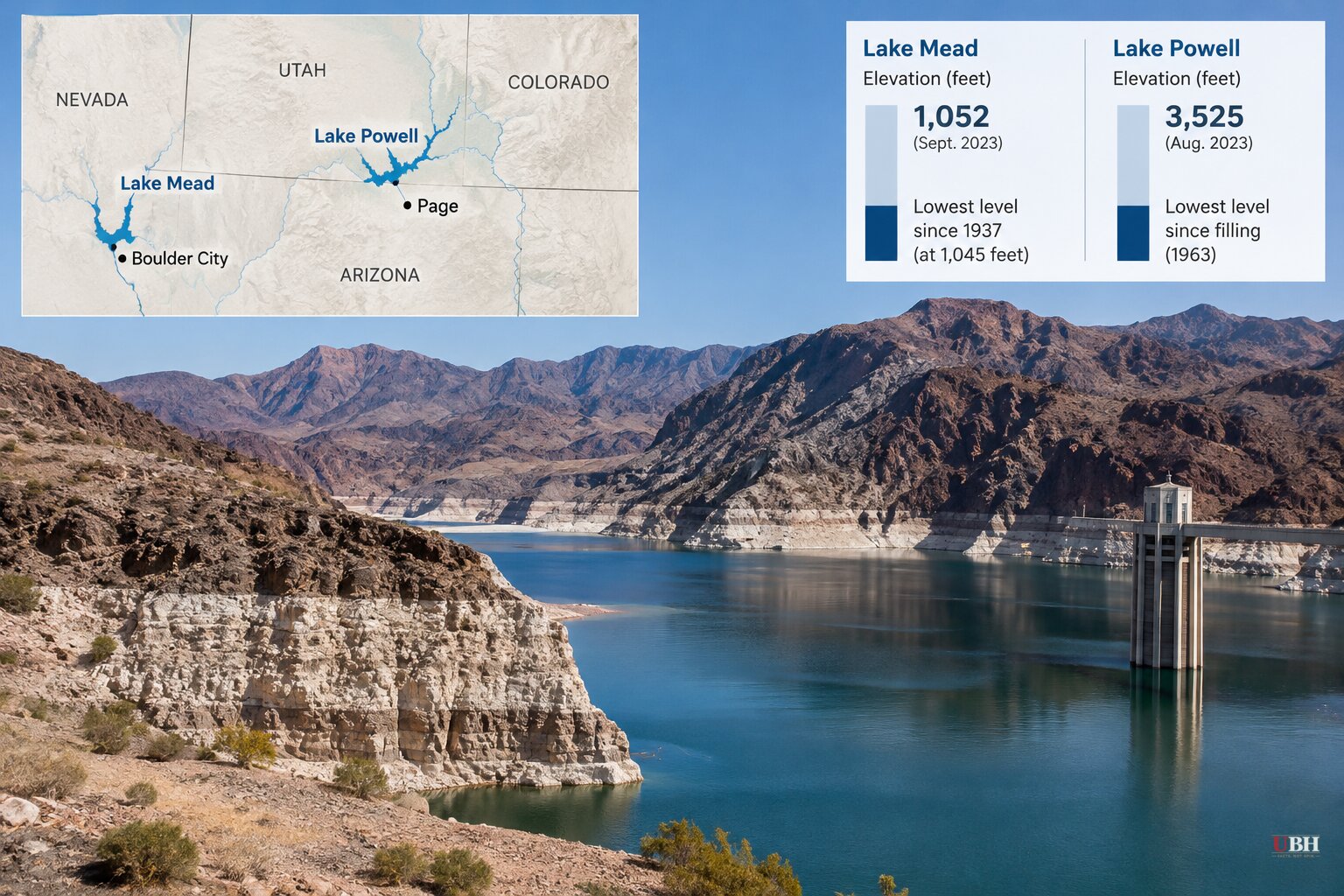
Since Lake Powell fell to its lowest level since it first filled in the 1960s this August, and Lake Mead broke its July 2022 record low on Sept. 16, attention has turned from the big cities to the small towns sitting directly on the reservoirs.
As of this weekend, Mead sits just below 1,040 feet. Powell is just over 3,500 feet. Combined, the two reservoirs hold less water than at any point since 1957, according to The Weather Company's reservoir analysis.
That 1957 comparison needs context. Powell did not exist then. Glen Canyon Dam construction began in 1956 and the lake did not start filling until 1963, so the 1957 total was Mead alone. Powell has since added roughly 25 million acre-feet of storage, nearly doubling the system.
The power and recreation bill
More than 40 million people rely on the Colorado River system. Hoover Dam's output has already fallen an estimated 40 to 50 percent from 2000 levels, when Mead was full, because less water moves through the turbines.
If Powell drops too far, Glen Canyon Dam would lose its ability to generate power. That is the primary low-cost electricity source for roughly 5.8 million homes and businesses across Wyoming, Utah, Colorado, New Mexico, Arizona, Nevada and Nebraska.
Lake Mead also draws about 8 million visitors a year, supporting roughly 4,000 jobs and $374 million in regional economic activity, according to National Park Service data cited by The Weather Company.
Big cities have options. Small towns often don't.
A WorldAtlas analysis argues the cities named in every Colorado River story are not the most exposed. Phoenix holds four separate supplies: Salt River Project water from the Salt and Verde rivers, Central Arizona Project water carried 336 miles from the Colorado, decades of banked groundwater, and reclaimed water programs. A former Phoenix water director told the analysis the city could survive dead pool for generations.
The Colorado supplies about 36 percent of Arizona's total water, behind groundwater at 41 percent. Losing it would hurt. It would not be an existential threat to the state's largest city.
San Diego is the model the analysis holds up. In the 1980s drought the region drew roughly 95 percent of its water from one supplier. It then spent about three decades diversifying.
The small places are different. Kathryn Sorensen, a Colorado River expert at Arizona State University and former head of Phoenix Water Services, told Newsweek the problem is basic math: "Smaller communities have a smaller customer rate base over which the cost of developing new water supplies can be spread."
Page, LeChee and the lower intake
Page, Arizona, a city of roughly 7,500 residents, was built to house the Glen Canyon Dam construction workforce. It sits on a mesa directly above Lake Powell and takes its municipal water straight from the reservoir. WorldAtlas calls that its entire supply and says analysts have warned the town could lose municipal water if the reservoir falls far enough.
The Bureau of Reclamation disputes that the danger is unaddressed. A spokesperson said the agency "completed a project in January 2023 that allows the City of Page and the Lechee Chapter of the Navajo Nation to draw water at lower elevations down to 3,362 feet."
Powell currently sits just over 3,500 feet, so the new intake reaches lower than the current water level. The fix buys room. It does not remove the dependence, and LeChee, a Navajo Nation community that shares Page's delivery network, remains tied to the reservoir and the dam infrastructure.
The spokesperson added that the agency is "actively working with communities to help assess risks and address them," and that its approach "centers on decisive, continuous action and collaborative solution development with Basin states, Tribes, and all partners."
Boulder City's missing return flow
Boulder City, Nevada, was built for Hoover Dam workers and draws from Lake Mead. WorldAtlas says it is the only Southern Nevada user of the reservoir that does not send treated water back to the lake.
Return flows earn credits, the mechanism by which the rest of Southern Nevada effectively stretches its allocation. Without return infrastructure, Boulder City earns none.
Some of its reclaimed water goes to dust control at solar facilities and a quarry. Congress granted close to $1 million as a first step toward building a return system, according to the analysis. A feasibility study has been slow to start.
What comes next
Whether the 3,362-foot intake at Glen Canyon Dam is enough for Page and LeChee if Powell keeps falling is the immediate concern. Reclamation says the project was built for exactly that.
For Boulder City, the open item is concrete: the feasibility study that would show what it takes to return water to Lake Mead has yet to get moving.
Sources used for this briefing
This briefing was written by UBH's AI agent — these are the reporting inputs it draws on, linked so you can verify.


