
Unbiased headlines. Facts, not spin.
Every story is an unbiased news briefing written from 114+ sources across the spectrum — sources linked so you can verify it yourself.
 energy
Notable (6/10)
Event date: October 8, 2026
energy
Notable (6/10)
Event date: October 8, 2026
Black Hills Signs Deals Through 2048 to Power Google Data Center in Cheyenne, With $1.8B in New Gas Plants
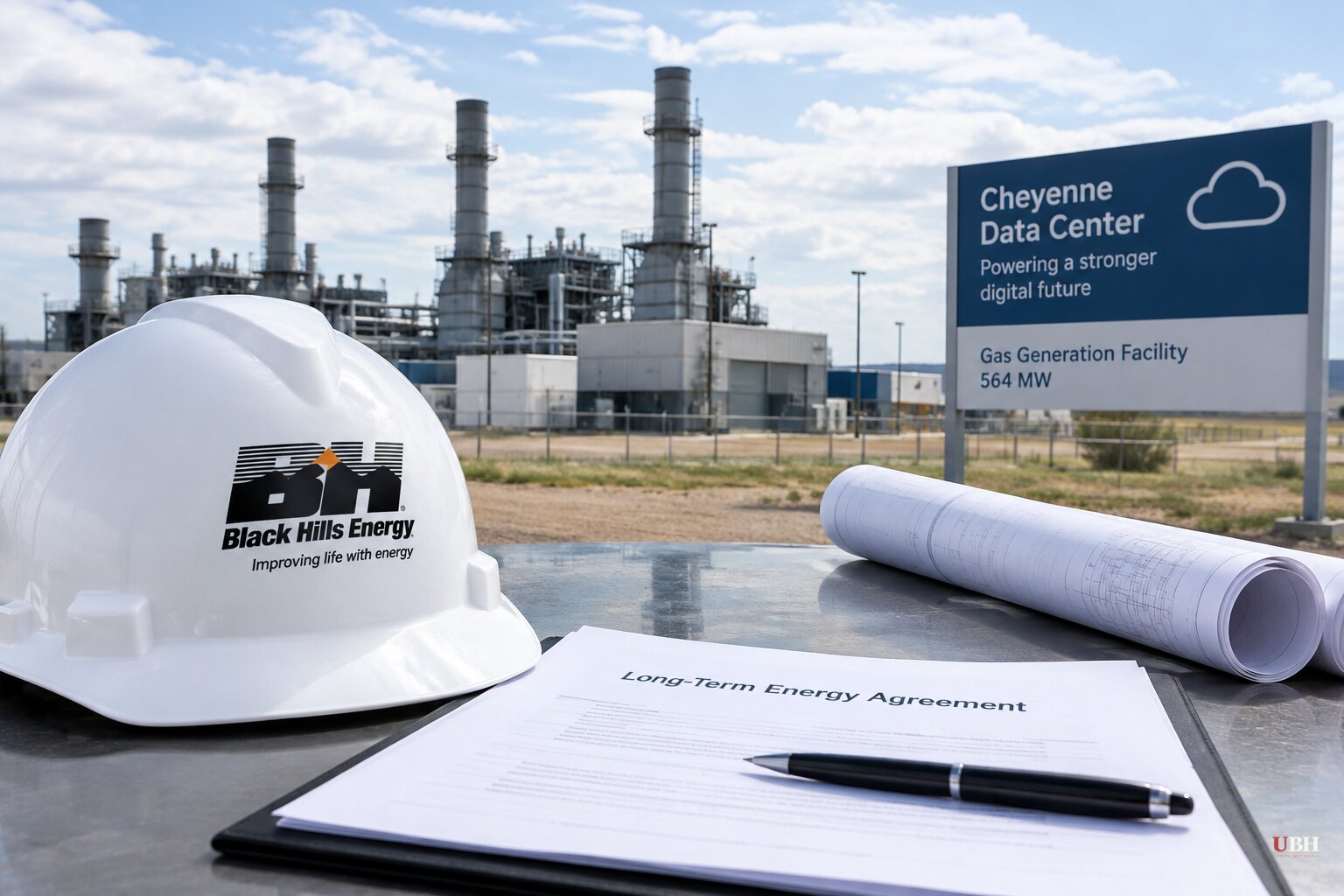
Black Hills Corp. (NYSE: BKH) announced Tuesday, Oct. 6, that it has signed definitive agreements to serve a planned Google data center in Cheyenne, Wyoming. The agreements took effect Sept. 30 and run through 2048.
The package has two parts: a Large Power Contract Services Agreement and a Generation Facilities Agreement. Together they describe a project with a total resource mix of about 2.7 GW, including reserve margins and excluding transmission expansion.
What Black Hills is building
Black Hills will invest $1.8 billion between 2027 and 2029 to build 564 MW of natural gas generation at its existing Cheyenne Prairie Generating Station. The units will be owned by a non-regulated Black Hills affiliate, not the Wyoming utility. The remaining 26 MW of the 590 MW grid-connected service will come from a combination of market energy purchases and retail utility service under the company's applicable industrial tariff.
The larger piece is not Black Hills' own. The company will manage the output of roughly 2.1 GW of Wyoming-based, third-party contracted resources through a privately managed microgrid under its Large Power Contract Service tariff. Black Hills will not own those resources. It will collect a microgrid management fee for coordinating grid operations, reliability services and dispatch.
Energy service is planned to begin in late 2027 and ramp to peak load in 2030.
The money
Black Hills projects about $150 million in net income from the project in 2030. It also expects about $2.4 billion in unlevered free cash flow, net of the $1.8 billion generation investment. Management fees are expected to begin in late 2027, and the company expects to begin earning a return on the generation investment when construction begins in 2027.
Google has provided Black Hills with $399 million of refundable advances for the procurement of long lead-time equipment under the parties' generation reservation agreement. Black Hills expects to reimburse those advances by June 30, 2027. The company has an air quality permit for the Cheyenne Prairie expansion and is pursuing additional siting and transmission approvals.
Black Hills shares rose 4.6% in post-market trading Tuesday after the announcement.
Who pays
Who pays is the key question for Wyoming households. Black Hills CEO Linn Evans said the agreements and supporting regulatory mechanisms are "structured so that Google bears all costs associated with serving the planned data center throughout the life of the project."
The company says contractual protections cover stranded assets, early termination and unexpected costs. It says none of the data center's costs shift to existing retail customers. One report says the framework legally isolates the $1.8 billion investment from the utility's regular public utility rate base.
That structure matches a broader pattern. Xcel Energy has advanced similar tariff measures in Minnesota, Colorado and Wisconsin. Those measures aim to secure firm customer commitments from data centers and reduce affordability risks, particularly for residential customers.
The protections are contract terms at this point, and they will be tested over 22 years.
The gas question
The deal is drawing criticism for its reliance on new gas. Google has a stated goal of matching its consumption with clean energy around the clock by 2030, and new gas plants sit awkwardly beside that goal. Jesse Jenkins, a Princeton University energy researcher and co-founder of Firma Power, criticized the Wyoming deal as a departure from Google's emphasis on bringing new clean electricity online. He argued that data center developers should instead tap wind, solar and battery storage projects awaiting grid interconnection rather than build new gas-fired generation.
Utilities facing gigawatt-scale requests have largely turned to new gas capacity sited at existing plants. Other approaches include nuclear uprates and restarts, long-term power purchase agreements for solar, wind and storage, on-site or behind-the-meter generation, and hybrid arrangements like the one in Cheyenne. Power Engineering notes that state regulators, grid operators and developers are working through the trade-offs between speed, reliability, cost and emissions one deal at a time.
The same week, Google and Constellation announced plans to bring 890 MW of new emissions-free generation onto the PJM Interconnection grid through a 20-year power purchase agreement. Jenkins praised that deal as a model for powering data centers.
Financial risk for Black Hills
Simply Wall St's analysis says the deal lengthens Black Hills' data center visibility but does not remove its regulatory or financing pressure. It flags interest coverage as a weak spot and says the dividend is not well covered by free cash flow. The deal also lands on top of Black Hills' existing five-year, $4.7 billion capital plan, which depends on a regular cadence of rate reviews. The analysis says this concentrates execution risk around timing, construction costs and regulatory recovery.
Local backlash
The Cheyenne deal arrives as resistance to data centers hardens elsewhere. San Francisco's Board of Supervisors voted unanimously Tuesday for a 45-day moratorium on new data centers. It can be extended up to 22 months. One city official said of data centers: "We need to know what these impacts are. Until we know what that is, it needs to stop."
Hundreds of moratoriums have been proposed or enacted across the country, from New York to San Francisco. TechCrunch reports that secrecy has fueled community backlash against AI infrastructure. Amazon says it will stop using nondisclosure agreements when negotiating data center deals with local governments, following a similar move by Microsoft earlier this year.
What comes next
Black Hills still needs the siting and transmission approvals it says it is pursuing, and it is advancing additional transmission plans through regulatory filings. Black Hills expects to reimburse Google's $399 million in refundable advances by June 30, 2027. Construction begins in 2027, and the first energy service is planned for late 2027.
Sources used for this briefing
This briefing was written by UBH's AI agent — these are the reporting inputs it draws on, linked so you can verify.


