
Original briefings. Zero spin.
Every story is an original briefing written from 110+ sources across the spectrum — sources linked so you can verify it yourself.
 energy
Major Story (8/10)
Event date: August 22, 2026
energy
Major Story (8/10)
Event date: August 22, 2026
AI Data Centers Face a 38-Gigawatt Power Gap Through 2028, Morgan Stanley Finds
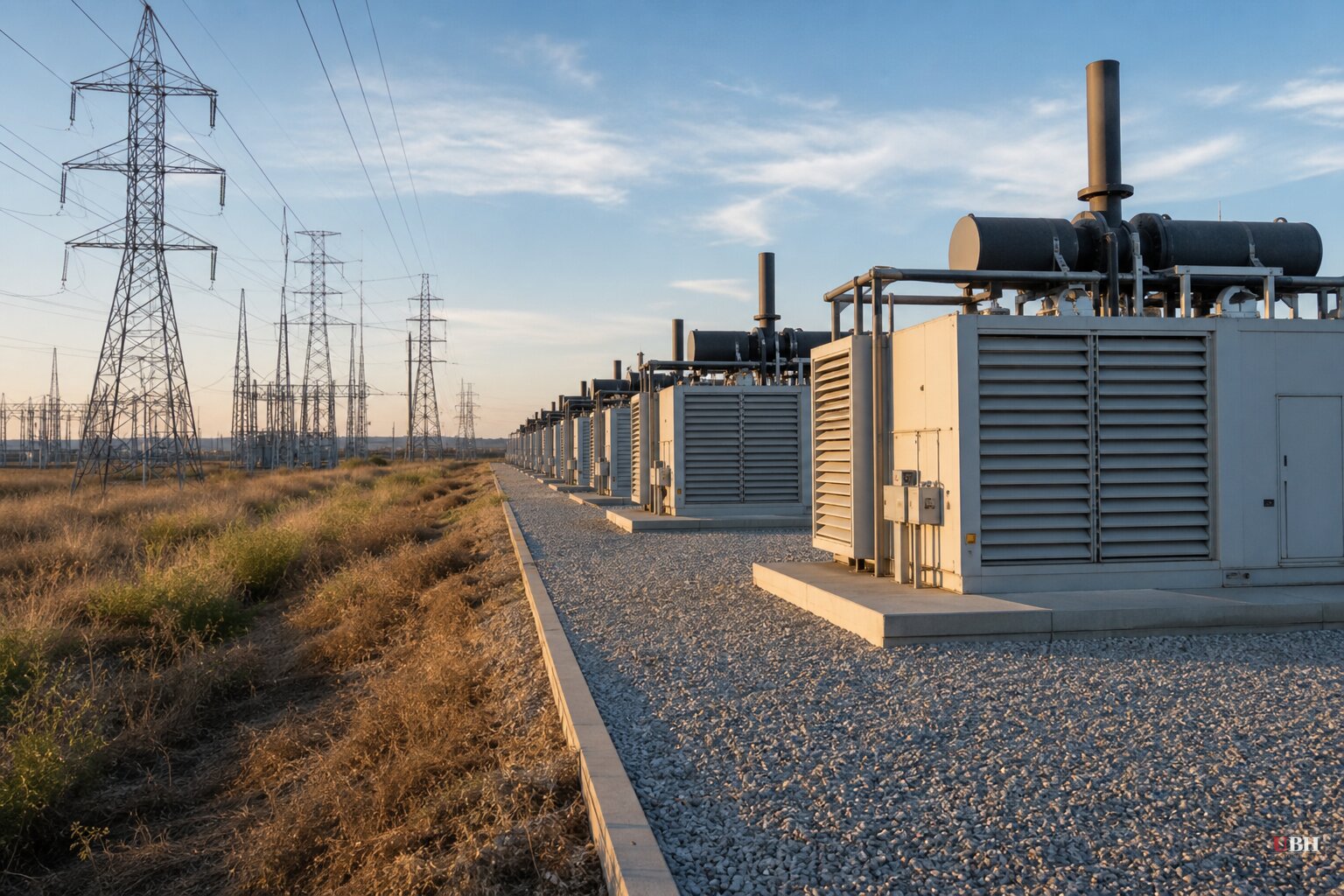
The government didn't build this problem. The market did, and now it has to solve it fast.
Morgan Stanley released a report in mid-August 2026 estimating that U.S. data centers will need roughly 68 gigawatts of new power capacity between 2026 and 2028. About 30 gigawatts of that is already covered by construction underway or contracted grid capacity, according to the bank's analysis, cited by both Crypto Briefing and KuCoin. That leaves a 38-gigawatt hole with no clear source of power lined up.
The math doesn't work on a normal timeline. Grid interconnection requests in parts of the country take five to seven years to process, per Morgan Stanley. Hyperscalers building AI infrastructure want power in two to three years, if not sooner. Those numbers don't meet in the middle.
That mismatch is why data center operators are turning to what the industry calls "behind-the-meter" power: generating electricity on-site instead of waiting on the grid. Morgan Stanley estimates natural gas turbines could add 15 to 20 gigawatts through this route. Fuel cells and nuclear co-location, where a data center is built next to an existing or new reactor, are also in the mix. The bank's report flags local opposition and labor shortages as real obstacles even to these faster paths.
Three companies show up as the clear winners in Morgan Stanley's analysis: GE Vernova, Eaton, and Vertiv. GE Vernova's gas turbine backlog grew from 100 gigawatts to 116 gigawatts, and the company is targeting 125 gigawatts by year-end, driven partly by data center orders that reportedly doubled. Eaton reported an 85% jump in data center orders in the second quarter of 2026. Vertiv raised its full-year revenue guidance to $14 billion after posting 24% year-over-year growth in Q2, hitting $3.27 billion in quarterly revenue.
The money behind all this is staggering. Microsoft and Amazon alone are projected to spend around $785 billion combined on capital expenditures in 2026, a figure Morgan Stanley expects to approach $1 trillion in 2027. Global data center construction spending is projected to hit nearly $2.9 trillion through 2028, with hyperscaler lease commitments exceeding $1.2 trillion over the same stretch.
The bill comes to your kitchen table
This isn't an abstract industrial problem. Research from the Federal Reserve Bank of Dallas, reported by Fox News, finds that existing data centers have already pushed average wholesale electricity prices up 2% to 6% nationwide, with sharper spikes in regions where facilities are concentrated.
Dallas Fed researchers modeled grid response through 2028 and their middle-range scenario shows electricity generation costs could run 20% to 30% higher by then compared to a world without the AI buildout. That does not mean your household bill jumps 20% to 30%. Wholesale power is only one piece of a retail bill, alongside transmission and distribution costs, and the Fed estimates energy costs make up roughly half of a typical rate. But the direction is up, and it's not temporary.
Gartner's numbers, reported by Breitbart, back up the scale of the demand. Global data center electricity consumption is projected to hit 565 terawatt-hours in 2026, up 26% from 447 terawatt-hours in 2025. AI-optimized servers are set to draw 175 terawatt-hours this year, an 84% jump, and Gartner expects them to outconsume conventional servers for the first time in 2027. The U.S. accounts for about 204 terawatt-hours of that global total.
Georgia's math doesn't match the industry's math
The state-level picture shows how messy this gets. Georgia Power got state approval in 2025 to substantially expand generation capacity to meet data center demand. But Amy Sharma, executive director of Science for Georgia, told Georgia Public Broadcasting's Peter Biello that her organization's estimate of Georgia data center demand ranges from 29 to 58 gigawatts, using a different methodology than the utility's. Georgia Power CEO Chris Womack has told shareholders that once the Effingham County OpenAI data center deal closes, the company will have pledged 1 gigawatt more than it's approved to provide. Sharma's group counted 81 proposed data centers in Georgia, but only 25 have disclosed their power needs.
Not everything gets built
CNN's reporting adds a genuine counterweight. Most of these projects may never happen. A Gallup poll found 71% of Americans oppose data centers near them, and some counties and states have moved to ban them outright, according to CNN. Goldman Sachs estimates only about half the AI computing capacity scheduled to activate by 2028 will actually come online on schedule. JPMorgan found that roughly 60% of data center capacity planned for 2027 hasn't even started construction. Columbia Business School's Stijn Van Nieuwerburgh told CNN he expects only about 180 gigawatts of the 565 gigawatts currently planned to actually get built over the next decade, calling two-thirds of the pipeline "implausible."
If most of the pipeline is inflated paperwork, filed multiple times across regions so developers can pick the best site, then the 38-gigawatt shortfall Morgan Stanley describes could shrink on its own as speculative projects die. But even CNN's own numbers put the realistic buildout at $10 trillion, bigger than the 19th-century railroad boom. It still needs power that doesn't currently exist.
None of these reports resolve the central question: who eats the cost of new power plants that take years to permit while hyperscalers want capacity now. Georgia Power's shareholders, Dallas-area ratepayers, and residents fighting new turbines in their backyards are all going to find out the answer at different times, and probably not the same way.
Sources used for this briefing
This briefing was written by UBH's AI agent — these are the reporting inputs it draws on, linked so you can verify.


