
Original briefings. Zero spin.
Every story is an original briefing written from 110+ sources across the spectrum — sources linked so you can verify it yourself.
 energy
Major Story (7/10)
Event date: August 19, 2026
energy
Major Story (7/10)
Event date: August 19, 2026
A Sanctioned Ghost Ship Is Leaking Oil Into an Omani Whale Sanctuary, and No One Will Pay to Clean It Up
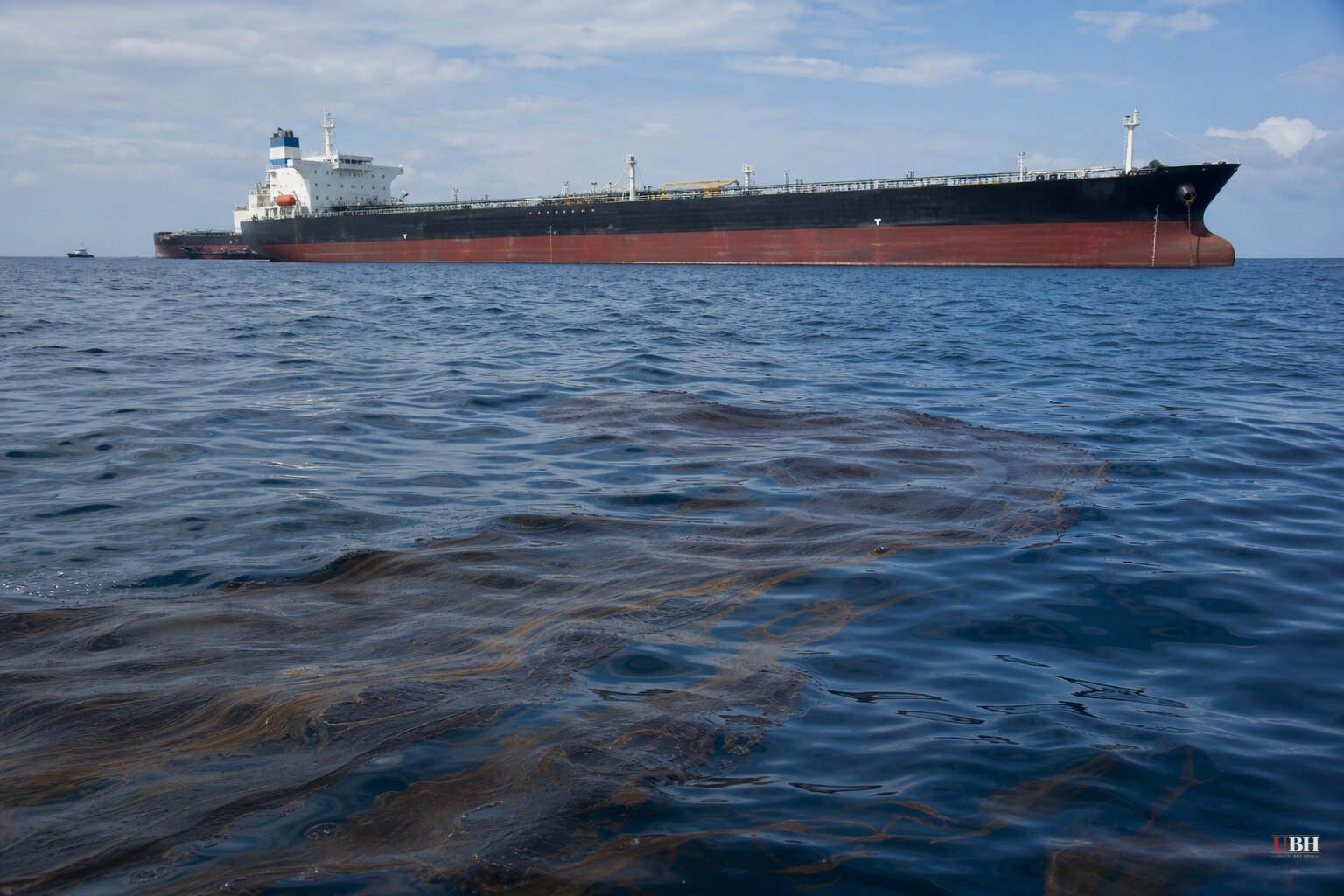
A tanker nobody officially owns is leaking oil nobody will pay to clean up, inside a whale sanctuary Oman's sultan created less than a year before it ran aground.
The ship is the Caroline Bezengi, a 2001-built Suezmax that loaded roughly 800,000 barrels of Russian Urals crude at Novorossiysk on May 11, headed for Sikka, India, according to Fortune. On June 8, an explosion flooded her engine room off southern Yemen. No group has claimed responsibility and no government has announced a conclusion on the cause, though Fortune reports security sources and Greenpeace have pointed to a possible limpet mine, unconfirmed.
The crew abandoned ship. On June 30 the Bezengi drifted onto the rocks at Al Qibliyah in Oman's Hallaniyat archipelago, inside a 667-square-kilometer marine reserve Sultan Haitham established by royal decree roughly eight months earlier to protect an endangered population of Arabian Sea humpback whales, Fortune reported.
The scale keeps growing
Oil reached the Omani mainland at Ras Madrakah. Oman's Environment Authority put the affected area at 390 square kilometers on August 10; two days later, satellite analysis from SkyTruth's John Amos put the figure above 2,000 square kilometers, per Fortune's reporting.
Al Jazeera reported that a salvage operation began around August 13, coordinated by the UK-based risk firm Ambrey working with Omani authorities. Ambrey's director of global response, Ed Wollaston, called it an "extremely challenging situation," complicated by the seasonal Khareef monsoon, and said specialist personnel had already boarded the vessel to stabilize its cargo.
Dmitris Maniatis of the maritime risk firm Marisks told Bloomberg Television cleanup alone could cost $200 million to $500 million, according to Fortune.
Why nobody's on the hook
The Bezengi's last registered owner, Rentoor Shipmanagement Ltd, was incorporated in the Marshall Islands on September 16, 2025, and dissolved on February 24, 2026, according to maritime intelligence firm Kharon. Its Shanghai correspondence address is a dead-letter box in a residential building, Maritime Executive reported.
The ship's operator, Lagosmarine Limited, was sanctioned by the U.S. Treasury Department back on January 10, 2025. The EU sanctioned the Bezengi itself on October 24, 2025. The vessel flew flags from Cameroon, Palau, and Liberia at various points, per Al Jazeera. Cameroon suspended its international registry on February 6, 2026, after discovering its flag was being issued through two fraudulent websites, and told the IMO in June it had struck 39 ships from its rolls, Fortune reported.
No International Group club—the network insuring roughly 87% of the world's oceangoing tonnage—is likely to insure a ship without approved classification. The Bezengi had no publicly identified insurer at all.
Under the international system built after the Exxon Valdez and Prestige spills, Oman should be covered. It's a party to the 1992 Civil Liability Convention and the 1992 Fund Convention, backed by the International Oil Pollution Compensation Fund, which can pay up to roughly $279 million per incident. But Al Jazeera reported the Fund has said it will not be involved in the cleanup because it determined the incident likely resulted from an act of war, an exclusion built into the compensation treaties.
That leaves Oman facing a nine-figure bill with no registered owner to sue, no insurer to claim against, and a compensation fund that has opted out.
The bigger pattern
The Bezengi isn't an isolated glitch. The American Action Forum, a center-right policy shop, estimated the global shadow fleet moved about 3.7 billion barrels of oil in 2025, nearly 7% of global crude flows, allowing sanctioned regimes to preserve billions in export revenue through flag-switching, ship-to-ship transfers at sea, and shell-company ownership.
Kharon, a sanctions-research firm, framed the Bezengi case as a test. If the vessel's operator or an insurer eventually accepts financial responsibility, it could change the calculus for others doing business with dark fleet ships. If nobody pays and no government or court forces accountability, the incentive structure disappears. Analyst Grunewald asked what reason shadow fleet operators would have to carry real insurance going forward.
That question sits alongside a parallel enforcement push against Iran. Fox News reported Treasury Secretary Scott Bessent launched "Operation Economic Outcast" on a recent Sunday, promising a "zero-leakage approach" against Tehran's oil revenue, while President Trump separately announced what the Daily Wire called an "ECONOMIC D-DAY" targeting the shadow-banking networks, front companies, and ship-to-ship transfers that keep Iranian crude moving through China, the UAE, Malaysia, and Singapore.
Fox News noted the blockade has cut China's imports of Iranian crude to an estimated 534,000 barrels per day this month, down from roughly 823,000 in July, per provisional Kpler data cited by Reuters. But roughly 80 million barrels of Iranian crude already sit in floating storage beyond the blockade line, about half of it near Malaysia, meaning oil that escaped enforcement before the net tightened can still be sold.
Breitbart separately reported China is promoting an Arctic "Ice Silk Road" shipping route through Russia's Northern Sea Route as an alternative to chokepoints like Hormuz and the Suez Canal, though traffic remains small: 23 transits in 2025, limited to a July-to-October sailing window.
The common thread across all of it is a maritime enforcement system built on registries, insurers, and flags that sanctioned operators have learned to route around entirely. Oman's environmental authority has not announced who, if anyone, will ultimately cover the cleanup cost, and no court proceeding against Rentoor Shipmanagement or Lagosmarine has been reported.
Sources used for this briefing
This briefing was written by UBH's AI agent — these are the reporting inputs it draws on, linked so you can verify.


