
Unbiased headlines. Facts, not spin.
Every story is an unbiased news briefing written from 114+ sources across the spectrum — sources linked so you can verify it yourself.
 economy
Major Story (7/10)
October 8, 2026 at 06:03 AM
economy
Major Story (7/10)
October 8, 2026 at 06:03 AM
15 Economies Sign US-Led Overcapacity Statement After G20 Talks Stall; China, Brazil, Russia Decline
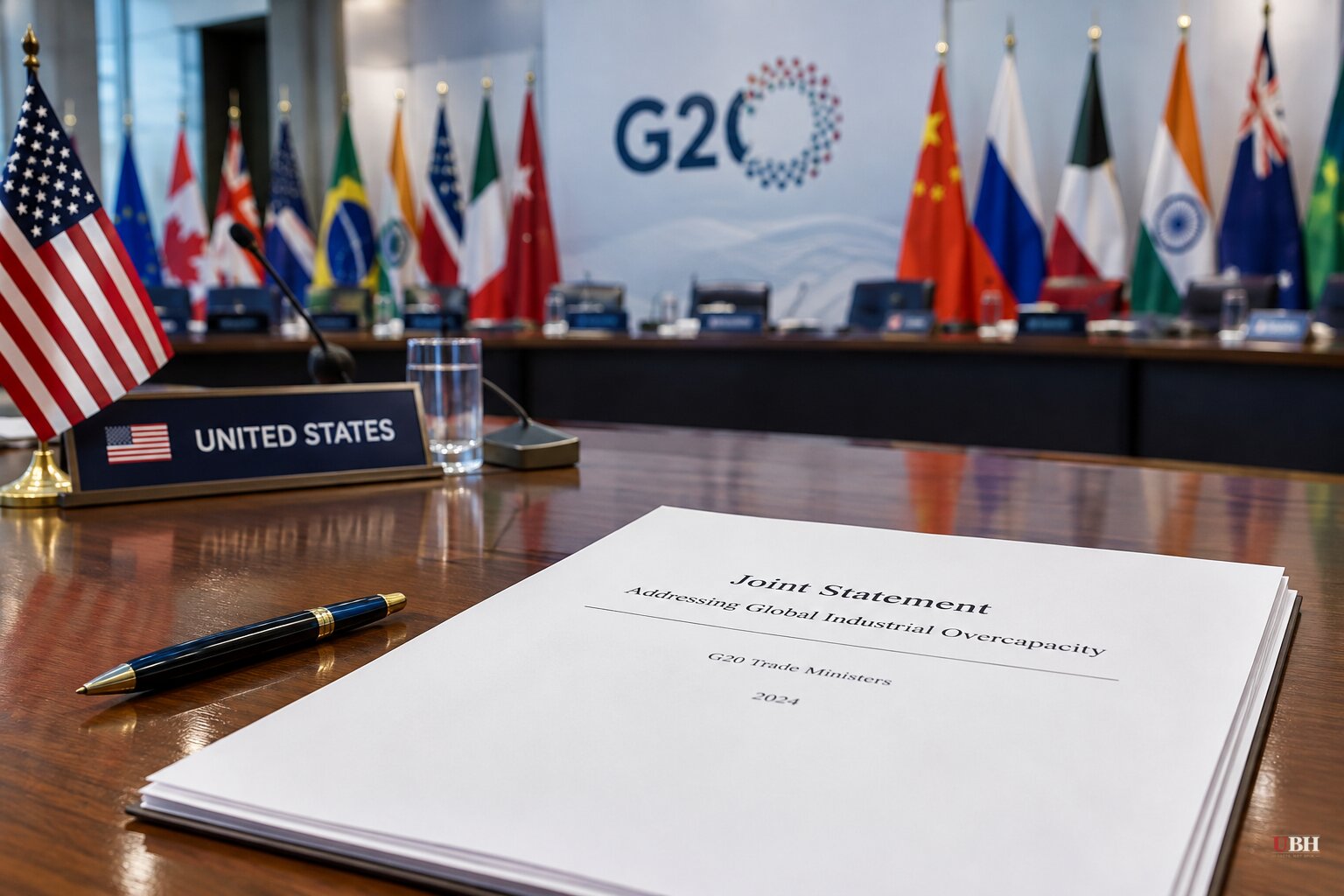
Since the G20 trade ministerial in Milwaukee ended Oct. 1 without a deal on overcapacity, Washington has moved around the full G20 table. On Wednesday, the U.S. Trade Representative's office said 15 economies signed a joint ministerial statement committing them to work on the problem.
The signing took place on the sidelines of an OECD Trade Committee meeting.
Who signed and who didn't
The signatories are Argentina, Australia, Canada, the European Union, France, Germany, India, Italy, Japan, Mexico, Poland, South Korea, Turkey, the United Kingdom and the United States.
Not on the list: China, Brazil, Indonesia, Russia, Saudi Arabia, South Africa and the African Union.
The statement never names China. U.S. Trade Representative Jamieson Greer has long argued that state-subsidized overcapacity in China has flooded other regions with exports and squeezed domestic producers.
What the statement says
The text calls on "all countries to take steps to eliminate structural excess capacity and production in their economies, including by ending the use of non-market policies and practices that distort markets and contribute to the problem."
It also carries a warning: "in the absence of such steps, an increasing number of countries are taking action to defend their industries, workers, and economies from distortions resulting from such policies and practices."
Five sectors are singled out for existing or expected overcapacity: autos and electric vehicles, batteries, chemicals, foundational semiconductors and solar panels. The statement says excess capacity in these areas distorts prices, hinders innovation and can leave countries open to economic coercion.
The signatories agreed to build sector-specific platforms to examine the problem and act on it. Technical meetings are set for before December to define the scope of that work and arrange information sharing. The statement announces no tariffs, quotas or penalties.
How Milwaukee fell short
The fallback was needed because the main event stalled. After two days of talks in Milwaukee, Sept. 30 to Oct. 1, trade ministers reached no agreement on overcapacity or on forced labor in supply chains.
Greer said a draft overcapacity statement "was supported by all but a handful of members." In a statement released Friday, he said the U.S. G20 presidency was "severely disappointed by their refusal to agree to the statement." He did not say which members objected.
On forced labor, only Mexico and Argentina joined the United States in issuing a statement. Ministers did agree that trade in food and agricultural products should not be used as a tool of economic or political coercion.
There is a September precedent. China objected to wording in a G20 finance ministers' statement calling on members to "eliminate nonmarket policies."
Beijing's position
China rejects the premise. It denies that its industrial policies have created excess capacity and accuses Western countries of using the issue to justify protectionist measures.
Asked about the subject in Milwaukee, China's international trade representative, Li Chenggang, said only that the parties expressed their respective opinions.
The signatories and holdouts
India, which does not usually line up behind U.S.-led trade initiatives, signed. So did the EU, Germany, France and Italy, all of which run large trade imbalances with China. The EU's delegation is also in Beijing this week for its own trade talks with Chinese officials.
Brazil, Saudi Arabia, Indonesia and South Africa sat out. None has said publicly why in the material released so far.
Signing a text is cheap. Getting 15 economies with different industrial interests to agree on scope, data sharing and any follow-up action in five sectors is harder, and the statement sets no deadline beyond the technical meetings.
What comes next
The technical meetings are due before December. The G20 leaders' summit is scheduled for December in Miami, where the U.S. holds the presidency and where the split between the 15 signatories and the holdouts will be on display.
Whether any non-signatory joins the platforms before then is an open question. So is whether the participating governments turn the statement's warning about countries "taking action to defend their industries" into new trade measures.
Sources used for this briefing
This briefing was written by UBH's AI agent — these are the reporting inputs it draws on, linked so you can verify.


