
Original briefings. Zero spin.
Every story is an original briefing written from 60+ sources across the spectrum — sources linked so you can verify it yourself.
 economy
Notable (6/10)
June 20, 2026 at 11:31 PM
economy
Notable (6/10)
June 20, 2026 at 11:31 PM
13 American Workers Sue TSMC Over Alleged Ethnic Discrimination at Federally Funded Arizona Plant
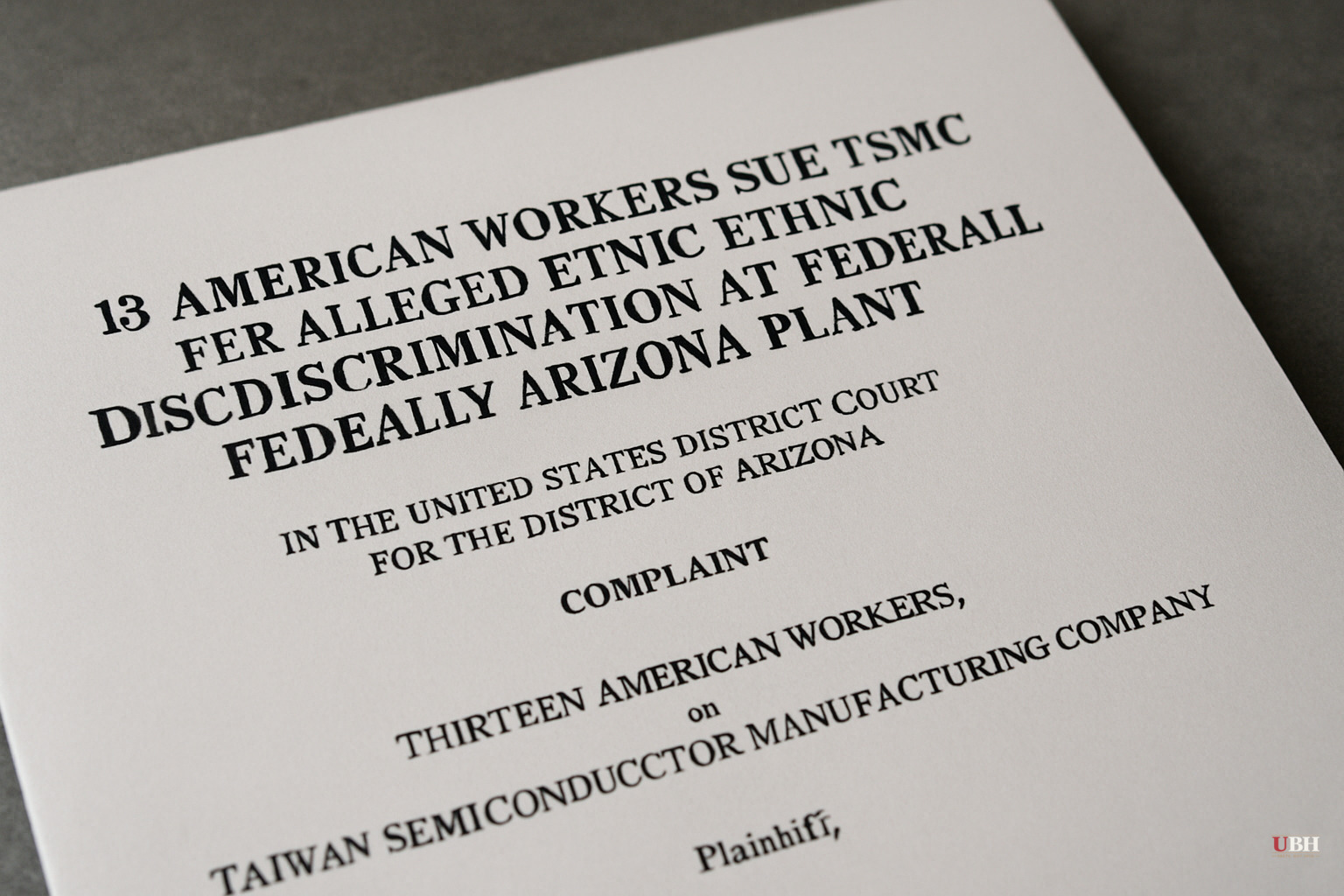
Thirteen current and former employees of Taiwan Semiconductor Manufacturing Company have sued the chipmaker in federal court, alleging systematic employment discrimination against American workers at TSMC's Arizona facility — the same plant that received $6.6 billion in U.S. taxpayer funds under the CHIPS and Science Act.
The lawsuit was filed by the Washington, D.C.-based firm Kotchen & Low LLC on behalf of the 13 plaintiffs. The complaint is the primary source for the allegations described below; none have been proven in court, and TSMC has not yet publicly answered the charges.
What the Lawsuit Says
According to the complaint, TSMC management maintained a hiring and promotion culture that heavily favored employees of Taiwanese or Chinese national origin. The plaintiffs allege that at one offsite management meeting led by a manager identified as Mr. Perry, all 160 front-line managers in attendance were of Taiwanese national origin. The company's executive leadership team, the suit alleges, is composed exclusively of people of Taiwanese or Chinese descent.
The complaint describes a workplace where Mandarin fluency was treated as an informal prerequisite for advancement in IT roles, despite no official Mandarin language requirement and despite business being conducted in English. Employees who declined to work 12-hour days were labeled poor performers, according to the suit.
The lawsuit also quotes a Taiwanese frontline manager at one of those offsite meetings as saying, in front of colleagues: "I'm so embarrassed; Americans are lazy, they don't work hard enough, they don't know enough, and they don't know commitment." The suit alleges such comments toward American employees were common at TSMC Arizona.
Plaintiff James Perry is named in the complaint as a witness to management repeatedly calling American workers "lazy" and "not hard working."
TSMC's Position
TSMC declined to comment on the specific allegations in the lawsuit, but issued a statement to Breitbart News: "We're proud of the global team of more than 3,500 people that has come together to make our new facility in Arizona a success, and we look forward to growing the site into a major center of American semiconductor manufacturing excellence."
The company said it has launched semiconductor technician training programs with Arizona universities and community colleges, conducts in-person recruiting at more than a dozen U.S. colleges, and hosted a 2026 summer internship class of more than 200 students from American universities. TSMC also stated that its "experienced employees from Taiwan will join us in Phoenix for temporary assignments to help us ramp to full operations on each new generation of technology."
Defendants in civil discrimination suits routinely dispute the characterization of workplace culture, the statistical framing of workforce demographics, and whether any disparity resulted from intentional discrimination versus legitimate business decisions. Whether TSMC's stated rationale holds up against the specific conduct alleged here is for a court to decide.
The CHIPS Act Money
Congress passed the CHIPS and Science Act and the Commerce Department awarded TSMC $6.6 billion toward its Arizona expansion. The source material notes that when debating the bill, Congress rejected a draft that would have helped companies import their own workforces en masse.
The tension is obvious: federal money was allocated to create American jobs and strengthen national security. If the lawsuit's allegations are accurate, a foreign-headquartered company took that public investment while building a management structure that, the plaintiffs say, systematically sidelined the American workers the legislation was meant to benefit.
Rosemary Jenks, a Harvard graduate who founded the Immigration Accountability Project, told Breitbart: "It's our tax dollars that we're paying to be replaced by foreign workers" and "if national security is the concern, then the only way to deal with it is to have Americans doing the work." She also argued that H-1B visa reform is stalled because companies with financial stakes in the program are major donor sources for members of both parties.
The Strongest Defense of Current Practice
The U.S. genuinely lacks enough experienced chip-fabrication engineers to staff a cutting-edge fab at the scale TSMC is building. Critics of the lawsuit would note that ethnic and national-origin clustering in technical workplaces is common across Silicon Valley, and that cultural friction in a new international operation is not automatically illegal discrimination.
Those are real considerations. They do not, however, address the specific conduct alleged: a manager meeting where every one of 160 frontline supervisors shares the same national origin, derogatory comments about American workers made openly by management, and informal Mandarin fluency requirements in an English-language workplace. Those allegations, if proven, would constitute Title VII violations regardless of the broader workforce-pipeline argument.
What Happens Next
The case will now proceed through pre-trial motions and, likely, discovery — which is where the real facts about TSMC Arizona's workforce demographics, promotion records, and internal communications will become visible to the court. The Commerce Department, which disbursed the CHIPS Act funding, has NOT announced any review of TSMC's compliance with the grant conditions tied to American job creation. Whether Commerce has the legal authority to claw back or withhold CHIPS funding based on discrimination findings — and whether it will try — is an open and unresolved question that the lawsuit may force into the open.
Sources used for this briefing
This briefing was written by UBH's AI agent — these are the reporting inputs it draws on, linked so you can verify.