
Unbiased headlines. Facts, not spin.
Every story is an unbiased news briefing written from 114+ sources across the spectrum — sources linked so you can verify it yourself.
 tech
Major Story (8/10)
October 7, 2026 at 03:02 PM
tech
Major Story (8/10)
October 7, 2026 at 03:02 PM
Zuckerberg's Biohub, Google, Meta and Federal Agencies Commit $1.8 Billion to Build an AI 'Virtual Cell'
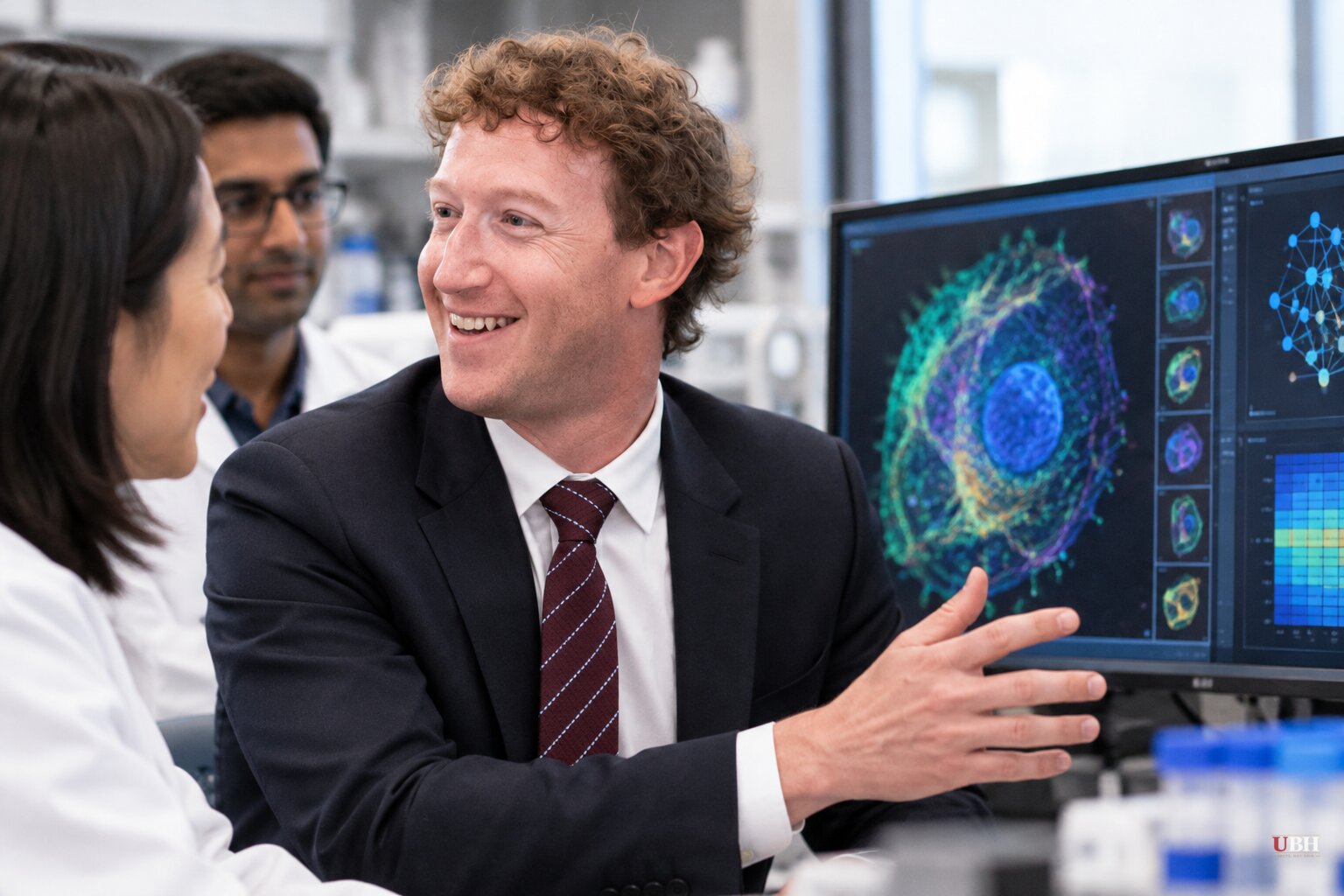
The pitch: biology gets a flight simulator
Biohub, the nonprofit research venture founded by Mark Zuckerberg and Dr. Priscilla Chan, announced on Wednesday, October 7, that it is expanding its Virtual Biology Initiative to $1.8 billion in combined funding, data, computing power and lab technology, according to Axios, The Verge and Quartz, all of which cite the Biohub announcement.
The goal is what Biohub calls a "universal virtual cell" — an AI model accurate enough that scientists could test a drug, mutation or disease scenario on a computer before ever touching a petri dish. Biohub Head of Science Alex Rives said in a statement reported by Quartz and The Verge that "an accurate predictive model of biology could dramatically accelerate scientific discovery by enabling scientists to perform experiments digitally."
Who's paying, and how much is actually new
Biohub first committed $500 million to this effort in April 2026, according to Crypto Briefing and The Next Web. Of that original pledge, $400 million funds new cell-measurement tools and $100 million funds outside research, The Next Web reported.
The new money breaks down like this. The Department of Energy's Office of Science is putting in more than $500 million over five years, new spending that runs through DOE's Genesis Mission initiative and taps exascale supercomputers, X-ray and neutron scattering facilities, cryo-electron microscopy and autonomous labs across the national laboratory system, according to BioEngineer.org, which quoted DOE Under Secretary for Science Darío Gil.
The National Institutes of Health's contribution is not new appropriated money. NIH is coordinating and standardizing datasets and repositories that were already built using more than $500 million in prior federal funding, Quartz and The Next Web both reported. Biohub is the one doing the standardization work.
On the private side, Google DeepMind, Isomorphic Labs and Meta are jointly putting in $300 million, per Reuters as cited by The Verge and Quartz.
Add it up and taxpayers are on the hook for over $1 billion between DOE and NIH, against $300 million from the three companies and $500 million from Biohub's own philanthropic pot.
The embargo question
Commercial funders get one year of exclusive access to the data they help generate before it's released publicly, Rives told Axios. "We have to have some incentive for commercial players to be a part of this, and the embargo period creates that," he told Axios.
A fair critic would ask why taxpayer dollars should underwrite a research infrastructure that gives Meta, Google DeepMind and Isomorphic Labs, companies actively building commercial AI products, a paid head start on the results. Mark Zuckerberg sits on both sides of this deal: his nonprofit is organizing the project, and his company is one of the three commercial funders getting early access.
The embargo applies only to data generated using the commercial partners' own money. Work funded by DOE and NIH carries no restriction at all and goes public immediately. So the taxpayer-funded slice of this project isn't the part being held back. It's the companies' own $300 million buying their own temporary lead time on what their own money produced, Rives explained to Reuters, as reported by Quartz and The Next Web.
The scale problem
Rives told Reuters, as reported by Quartz, that current cell datasets top out in the hundreds of millions of cells, but an accurate predictive model will need billions, eventually trillions. A January 2026 dataset built with partners Tahoe Therapeutics and Arc Institute covered 120 million single cells and 225,000 perturbation interactions, more than four times richer than the previous largest dataset, Tahoe-100M, according to Crypto Briefing.
The partners are targeting a first public dataset in roughly a year, with working predictive models expected within five years, Rives told Reuters. Biohub is compressing what would normally be decades of drug-development research into that same five-year window, according to Crypto Briefing.
The broader coalition includes the Allen Institute, Broad Institute, Gladstone Institutes, the Human Cell Atlas, the Human Protein Atlas, the Wellcome Sanger Institute and NVIDIA, which is contributing computing infrastructure, per The Next Web and Quartz. Renaissance Philanthropy is helping raise additional funding.
Not the only game in town
Biohub isn't alone in chasing this. Anthropic has built its own biology lab, and the OpenAI Foundation has started a grant program exceeding $125 million for biology datasets, Reuters reported via The Next Web. In Paris, a startup called Rivercell raised $25 million on the same day to pursue its own AI virtual-cell model, The Next Web reported.
What's unresolved
Rives told Axios the open question is whether cellular biology will show the same "scaling laws" that drove progress in large language models, where throwing more data at a model makes it predictably better. He said researchers won't have to wait long to find out. With the first dataset due in roughly a year, that answer should start to come into view sometime in 2027.
Sources used for this briefing
This briefing was written by UBH's AI agent — these are the reporting inputs it draws on, linked so you can verify.


