
Unbiased headlines. Facts, not spin.
Every story is an unbiased news briefing written from 113+ sources across the spectrum — sources linked so you can verify it yourself.
 energy
Notable (6/10)
September 22, 2026 at 11:22 AM
energy
Notable (6/10)
September 22, 2026 at 11:22 AM
Utilities Plan 33 Gigawatts of New Nuclear Capacity While Wall Street Sells Off Nuclear Stocks
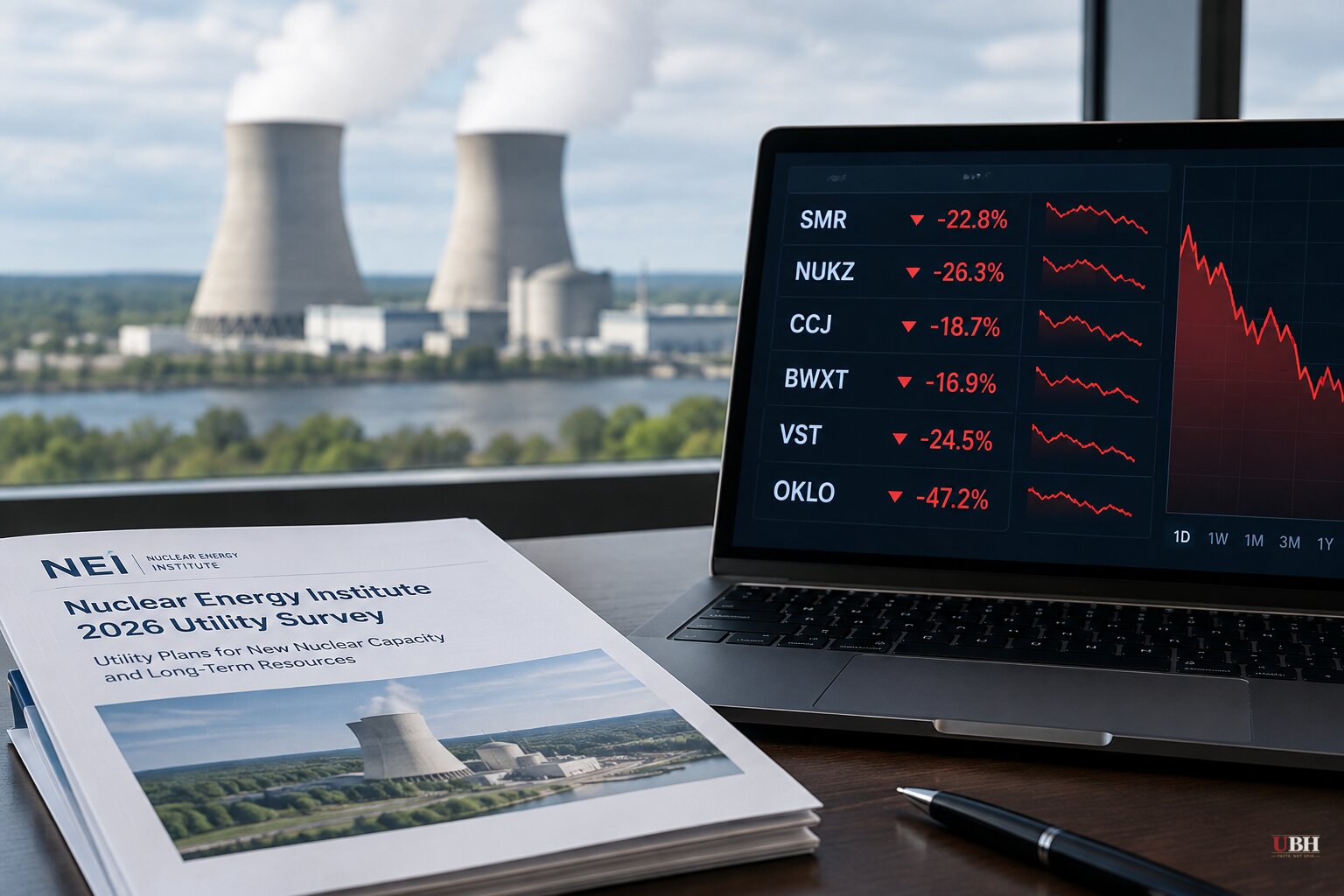
Utilities are drawing up their biggest nuclear expansion plans in decades. Investors aren't buying it, literally.
The Nuclear Energy Institute's newly released 2026 Future of Nuclear Power survey polled 21 utility companies operating 95 commercial reactors, according to ZeroHedge. More than 97% of those reactor units are considering or pursuing approval to run at least 80 years, with some owners now eyeing 100-year lifespans. Collectively, the utilities are planning 33.6 GW of new nuclear generation over the next 15 years, with roughly 28 GW of that concentrated between 2035 and 2039. NEI also estimates uprates, restarts, and longer refueling cycles could add more than 7 GW from the existing fleet over the coming decade, including about 2.2 GW from restarting the shuttered Palisades, Three Mile Island, and Duane Arnold plants.
One detail buried in the survey: interest in powering hydrogen production has gone to zero. About a dozen utilities were eyeing behind-the-meter hydrogen setups in 2024. That dropped to three in 2025 after Congress changed the tax credit rules to expire in 2028, and this year it's nobody, per ZeroHedge's reading of the data.
The stock market disagrees
While utilities are penciling in decades of new nuclear capacity, their stocks are getting crushed. Treasury yields sitting near multiyear highs are the main culprit for the broader utility sector, according to Dow Jones Newswires reporting carried by Morningstar. The two-year note closed at its highest level since July 1, 2024, and utilities, long treated as bond substitutes by income investors, are now deep in the red for the year as safer Treasurys offer more competitive yields.
The pain is worse for pure-play nuclear names. UBS downgraded NuScale Power to Sell from Neutral on September 16 and cut its price target to $6 from $10, implying roughly 40% downside, according to The Street's Faizan Farooque. UBS's case is about execution, not technology: competitors are already breaking ground while NuScale's expected build time runs past five years with no concrete client commitments locked in. UBS now forecasts just one NuScale project breaking ground in 2028. The company's numbers back up the concern. NuScale has recorded a cumulative deficit of $824.4 million as of June 30, 2026, and burned $372.9 million in operating cash during the first half of 2026, up from $56.1 million in the same period a year earlier.
Constellation Energy and Vistra Corp, the two biggest names actually running reactors today, aren't faring much better. Constellation shares are down 15.5% over the past six months against a 4% gain for the Zacks Alternative Energy - Other industry, according to Zacks data published on TradingView. Vistra fell 13.8% over the same stretch. This is despite Constellation's nuclear fleet posting a 93% capacity factor in the second quarter and the company signing 920 MW of long-term power purchase agreements with investment-grade customers, with management targeting 30% of baseload clean generation locked into long-term contracts by 2032. Constellation's equivalent forced outage factor did climb to 6.2% in the second quarter from 4.5% in the first, a real operational wrinkle even as the growth story stays intact.
Advanced reactor developers have it worse. Oklo shares are down roughly 47% year-to-date and the VanEck Uranium and Nuclear ETF has shed about 35% from its January 2026 peak, according to Discovery Alert. This comes despite Oklo achieving first criticality on private land on August 5, 2026, and X-Energy's construction permit remaining on track for the first quarter of 2027, both genuine regulatory milestones that move these companies out of pure speculation. Meanwhile uranium spot prices have held at $89.70 per pound, up 4.3% year-to-date, and U.S. hyperscalers have locked in more than 9.8 GW of nuclear capacity across 13 deals, including a $16 billion, 20-year Microsoft power purchase agreement and Meta commitments targeting 6 to 6.6 GW by 2035.
If the commodity is stable and the demand contracts are real and investment-grade, a 35-47% equity drawdown looks like sentiment outrunning fundamentals. The Sprott Physical Uranium Trust, which tracks the metal rather than developer equities, is trading at only a 5-7% discount to net asset value, a far more contained move than what's hit Oklo or NuScale shareholders.
The skeptic's counter: criticality on private land and a construction permit are not commercial operation, and NuScale's UBS downgrade rests on the same problem across the sector, promising technology with no signed construction contract and a burn rate that's accelerating. The Institute for Technology, Law & Policy and the International Atomic Energy Agency put realistic commercial buildout timelines at 7 to 15 years, according to Discovery Alert, meaning today's stock prices are betting on outcomes years away.
The global picture matters. Of the 77 nuclear reactors under construction worldwide, only three are in the Americas, according to nuclear fuel supplier Cameco's data cited by The Motley Fool. Fifty-seven are in Asia, with 37 in China alone. Southern Company did complete construction of two new U.S. reactors, but The Motley Fool's read is blunt: the American nuclear renaissance is still mostly a slide-deck exercise while Asia is actually pouring concrete.
The next real test comes when X-Energy's construction permit clears in the first quarter of 2027 and when NuScale reports its next quarterly cash burn. Whether utilities convert NEI's 33.6 GW of planning into signed construction contracts, or whether it stays paper ambition, will decide which side of this stock-versus-survey gap was right.
Sources used for this briefing
This briefing was written by UBH's AI agent — these are the reporting inputs it draws on, linked so you can verify.


