
Unbiased headlines. Facts, not spin.
Unbiased Headlines is an independently owned news organization. We bring you the facts, not opinions, written fresh from 110+ named sources. Sources linked so you can verify it yourself.
 energy
Notable (6/10)
Utilities Demand Collateral and Longer Contracts From Data Center Developers as Wood Mackenzie Rates Only 23% of Requests High Confidence
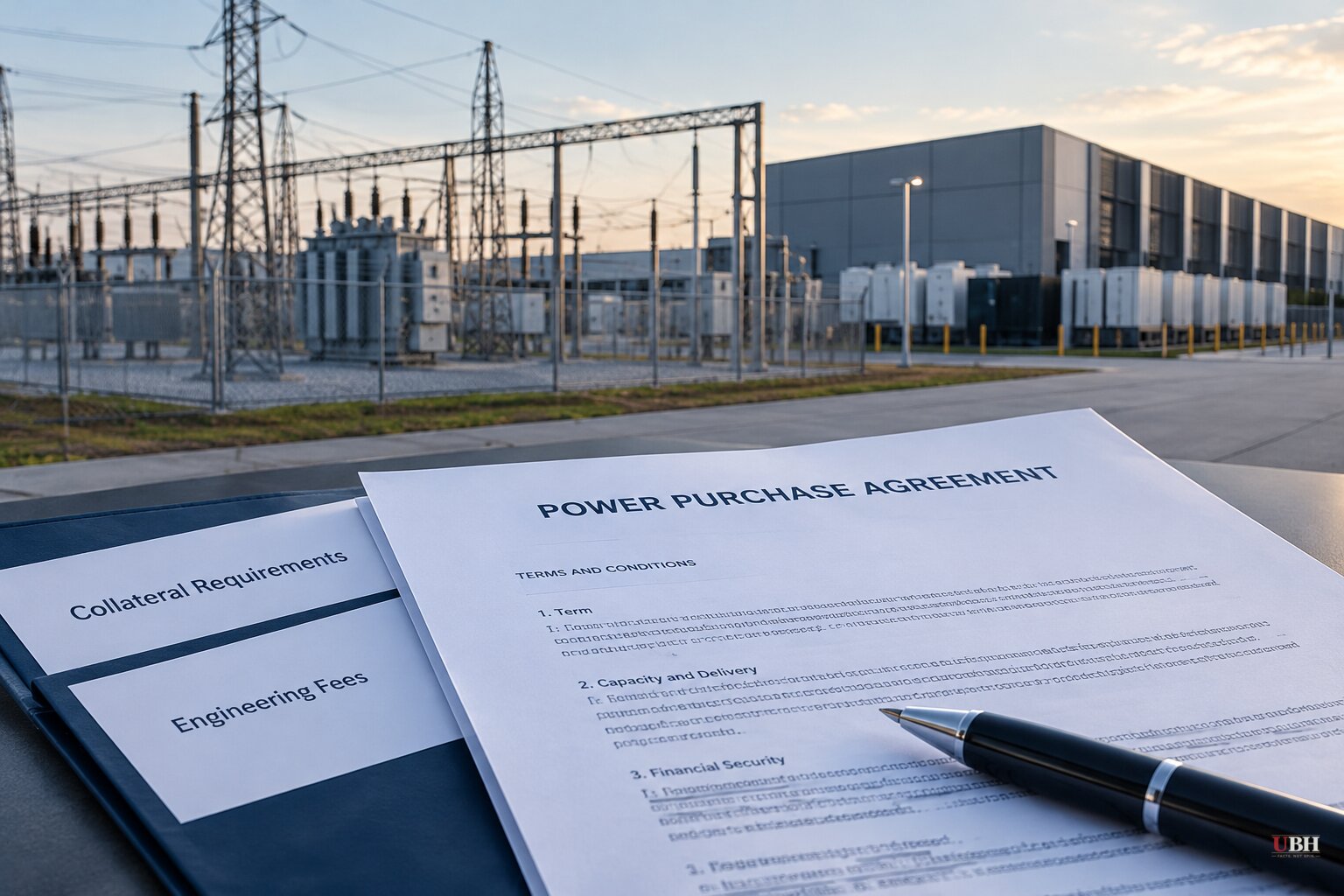
Electric utilities are no longer taking AI data center requests at face value.
Across the country they are demanding binding financial commitments, collateral and steep engineering fees before they will study a grid connection. The goal is to separate real projects from what the industry calls "phantom" data centers.
The paper pipeline
Wood Mackenzie, a research firm, puts only 23% of disclosed data center requests in its high-confidence category. The rest is speculation.
Jeanne Jones, executive vice president of finance and strategy at Exelon, says inquiries began ballooning in 2024 and the individual asks got bigger. A typical request used to be about 50 megawatts. Now developers ask for 1,000 megawatts or more, roughly the output of a large nuclear reactor.
Exelon used to study each project alone. After service requests from large customers tripled to 18,000 megawatts, it began studying them in clusters.
Then it required binding commitments and collateral. The high-probability list fell from 18,000 megawatts to 11,000, and the remaining projects posted roughly $1 billion in collateral.
"It did kind of help weed out the speculative projects," Jones said. "It might not be glamorous. Hey, our pipeline went down from 18 to 11. Investors are like, Wait, why? But it's the smart thing to do."
Who pays if the customer walks
Jones framed the stakes in ratepayer terms. "If we build out the grid and then that data center walks away, someone's got to pay for it and that's not fair to them," she said.
Contracts are getting longer too. Average minimum contract length for large customers has reached about 10.8 years since 2024, up from roughly 4.6 years before, according to utility filings aggregated by the AI startup Halcyon.
Texas is where the strain is sharpest. Cleanview, which tracks data center development, counts about 12,800 megawatts of projects under way in the state. The connection queue has swelled past 400,000 megawatts. The Wall Street Journal reported that Gov. Greg Abbott, a Republican, has paused grid connections and environmental permitting for data centers.
Forecasts point in two directions
The skepticism about phantom projects sits awkwardly beside the survey data. A global survey commissioned by Adipec, Abu Dhabi's annual energy conference, found that 81% of energy industry insiders expect AI-driven electricity use to exceed existing projections. Thirty-two percent expect it to be significantly higher. Only 3% expect it to come in below forecasts.
The International Energy Agency expects data centers to consume about 950 terawatt-hours of electricity by 2030, roughly double the 2025 level, according to figures cited in the Adipec report. Dr. Sultan Al Jaber, the UAE's industry minister and Adnoc's group chief executive, has said data center electricity needs could increase fivefold by 2040.
Both things can be true. Demand can be real in aggregate while a large share of individual requests never become buildings. Utilities are betting that collateral is the best way to tell the difference.
The pressure is not limited to data centers. Factories are returning to the United States, and transport, buildings and industry are leaning more on electricity. For decades, U.S. demand was relatively flat, and the grid was built around that.
Vendors line up with fixes
Equipment and software makers say they have answers. NVIDIA says more than $300 billion in power equipment is backlogged and over 200 gigawatts of projects are waiting in U.S. interconnection queues. NVIDIA sells the chips driving the demand, so those figures come from an interested party.
Its DSX platform is meant to plan the grid and the AI facility as a single system. GE Vernova, Hitachi Energy, Schneider Electric and Siemens Energy are among the companies building around it. NVIDIA says Emerald AI's software could unlock up to 100 gigawatts on the existing U.S. grid, a modeled figure rather than a measured one.
Earlier this month, Schneider Electric agreed to acquire Boston-based industrial software maker PTC for $22.6 billion. It would be the largest acquisition in Schneider's history, topping its $11 billion purchase of Aveva in 2023, and its third deal of more than $1 billion this year.
Utilities are using AI on the grid, with limits
Utilities are also adopting AI themselves. Executives told Utility Dive the tools are mostly niche aids for load forecasting and vegetation management, with humans still making the decisions.
Rick Lesley of QualityAI said evidence of consistent performance at scale "remains limited."
Regulators are watching. The Federal Energy Regulatory Commission, in a cybersecurity audit of critical infrastructure entities released earlier this month, flagged increasing use of AI tools and warned their "evolving capabilities may introduce access control risks."
Guardrail Technologies, which sells AI security and governance software, reviewed federal filings. It found roughly 70% of energy and utility companies identified AI as a cybersecurity risk, but only 23% of utilities and 9% of energy companies documented a process for managing it. "Most utilities could not reconstruct what an AI system read, what it did and why," said CEO T.J. Marlin.
New York regulators have directed utilities to file inventories of their AI use. On Oct. 13, Connecticut Attorney General William Tong and Consumer Counsel Claire Coleman petitioned state regulators to open a similar review.
The conversation continues at Adipec, where AI and electricity are a central theme. The conference is scheduled for Nov. 2 to Nov. 5 at the Adnec Centre in Abu Dhabi.
Sources used for this briefing
7 links from 5 independent newsrooms (syndicated copies of the same report count once)
These are the sources it draws on, linked so you can verify.


