
Unbiased headlines. Facts, not spin.
Unbiased Headlines is an independently owned news organization. We bring you the facts, not opinions, written fresh from 110+ named sources. Sources linked so you can verify it yourself.
 economy
Breaking / Critical (9/10)
USTR Proposes Section 301 Tariffs on 14 Economies, With China Facing 20% Extra and Mexico, Norway Spared
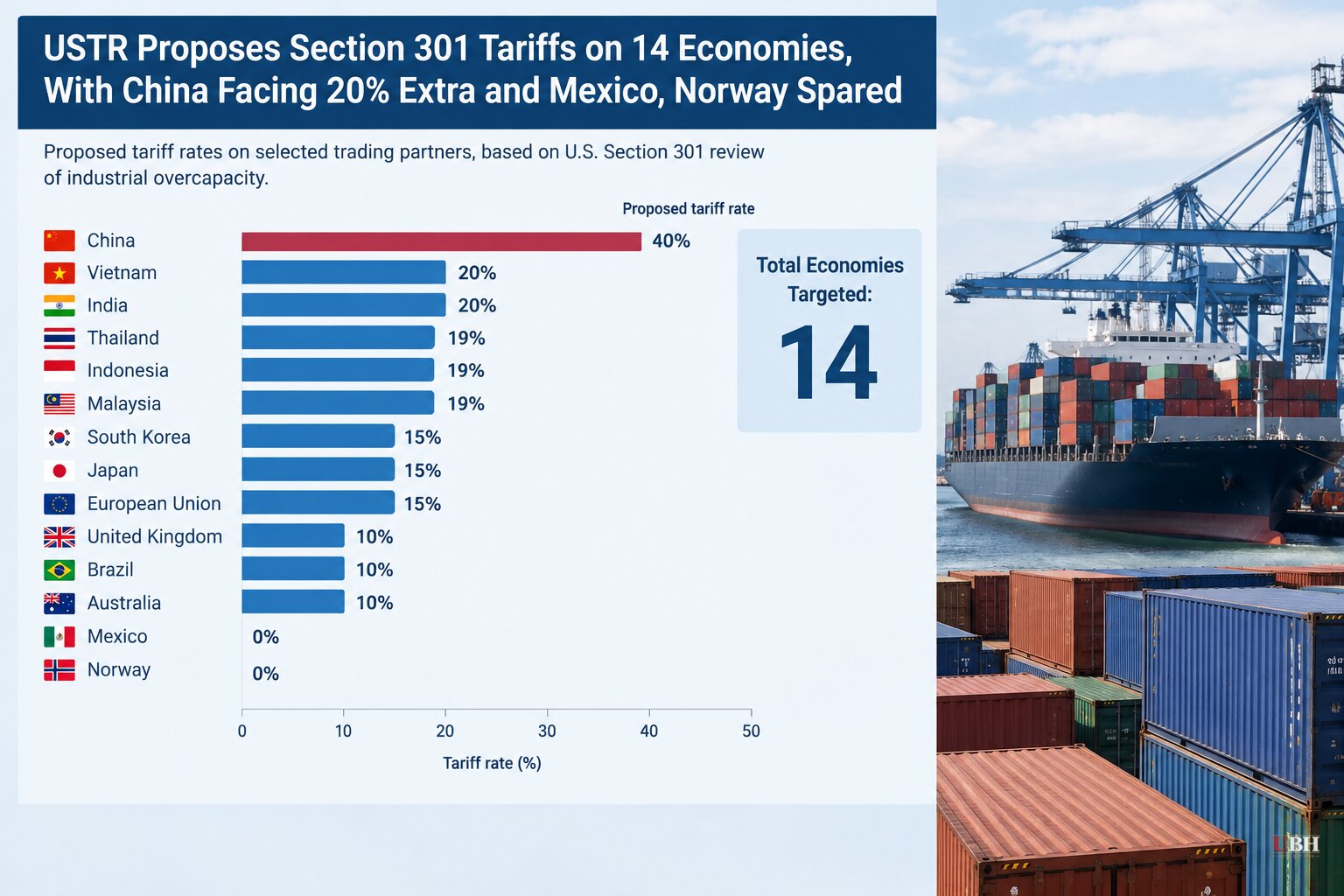
The tariff plan that had been circulating for two days is now official. On Wednesday, Nov. 25, the U.S. Trade Representative's office proposed new duties on 14 trading partners, ending an eight-month Section 301 probe that Jamieson Greer opened in March.
The targets are China, Bangladesh, Cambodia, the European Union, India, Indonesia, Japan, South Korea, Malaysia, Singapore, Switzerland, Taiwan, Thailand and Vietnam. The probe covered 16 partners. Mexico and Norway were left off "for the time being," a senior U.S. official said.
What the USTR is proposing
The official said each of the 14 "creates, sustains, or contributes to structural excess capacity and production in manufacturing sectors through various acts, policies, and practices that we find to be unreasonable and burden or restrict US commerce."
The USTR defines the term as production and capacity "divorced from the realities of demand and market principles." That includes industrial policy, subsidies and the use of components from non-market economies.
China would face the highest rates. The proposed 20% excess-capacity duty would sit on top of the roughly 25% tariffs imposed in Trump's first term. The official said that keeps China above the 20% proposed for Vietnam. The Associated Press reported that some Chinese goods would reach a combined 45%.
The China rate could climb to 40% if Beijing fails to uphold the trade truce reached in Busan, South Korea, in October 2025, according to CNBC. Tariffs on Chinese exports were cut to 47% after that deal.
The stacking rules
The plan is built around limits. The official said the duties would not exceed the caps in deals the administration already struck. Those include 15% for the EU, Japan, South Korea and Taiwan, 19% for Malaysia, and a 20% cap for China under the truce.
The new duties would not stack on the 10% or 12.5% tariffs imposed in July on 60 economies over alleged lax enforcement of forced-labor rules. Where both apply, the higher rate prevails. They also would not stack on sector tariffs such as those on autos and steel.
About $30 billion in Chinese imports that the U.S. is weighing for tariff cuts through a bilateral process called the Board of Trade are exempt.
Reuters noted that these limits suggest many countries may not see a big jump in the cost of selling to the U.S.
Brazil gets separate treatment
According to the Associated Press, the official said Brazil was singled out for extra punishment after trade talks stalled. The U.S. is proposing higher import taxes on raw and refined sugar and a new 10% tariff on aircraft, which would hit Embraer, Brazil's largest aircraft maker.
Beijing's response
China rejects the premise. Foreign Ministry spokesperson Guo Jiakun said before the USTR reports were released: "The so-called 'overcapacity' is a false issue, and China opposes using it as an excuse for political manipulation." The ministry also said the overcapacity "does not really exist."
Beijing restated its opposition to trade wars but did not threaten retaliation. The U.S. official said Washington does not expect China to retaliate.
"We know that they don't like these actions, but we are seeking stability with the Chinese. China is seeking stability with us," the official said. The official called President Trump's meeting with Xi Jinping last week "really great."
The legal backdrop
The Supreme Court struck down Trump's tariffs under the International Emergency Economic Powers Act in February. Trump then imposed a 10% global tariff under Section 122, and replaced it in July with levies of up to 12.5% on 60 economies under Section 301.
Those July duties and the new excess-capacity tariffs are widely viewed as a rebuild of the tariffs the court struck down.
ING analysts wrote that "while the legal justification for tariffs keeps changing, US protectionism is becoming increasingly difficult to unwind."
The politics have shifted too. A Reuters/Ipsos poll taken after the November midterm losses by Trump's Republicans found 62% of respondents would support efforts to repeal the tariffs.
The administration's counter is the case it has made since March. Greer and other officials say subsidized foreign output floods world markets with cheap goods and undercuts American manufacturers. They name steel, electric vehicles and solar products as examples.
What comes next
The rates are proposals, not final duties. They were to be published in a Federal Register notice on Wednesday, and public comment could push implementation into January, according to Reuters-based reporting.
The China truce expires Jan. 10. The plan could also prompt more trade talks, possibly on the sidelines of the G-20 summit in Miami in December. Whether Beijing treats the 20% as consistent with the truce cap, or as a breach, is the open question.
Sources used for this briefing
8 links from 8 independent newsrooms (syndicated copies of the same report count once)
These are the sources it draws on, linked so you can verify.
More coverage: China


