
Unbiased headlines. Facts, not spin.
Unbiased Headlines is an independently owned news organization. We bring you the facts, not opinions, written fresh from 110+ named sources. Sources linked so you can verify it yourself.
 economy
Major Story (8/10)
Third-Quarter GDP Revised Up to 4.3%, Fastest in Three Years, Beating Forecasts
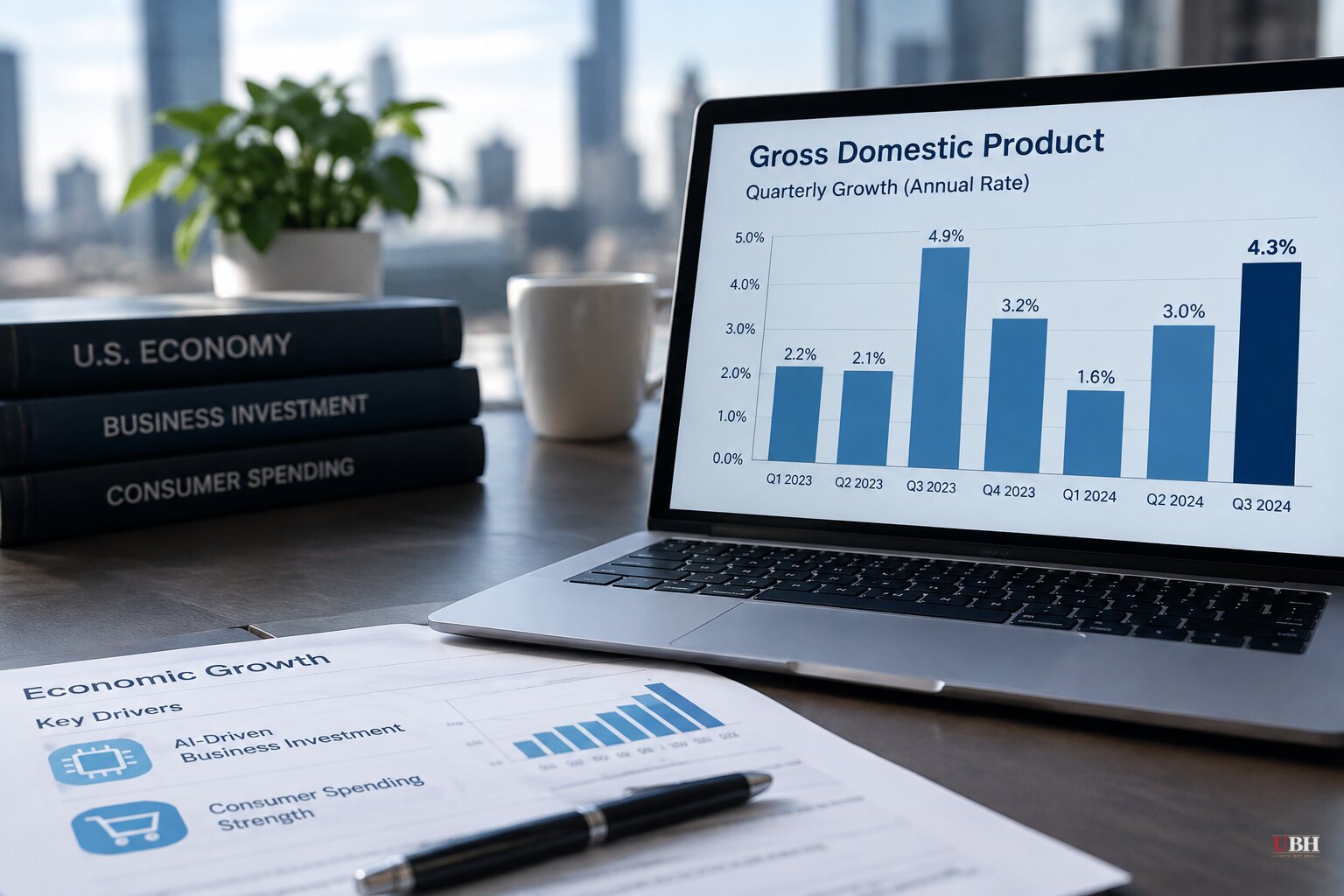
The U.S. economy grew at a 4.3% annual rate in the third quarter, the Commerce Department's Bureau of Economic Analysis said today, Nov. 25. That is a sharp upgrade from the 3.4% first estimate and the fastest pace in three years.
Economists polled by Reuters had expected a revision to 3.5%. The 4.3% figure is nearly double the second quarter's 2.2% rate. First-quarter growth was 2.1%.
Where the upgrade came from
Two pieces of the report did most of the work: consumer spending and business investment.
Consumer spending, about two-thirds or more of the economy, grew at a 4.2% rate. The earlier estimate was 3.8%. Households spent more on prescription drugs, software and computer accessories, and gasoline than first estimated. The government cut its estimate for spending on services, mainly health care.
Business fixed investment grew 16.1%, up from 12.7%. Equipment spending rose 21.8%, up from 20.9% last month. Structures rose 9.5%. Software drove much of the revision after the government folded in revised software price data. Housing investment fell 3.4%.
This is the third straight quarter of double-digit business investment growth.
Final sales to private domestic purchasers, which strip out inventories, government and trade, rose at a 5.8% rate. That is up from 4.9% in the first estimate and the fastest since the second quarter of 2021.
The swing factors
Inventory building added 1.64 percentage points to growth. Trade subtracted 3.21 points as imports surged and exports fell. MarketWatch's Jeffry Bartash wrote that much of the jump in imports was tied to equipment and technology for the AI buildout.
Government spending also rose sharply. Bartash attributed that to purchases of military equipment to replace stocks sent to Ukraine or used in the war with Iran.
The income side of the ledger agrees with the output side. Gross domestic income grew at a 4.4% rate, up from 2.3% in the second quarter. The average of GDP and GDI, which many economists treat as a better gauge of activity, also came in at 4.4%.
Corporate profits from current production rose by $206.0 billion in the quarter. In the April-June quarter they rose by $384.0 billion.
Inflation is the catch
The growth number landed alongside October's Personal Consumption Expenditures price index, the Fed's preferred inflation gauge. Prices rose at a 3.8% annualized rate, up slightly from 3.7% in September. The Fed's target is 2%. On a monthly basis, prices rose 0.3%, down from 0.5% in September.
Personal income rose 0.7% in October. Inflation-adjusted spending was flat. The saving rate rose to 4.1% from 3.6%, but it was 4.9% in October 2025. CNN reported that much of the income gain came from Medicare rebate payments.
Heather Long, chief economist at Navy Federal Credit Union, wrote in a note today: "The cautious consumer is back. It will be a bargain-hunting holiday for many Americans."
The Reuters analysis of the report also points to who is driving the spending. It is mostly higher-income households, whose wealth got a lift from the stock market before the recent AI-led selloff. Historically low layoffs and moderate hiring are helping other households keep spending. Wage gains have at times lagged inflation, and households are saving less and dipping into their nest eggs.
What comes next
The Fed is widely expected to raise interest rates at its Dec. 8-9 meeting. Inflation of 3.8% is nearly double target, and GDP data this strong gives the central bank little reason to hold back. A hike would raise borrowing costs for an economy that has so far absorbed them.
The AI investment trend carries its own risk. Economists cited by Reuters warned that business spending could slow as investors scrutinize AI valuations. Durable goods data show the spending carried into the fourth quarter: core orders, a key gauge of business investment, rose 1.2% in October. There are still about five weeks left in the quarter.
Most economists expect robust growth in 2027, according to MarketWatch. How much of that depends on whether the Fed has to raise rates sharply to bring inflation down is the open question heading into the December meeting.
Sources used for this briefing
7 links from 6 independent newsrooms (syndicated copies of the same report count once)
These are the sources it draws on, linked so you can verify.


