
Unbiased headlines. Facts, not spin.
Unbiased Headlines is an independently owned news organization. We bring you the facts, not opinions, written fresh from 110+ named sources. Sources linked so you can verify it yourself.
 energy
Notable (6/10)
USGS Estimates Up to 96 Trillion Cubic Feet of Undiscovered North Slope Gas as Alaska Data Center Plans Advance
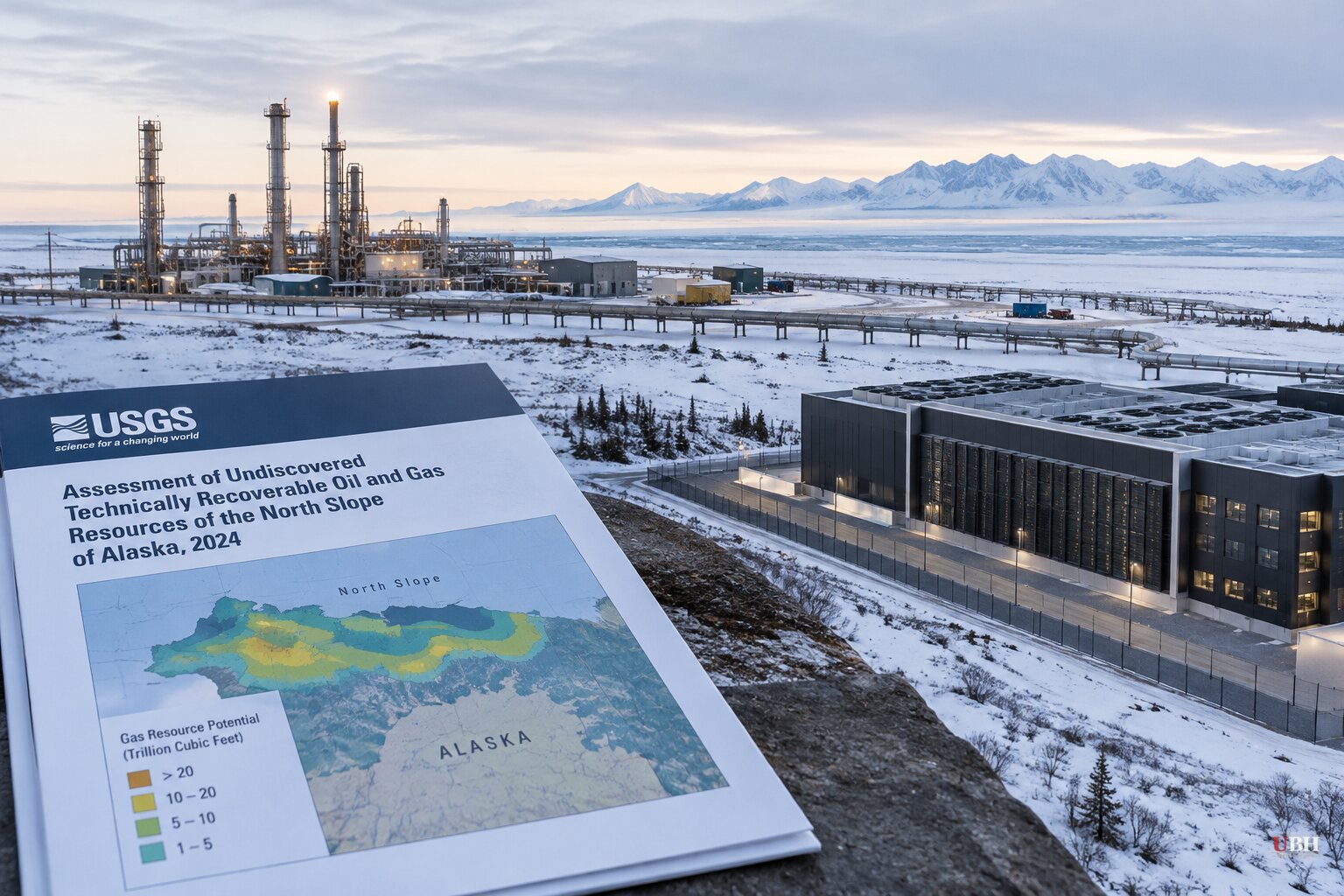
Alaska's pitch to the AI industry just got a bigger number behind it.
In October, the U.S. Geological Survey released its first assessment covering the entire North Slope. It estimates as much as 96 trillion cubic feet of technically recoverable, undiscovered natural gas. That is roughly three times the known gas reserves there.
Alicia Lindauer, the USGS Energy Resources Program coordinator, put it in national terms: "three years' supply for the U.S. at the 2025 rate of consumption."
What the estimate does and doesn't mean
The figure covers undiscovered gas that is technically recoverable. That is not proven reserves, and it says nothing about whether drilling it would pay.
No one has said how much of it will be developed. The Last Frontier LNG pipeline, a roughly $55 billion project to move North Slope gas to Anchorage and beyond, is still working through federal and financial hurdles. Its cost remains an early figure.
Project Aaka
The most concrete data center proposal is Project Aaka, from Alaska-based STAK Energy. It would be a 3-gigawatt, natural-gas-powered facility in an established industrial corridor on the North Slope. If built, it would be the largest data center in the state.
STAK recently announced a 15-year agreement with ExxonMobil Alaska Production Inc. to supply the gas. Alaska already has at least six operating data centers, and more projects have been announced or proposed.
Kay Zinngrabe, STAK's chief development officer, said the site will draw on fields that already produce. "The USGS estimate change adds further optimism for future expansion should demand for power generation continue to increase," she said.
The obvious question is whether the data center and the LNG pipeline would compete for the same gas. Zinngrabe said no. "The latest USGS gas estimates reaffirm there's enough North Slope gas to support both, and that's a strong reason to move forward on each," she said.
The cold climate, open land and cheaper energy are why developers are looking north. Alaska is pitching itself as a lower-cost alternative to Northern Virginia and Texas.
The politics
Gov. Mike Dunleavy supports data centers in the state. His successor may not.
Two of the four candidates to replace him are critics of AI. Democrat Jonathan Kreiss-Tomkins has said he would seek a temporary ban on new computing data centers in Alaska if elected. Republican Bernadette Wilson is the other. Newsweek's Nov. 8 reporting described the governor's race result as still unknown.
That is a real fork. A moratorium would hit a project like Aaka before construction starts.
Residents have raised their own objections, according to an Alaska Current report by Matt Acuña Buxton, dated Oct. 20. It says Alaskans worry about fuel shortages, electric grid capacity, noise and water pollution. Residents near Air Force land slated for data centers fear it could upend their lives, the report says. It also cites studies suggesting data centers create fewer jobs than backers claim and do little for local wages.
Those are the concerns of the people who live next to the projects. They are not yet backed by any measured data in the Alaska projects themselves.
Sullivan and the federal push
Sen. Dan Sullivan, a Republican, has been Alaska's loudest booster for the industry. At a 2025 hearing he told OpenAI CEO Sam Altman and Microsoft's Brad Smith: "We want you guys to all come up to Alaska with your data centers. We've got a lot of cold weather, we got gas, we got land, we got water, we got it all. Come on up." Altman replied, "Very compelling."
In his annual address to the Alaska Legislature this year, Sullivan took credit for the Air Force's request for information on putting data centers on military land in the state. "The Air Force, at my strong urging, put out a request for information on doing this in Alaska for data centers," he said.
The Alaska Current reported that Sullivan's largest single stock holding is RPM International, a chemical company it says has profited from supplying data center construction. The Alaska Democrats, a partisan group, are circulating that report as an accusation of a conflict of interest. The claim rests on that one report. Owning a stock is not a violation in itself, and no investigation has been reported. Sullivan's side of it is not in the record.
The question for a senator who promotes an industry while owning shares in a company that sells to it is a fair one. It deserves a direct answer from Sullivan.
Underwater plans
The Guardian reported that recent reports suggest the Trump administration is weighing four sealed-pod underwater data centers off Maine and Alaska. An EPA spokesperson said the agency "supports development of data center infrastructure that is essential to remaining the world leader in Super Intelligence while using its statutory authorities to protect water quality." No site, schedule or cost has been announced for the Alaska pods.
What comes next
The gas is there on paper. The two things that decide whether Aaka becomes steel in the ground are the settled result of the governor's race and whether the LNG pipeline clears its federal and financial hurdles. Kreiss-Tomkins has already said what he would do about the first.
Sources used for this briefing
7 links from 6 independent newsrooms (syndicated copies of the same report count once)
These are the sources it draws on, linked so you can verify.


