
Unbiased headlines. Facts, not spin.
Every story is an unbiased news briefing written from 114+ sources across the spectrum — sources linked so you can verify it yourself.
 economy
Major Story (7/10)
Event date: October 6, 2026
economy
Major Story (7/10)
Event date: October 6, 2026
US Trade Deficit Widens to $105.6 Billion in August as Imports Hit Record $420.8 Billion
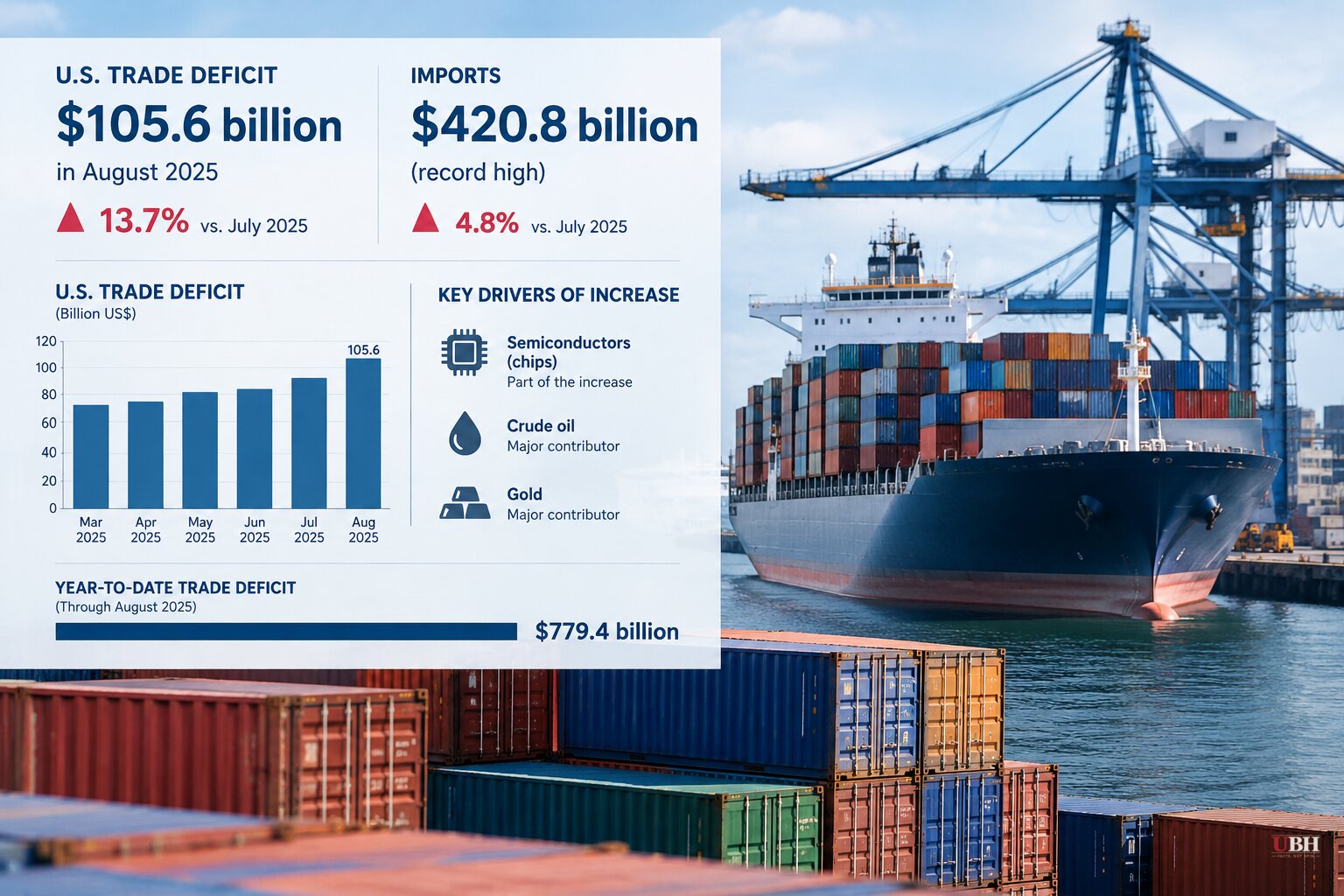
The U.S. trade deficit widened to $105.6 billion in August, up $12.7 billion, or 13.7%, from July's revised $92.8 billion, the Commerce Department reported Oct. 6. It is the largest monthly gap since March 2025.
Economists surveyed by Bloomberg had expected $102.1 billion. July's deficit was also revised up sharply from the $88.6 billion originally reported.
Imports hit a record
Total imports rose $17.2 billion, or 4.3%, to a record $420.8 billion. Exports rose $4.5 billion, or 1.4%, to $315.2 billion.
Goods did the damage. The goods deficit grew $12.8 billion to $136.6 billion, while the services surplus held essentially flat at $31.0 billion.
The three-month average deficit climbed $9.9 billion to $89.9 billion.
Chips grabbed the headlines, but oil and gold did more
Semiconductor imports rose $2.4 billion to $15.4 billion, a monthly record, according to figures cited in the release. They sit inside capital goods imports, which rose $6.2 billion to a record $146.4 billion.
The chip number is real. Through August, semiconductor imports total $90.5 billion, up from $49.2 billion a year earlier. Computer imports are at $255 billion, against $130.9 billion.
But the month's biggest movers were industrial supplies, up $9.1 billion. Crude oil imports added $3.3 billion and nonmonetary gold added $3.1 billion. Together they account for about 37% of the $17.4 billion jump in goods imports.
The oil rise was about volume, not price. Crude imports averaged 6.5 million barrels a day, up from 5.5 million in July, while the average price fell to $76.94 a barrel from $79.32.
AI hardware was not the whole picture either. Computer accessory imports fell $1.6 billion and computer imports fell $0.4 billion. Overall AI-related imports were little changed from July, though still elevated.
Tariffs in the background
The August data covers the first month after President Trump's latest round of tariffs took effect in late July: 10% on allies such as the European Union and 12.5% on other countries, including China. It was also the month trade talks with Canada collapsed.
Imports hit a record anyway. The largest bilateral deficit was with Mexico, at $27.7 billion.
The broader year still looks different from 2025. Through August, the deficit is running $138.2 billion, or 19.9%, below the same period last year, which was inflated by importers front-running tariffs. Exports are up $267.7 billion, or 11.8%, while imports are up $129.5 billion, or 4.4%.
What it does to GDP
A wider trade gap subtracts from measured growth, and forecasters moved quickly. Goldman Sachs cut its third-quarter GDP tracking estimate by 0.3 percentage points to 3.1%.
Capital Economics said the "sharp rise in imports suggests third quarter GDP growth will be well below our current forecast of 4.0%," putting the annualized figure closer to 2.5%. The Atlanta Fed's GDPNow model had already indicated net exports would subtract 2.59 percentage points from third-quarter growth, which would be the most since early 2025.
The import surge sits alongside strong domestic demand. The Institute for Supply Management's manufacturing index read 54.5 in September, the ninth straight month of expansion. Orders for nondefense capital goods excluding aircraft rose 1.6% in August.
Is chip dependence the right way to read it?
The import figure shows how much hardware the U.S. buys abroad. Exports of semiconductors were roughly $7.79 billion in August, so the country imports nearly twice what it ships out.
Chris Miller, author of "Chip War," argues that counting chips by where they are manufactured misses the value chain. "Often, the majority of the profit accrues to the design firm rather than to the companies that actually do the manufacturing of that chip," Miller said, noting that almost all of the world's leading chip designers are American. For chips made overseas, that profit comes back as an exported service.
IDC estimates about 10% of the world's semiconductors are made in the U.S. Jason Oxman, head of the Information Technology Industry Council, credits the 2022 Chips and Science Act with sparking billions of dollars in new domestic manufacturing investment. Chip exports have risen steadily all year.
The import bill is still the larger number, and domestic capacity has not closed the gap yet.
What comes next
The immediate test is the government's first estimate of third-quarter GDP, which will show how much of August's import surge lands in growth. Forecasts now range from 2.5% (Capital Economics) to 3.1% (Goldman Sachs), against the 4.0% Capital Economics had expected before the trade data.
Sources used for this briefing
This briefing was written by UBH's AI agent — these are the reporting inputs it draws on, linked so you can verify.


