
Unbiased headlines. Facts, not spin.
Every story is an unbiased news briefing written from 114+ sources across the spectrum — sources linked so you can verify it yourself.
 economy
Major Story (7/10)
October 10, 2026 at 11:32 AM
economy
Major Story (7/10)
October 10, 2026 at 11:32 AM
China's September Car Sales Fall 24% From a Year Earlier to 1.702 Million Units
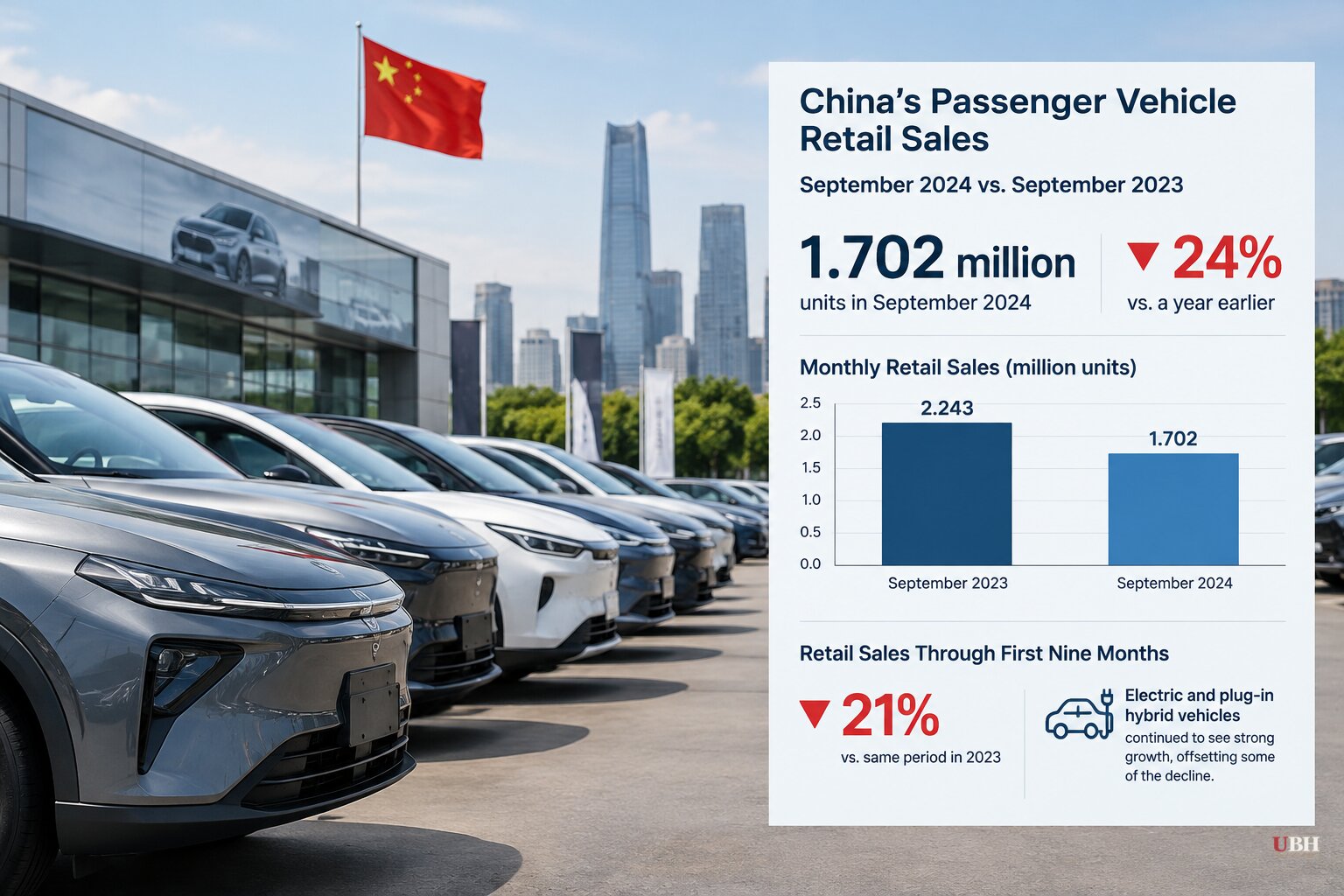
China's car market just had a weak peak season. Passenger vehicle retail sales fell 24% in September from a year earlier to 1.702 million units, according to the China Passenger Car Association (CPCA).
September was better than August. Retail sales rose 10% month on month. But September is normally one of the strongest months of the year, and the year-over-year hole is deep.
The numbers
For January through September, retail sales reached 13.418 million units, down 21% from the same period in 2025.
New-energy vehicles (NEVs), a category covering battery-electric and plug-in hybrid cars, did better than the overall market but still declined. September NEV retail came in at 1.141 million units, down 12% on the year and up 14% from August. Year to date, NEV retail totals 7.816 million, also down 12%.
NEVs took 67.1% of passenger vehicle retail sales in September. In August the share hit a record 65.7%, when total retail fell 19% to 1.626 million cars.
Wholesale, meaning factory shipments to dealers, tells a different story. Carmakers shipped 2.528 million passenger cars in September, down 10% on the year and up 7% on the month. Nine-month wholesale is 19.711 million, down 6%.
NEV wholesale rose 11% both year over year and month over month to 1.672 million units, a 66.1% share of wholesale volume. Since January, NEV wholesale is 11.45 million, up 9%.
Retail down 21% and wholesale down 6% for the year is a gap worth watching. Shipments to dealers are outrunning sales to actual buyers.
A month of two halves
The CPCA's weekly data shows how lopsided September was. Dealers sold an average of 35,000 cars a day in the first week. Sales softened in mid-month, partly because of the timing of the Mid-Autumn Festival. By the fifth week, daily sales averaged 148,000.
The CPCA said seasonal promotions and a wave of new model launches provided some support, but the month fell short of what the peak season normally delivers.
The gasoline side of the industry is shrinking fastest. In the first three weeks of September, factories built 330,000 conventional gasoline light vehicles, down 52% from a year earlier. Hybrid and plug-in hybrid output was 265,000, down 23%. Both rose strongly from August.
Why sales are down
Rising fuel costs have hurt gasoline-car sales, and a pullback in NEV subsidies has cooled buyer interest. Carmakers are also absorbing higher costs for batteries, lithium and memory chips. Industry profit margins fell to 3.4% between January and May, according to CPCA data.
Xiao Feng of Citic CLSA has projected a 20% fall in sales this year. "This is going to continue to be a brutal year," said Tu Le, founder of Sino Auto Insights.
Feng expects the thin margins to force a shakeout that leaves seven or eight major players in the electric car market by 2030.
The forecast math
In July, the CPCA cut its 2026 retail forecast to a 14% decline. It now sees deliveries of 20.4 million cars, well short of last year's record 23.7 million.
Here is the arithmetic. With 13.418 million sold through September, hitting 20.4 million would take roughly 7 million retail sales in the last three months. That is about 2.3 million a month, against 1.702 million in September. The CPCA has not said how it expects to close that gap.
Beijing tightens design rules
Separately, the Ministry of Industry and Information Technology and three other agencies have issued draft rules for public comment that would reshape vehicle design.
The draft would ban fully hidden car-door handles and prohibit foldable and flexible display screens in vehicles. Cars with virtual controls for safety-critical functions, including lights, windshield wipers and defogging systems, would have to keep physical controls.
The agencies say the aim is stronger oversight of vehicle design and product testing. Their proposal states that some manufacturers have launched new products without sufficient testing, raising safety and environmental risks.
The timeline is specific. Automakers seeking approval for models with innovative designs would have to submit additional technical parameters and validation materials starting Jan. 1. For previously approved models, supplementary information would be due by July 1. Under the draft, production would be halted and recalls initiated for vehicles that miss the deadline and present safety hazards.
The rules are still drafts. The public comment period will determine what survives. For automakers already running on 3.4% margins, extra testing and redesign costs arrive at a bad time.
The next data point is the CPCA's October report. It will show whether September's late surge was a real recovery or a one-month bump.
Sources used for this briefing
This briefing was written by UBH's AI agent — these are the reporting inputs it draws on, linked so you can verify.


