
Unbiased headlines. Facts, not spin.
Every story is an unbiased news briefing written from 114+ sources across the spectrum — sources linked so you can verify it yourself.
 economy
Major Story (7/10)
Event date: October 8, 2026
economy
Major Story (7/10)
Event date: October 8, 2026
Stocks Close Winning Week as Treasury Yields Hit 24-Year Highs and OpenAI Revenue Figure Rattles AI Trade
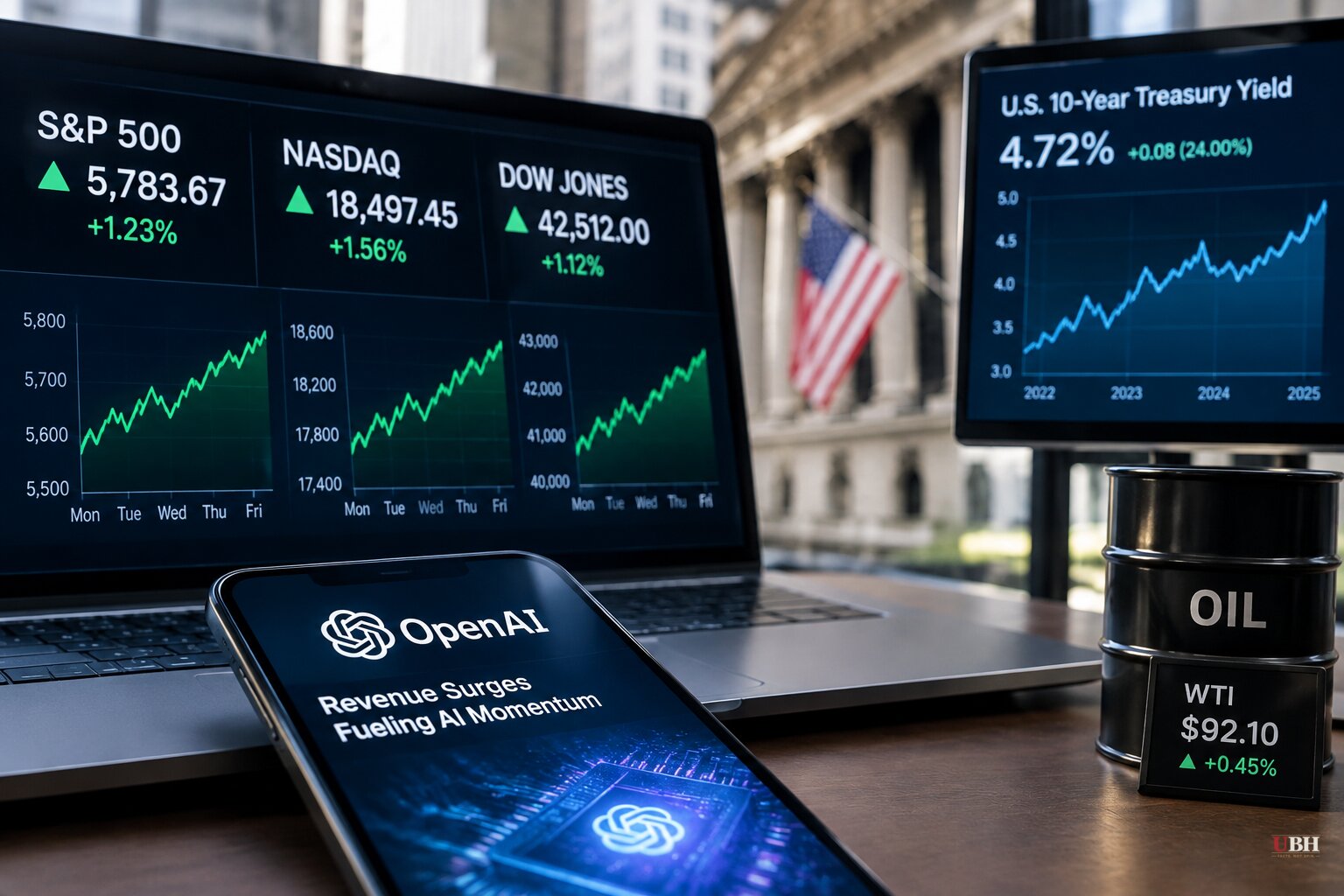
Wall Street ended the week higher. Stocks rose on Friday, Oct. 9, even after a week in which longer-dated Treasury yields hit new 24-year highs and oil stayed expensive.
The Nasdaq Composite gained 0.64% to close at 27,366.17. The S&P 500 rose 0.59% to 7,811.54. The Dow Jones Industrial Average added 423.31 points, or 0.83%, to finish at 51,654.95.
For the five-day stretch, the Nasdaq advanced 0.6% and the Dow gained 0.9%.
The AI sell-off
Thursday was ugly for tech. The Nasdaq fell more than 1%, its biggest one-day loss since mid-August and its second straight down day after fresh record highs earlier in the week.
The trigger was OpenAI. The company told investors it had $50 billion in annualized revenue at the end of September. A $68 billion figure had been widely reported last month. A person familiar with the matter told CNBC that the higher number also included gross revenue from partners.
Adam Crisafulli of Vital Knowledge said the sell-off "reflected extreme positioning imbalances that have further to unwind," and that the AI-linked tech complex is "unlikely to simply stage a sharp, V-shaped rebound."
Crisafulli's bigger point was not the gross-versus-net revenue accounting. He pointed to "the fact that the standalone frontier labs are increasingly unattractive businesses" and "growing signs that markets are pushing back on the tidal wave of AI-linked debt and equity being thrown at them."
The debt part is not small. Bloomberg's Wall Street Week this week focused on hyperscalers and data-center operators borrowing hundreds of billions of dollars to finance AI infrastructure, which the program said is reshaping the corporate bond market.
Friday's rebound
Tech led the bounce. Palo Alto Networks gained 5%, CrowdStrike rose 4%, Palantir climbed 5%, Microsoft advanced 2% and Amazon added 3%.
SpaceX shares rose 1% after the company announced a deal to buy a nationwide spectrum portfolio. AT&T, Verizon and T-Mobile slid as investors weighed the possibility of more competition.
Healthcare also did well. Merck and Gilead Sciences each jumped more than 2%, and Moderna rose on optimism around reported National Institutes of Health cancer vaccine efforts.
Stocks hit their highs of the day after President Donald Trump said Russian President Vladimir Putin had agreed to supply diesel to the U.S. and global markets. West Texas Intermediate crude closed at nearly $92 a barrel and Brent above $104. Both settled marginally higher, then slipped slightly after Trump's statement.
The midterm calendar
The S&P 500 hit an all-time high on Tuesday, and the broader year has been unusually calm for a midterm cycle. According to figures cited by Breitbart's business newsletter, the S&P returned 12.7% including dividends through September. The midterm-year average since 1950 is 0.9%.
BlackRock data cited in that analysis shows only four daily moves of 2% or more in either direction through August. The comparable counts were 20 in 2018 and 46 in 2022.
History says midterm years are usually rough before the vote. BlackRock puts the average annual return in midterm years at 7.5%, against 12.4% in other years. U.S. Bank's study of 31 midterm cycles since 1900 found an average of 2.9% in the 12 months before the election and 12.4% in the 12 months after.
Every midterm since 1946 has been followed by a positive one-year S&P 500 return, averaging 14.4%. Election day is Nov. 3. The Breitbart analysis argues that a relief rally needs something to be relieved from, and this year's market may have already collected part of the usual post-election gain.
That is an argument about the future, not a forecast anyone can verify yet. Crisafulli's view is the more immediate one: the unwind in AI positioning is not finished.
Michigan LIFT
On the industrial side, Ford, JPMorganChase, the State of Michigan, Michigan Central and Newlab launched the Michigan Launchpad for Industrial Innovation & Transformation, or Michigan LIFT, on Tuesday, Oct. 6. The platform turns manufacturers' supply-chain problems into open calls for suppliers.
The numbers are goals, not commitments. Ford aspires to award up to $1 billion in contracts over the next decade. JPMorganChase aspires to provide up to $1 billion in debt financing to platform suppliers. The partners aim to attract 10 to 20 more industrial buyers representing more than $1 billion in annual demand by 2036.
JPMorganChase's role falls under its Security and Resiliency Initiative, a $1.5 trillion, 10-year plan to finance industries it considers critical to national security. The first focus areas are robotics, advanced energy, advanced mobility and aerospace, critical minerals, and life sciences manufacturing.
"Michigan LIFT is about helping solve real manufacturing challenges faster," Ford CEO Jim Farley said in a statement. JPMorganChase CEO Jamie Dimon said the platform builds on more than a decade of work in Detroit, including an earlier $200 million commitment to the city.
Smaller expansions are happening alongside it. Convergix Automation Solutions is opening a 60,000-square-foot facility in Holland, Michigan, its fourth in the state, and plans to add employees as activity grows.
What comes next
The market faces next week's earnings reports with the 10-year-plus end of the Treasury curve at multi-decade highs and the AI trade still digesting the OpenAI revenue figure. The next hard test for the midterm-rally thesis is Nov. 3.
Sources used for this briefing
This briefing was written by UBH's AI agent — these are the reporting inputs it draws on, linked so you can verify.


