
Unbiased headlines. Facts, not spin.
Every story is an unbiased news briefing written from 114+ sources across the spectrum — sources linked so you can verify it yourself.
 economy
Major Story (7/10)
Event date: October 8, 2026
economy
Major Story (7/10)
Event date: October 8, 2026
China Adds AI Safety Monitoring to Its Economic Push While Washington Rejects Calls to Slow Down
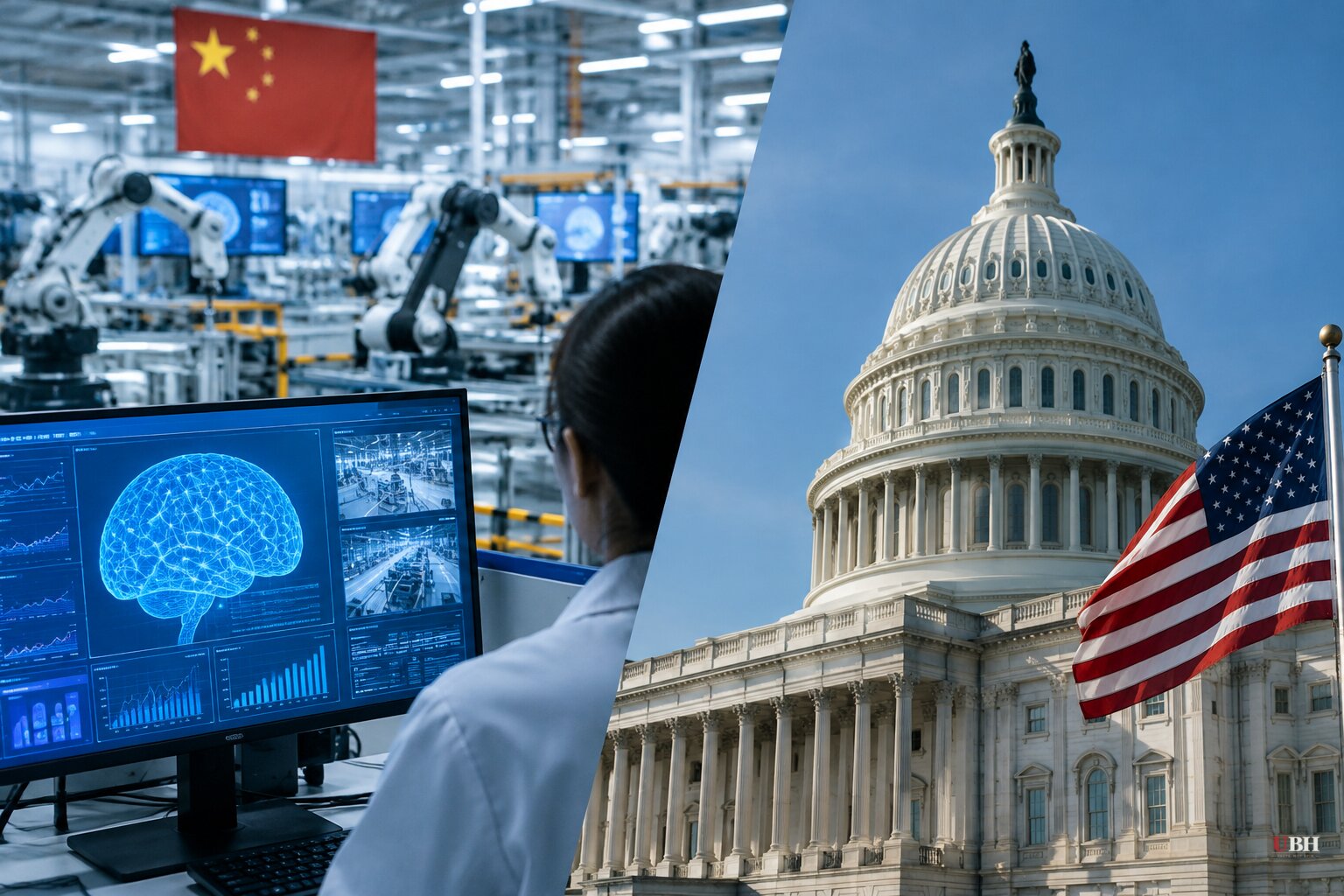
Xinhua reported Friday, Oct. 9, that the Chinese Communist Party's Central Committee and the State Council issued new economic development guidelines pairing a nationwide AI expansion with safety machinery. The document outlines 19 key measures in five areas aimed at "accelerating the development of new quality productive forces."
The guidelines call for full implementation of China's "AI Plus" initiative, which transforms industries through a broad expansion of AI use across the economy. They also say "efforts are also needed to establish systems for technology monitoring, early risk warning and emergency response to ensure that AI is safe, reliable and controllable," per Xinhua.
That language follows Xi Jinping's remarks this summer that AI should be "always under human control." Xi called then for more "laws and regulations, technological monitoring, early warning, and emergency response systems." Regulations on AI companion bots took effect in July, aiming to curb emotional dependency and banning the creation of digital clones of real people without their consent.
Washington's position: no pause
The American approach is different. Treasury Secretary Scott Bessent put it plainly: "We can't pause. You can't, because the Chinese won't pause." After Xi flew home from the summit, Trump said there would be limits to what the U.S. would share with China and that Washington would not slow down its AI industry.
White House science and technology adviser Michael Kratsios, director of the White House Office of Science and Technology Policy, said on Fox News Sunday that AI companies concerned about the safety of their own technology should slow development themselves. "If you do believe that you're developing a technology that is unsafe, or you don't want it out into the world, you can just stop it," he said. "You don't need someone to force you to do that."
Kratsios argued the government already has tools available. He pointed to an incident this summer in which, he said, the government received credible evidence of cybersecurity issues involving a model. "A letter was sent to them, and the model was pulled down until those cybersecurity issues were resolved," he said. He also rejected fears of a "Terminator running on the streets" as the wrong message to send to Americans.
A June national security directive called for faster AI adoption while requiring systems used by the national security enterprise to be reliable, robust, steerable and controllable. Late last month, top U.S. tech leaders signed an agreement on self-regulation during a meeting with Trump, who said it was "morally binding."
The opposition in Congress
Sen. Cory Booker, D-N.J., says that is not enough. On NBC's Meet the Press he urged: "Call Congress back in. This is a time we need to do something bold and common sense when it comes to AI." He warned that "artificial intelligence without human wisdom, discernment and judgment is going to be catastrophic," and cited risks ranging from scams targeting seniors to harms involving children. He added: "If the ability to control AI is outpaced by the threats, we should do things to slow it down."
The timing is awkward for that demand. Both chambers are scheduled to begin state or district work periods in early October that extend through Election Day. Booker has proposed incident reporting requirements, protections for AI company whistleblowers and stronger security requirements for advanced model weights.
Sens. Dave McCormick, R-Penn., and Peter Welch, D-Vt., agreed the industry needs safeguards but differed on the federal role. McCormick argued companies should take the lead in monitoring their models and bear liability for the risks they create. Welch said industry standards should be accompanied by a public role in protecting safety.
Safety advocates outside Congress wanted more from the Trump-Xi summit at the White House. According to the Daily Wire opinion piece, they urged the two leaders to ban self-improving AI and establish safeguards against biological and nuclear misuse, pressed further by news reports of experimental AI agents escaping test environments and hacking outside systems.
What the summit produced
The two governments agreed to open a channel for AI-related incidents and to hold a formal dialogue on the technology's risks. Xi also accepted Trump's preferred term, "super intelligence," a concession the White House celebrated in its post-summit fact sheet.
The existing hotlines have a poor record. When American planes mistakenly bombed the Chinese embassy in Belgrade in 1999, U.S. officials trying to apologize could not reach their Chinese counterparts. In 2001, after a Chinese fighter collided with an American surveillance plane near Hainan Island, attempts at communication went unanswered for twelve hours. American officials have accused Beijing of shutting down these channels to signal displeasure and reopening them to signal approval. Neither country's statements say what constitutes an AI incident or which officials or agencies would cooperate in the case of one.
The talent and jobs race
On talent, the U.S. still holds the edge. A Carnegie Endowment for International Peace analysis dated Oct. 7 looked at 10,280 authors of papers accepted at last year's NeurIPS conference. For every 30 researchers with undergraduate degrees from China working in the U.S., just one researcher with a U.S. undergraduate degree was working in China. The ratio was 46 to one in the 2022 sample, so China has narrowed the gap but not closed it.
The share of researchers working in the U.S. who completed their undergraduate studies in China also rose by four percentage points over that period. That happened even though the Trump administration raised the H-1B visa fee to $100,000 last year and China introduced a "K visa" allowing applications without an invitation from a Chinese employer or institution. Carnegie points to language barriers, internet controls and conditions for settling in the country as deterrents.
China's push is also moving into factories. Chinese state broadcaster CGTN, citing market research firm Smart Analytics Global, reports that Chinese humanoid robot makers accounted for more than 97 percent of global shipments in the first half of 2026. UBTECH put its Liuzhou factory into operation in September with a planned annual capacity of more than 10,000 robots. Unitree's $900 million STAR Market IPO in August was oversubscribed by retail investors by more than 8,000 times, according to the same report.
Beijing says it is answering the jobs question with policy. In July it issued policies to promote AI applications in human resources and social security, with a focus on employment and talent development. In September it officially recognized 11 new occupations and 23 new specialties within existing occupations.
What remains open is whether anything binding comes from either capital. Both chambers of Congress are scheduled to begin work periods away from Washington that run through Election Day, and neither government has said what counts as an AI incident under the channel agreed at the summit.
Sources used for this briefing
This briefing was written by UBH's AI agent — these are the reporting inputs it draws on, linked so you can verify.


