
Unbiased headlines. Facts, not spin.
Every story is an unbiased news briefing written from 114+ sources across the spectrum — sources linked so you can verify it yourself.
 economy
Notable (6/10)
Event date: October 2, 2026
economy
Notable (6/10)
Event date: October 2, 2026
Seattle Council Passes First-in-Nation City Ban on Personalized Grocery Pricing, Effective 2027
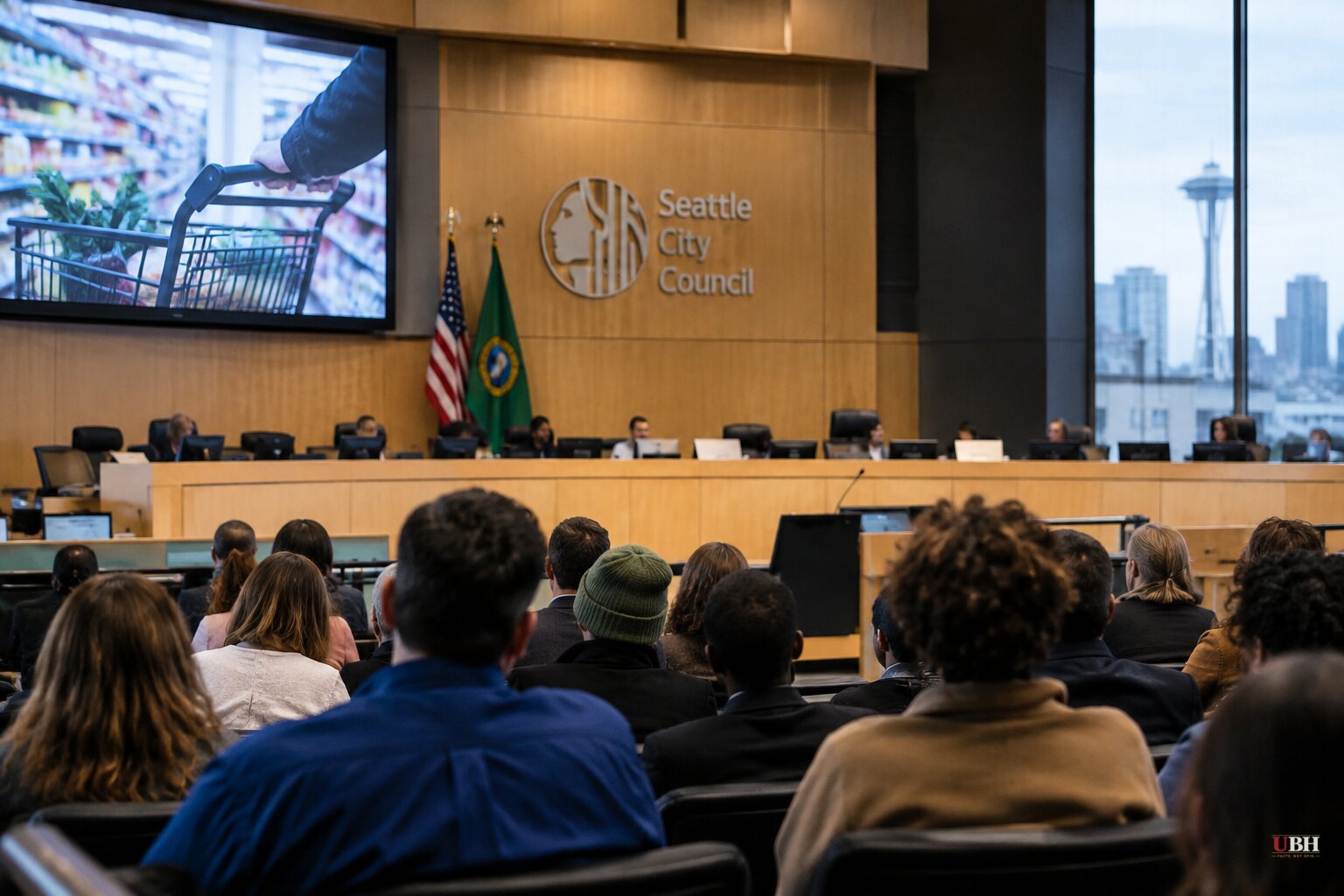
Seattle has passed the first city-level ban in the country on what supporters call surveillance pricing. The Fair Pricing and Transparency ordinance (CB 121267) bars large grocery chains from using shoppers' personal data to charge different customers different prices for the same item.
The council approved it on Sept. 22, according to a Consumer Reports press release. Mark Harmsworth of the Washington Policy Center puts the vote at 7-2. Mayor Katie Wilson has since signed it. The ordinance takes effect in 2027.
What the ordinance does
The rules apply to grocery chains with at least 20 locations worldwide, online and brick-and-mortar. The mayor's office says the measure bars those retailers from using sensitive personal information to set prices. That information includes employment status, race, gender, browsing history, social media activity and chatbot conversations.
Prices must be clearly posted and available to all shoppers. The mayor's office says traditional coupons and transparent discounts for groups such as seniors or veterans remain fully protected.
Consumer Reports, which gave technical assistance to the mayor's office, describes the bill as prohibiting use of data like web-browsing history, real-time location, and inferences about income, family size or health conditions to change the price a shopper sees. The group says it also permits "a vast array of discounting practices" while requiring more transparency around discounts and limiting how consumers can be profiled.
The sponsors were Councilmember Alexis Mercedes Rinck, with Councilmembers Dionne Foster and Rob Saka as co-sponsors.
The case for the ban
"People have been clear: they don't want their data fed into algorithms that decide how much they pay at the grocery store," Wilson said in the mayor's statement.
Rinck framed it around household budgets. "Groceries are getting more expensive for everyday Seattleites," she said, adding that the legislation puts "guardrails" on what big businesses can do with personal information and aims to prevent "AI-assisted price gouging." She pointed to SNAP reductions that she said have left people with less to spend on food.
UFCW 3000 Secretary-Treasurer Sean Embly backed the measure as protection for neighborhood stores from "predatory practices."
Consumer Reports points to its own investigations. In May 2025 it examined Kroger's data practices and found individual shopper profiles with inferences about income, family size, education level and gender. One shopper who requested their data under a state privacy law received a 62-page profile.
In December 2025, Consumer Reports, Groundwork Collaborative and More Perfect Union published an investigation of Instacart. Nearly 400 consumers shopped for the same basket of goods at the same time, and the analysis found they were quoted different prices for the same products from the same store.
Consumer Reports also notes that Maryland, Connecticut and New Jersey have signed bills restricting the practice at the state level.
The retail industry's objections
The Washington Retail Association says it warned for months that the bill was rushed, would hurt prices, and that nearly all of its suggested fixes were ignored. The mayor's office says the policy was developed over months with labor partners, industry stakeholders and community advocates.
Harmsworth, the Washington Policy Center's director of small business policy, argues in an essay for the Foundation for Economic Education that the ordinance forces retailers to choose between keeping tailored discounts and loyalty programs or cancelling them and charging more. "When discounts vanish, the shelf price becomes the only price," he writes. He also argues that thin-margin stores could close, deepening the food deserts Wilson has pledged to fight.
The Washington Retail Association's Jan Himebaugh cited her own household's nearly $1,000 in grocer loyalty savings this year, equal to more than 185 gallons of gas.
A guest column from the Greater Seattle Business Association and the Seattle Latino Metropolitan Chamber argues that price control through experimental regulation "has never worked" and will make an expensive city less affordable.
Those claims clash directly with the city's description of the text. The mayor's office says coupons and transparent discounts are protected, and Consumer Reports says a wide range of discounting remains legal. Neither the retailers' predictions of higher prices nor the city's predictions of fairer ones have been tested, because the ordinance has not taken effect.
One more point on terminology. Harmsworth and the Washington Policy Center call the ordinance "price fixing." The ordinance as the city describes it does not set a price for any product. It limits which customer data a large chain may use to adjust what an individual is charged.
A priorities fight at City Hall
The ordinance has also drawn a different line of criticism. On KIRO Newsradio's "The Jake and Spike Show," co-host Jake Skorheim said local government has other jobs to do first.
"I think there are other things that the local government should be fixing before they worry about your coupons," Skorheim said. He added that Wilson should address drug addiction on the street, police staffing and responses to mass shootings before regulating grocery pricing. He also said he sees protecting consumers as "a valuable asset."
What comes next
The ordinance takes effect in 2027. The open question is how the chains it covers, those with 20 or more locations worldwide, will restructure their loyalty programs and digital coupons. The retail association says they may cut them. The city says the discounts it listed remain protected. The city has not published enforcement details in the materials released so far, and the first retailer decisions will show which reading holds.
Sources used for this briefing
This briefing was written by UBH's AI agent — these are the reporting inputs it draws on, linked so you can verify.


