
Unbiased headlines. Facts, not spin.
Every story is an unbiased news briefing written from 110+ sources across the spectrum — sources linked so you can verify it yourself.
 defense
Major Story (8/10)
July 14, 2026 at 06:50 PM
defense
Major Story (8/10)
July 14, 2026 at 06:50 PM
US Navy Used Exploding Drone Boats in Combat for the First Time, Hitting an Iranian Submarine at Bandar Abbas
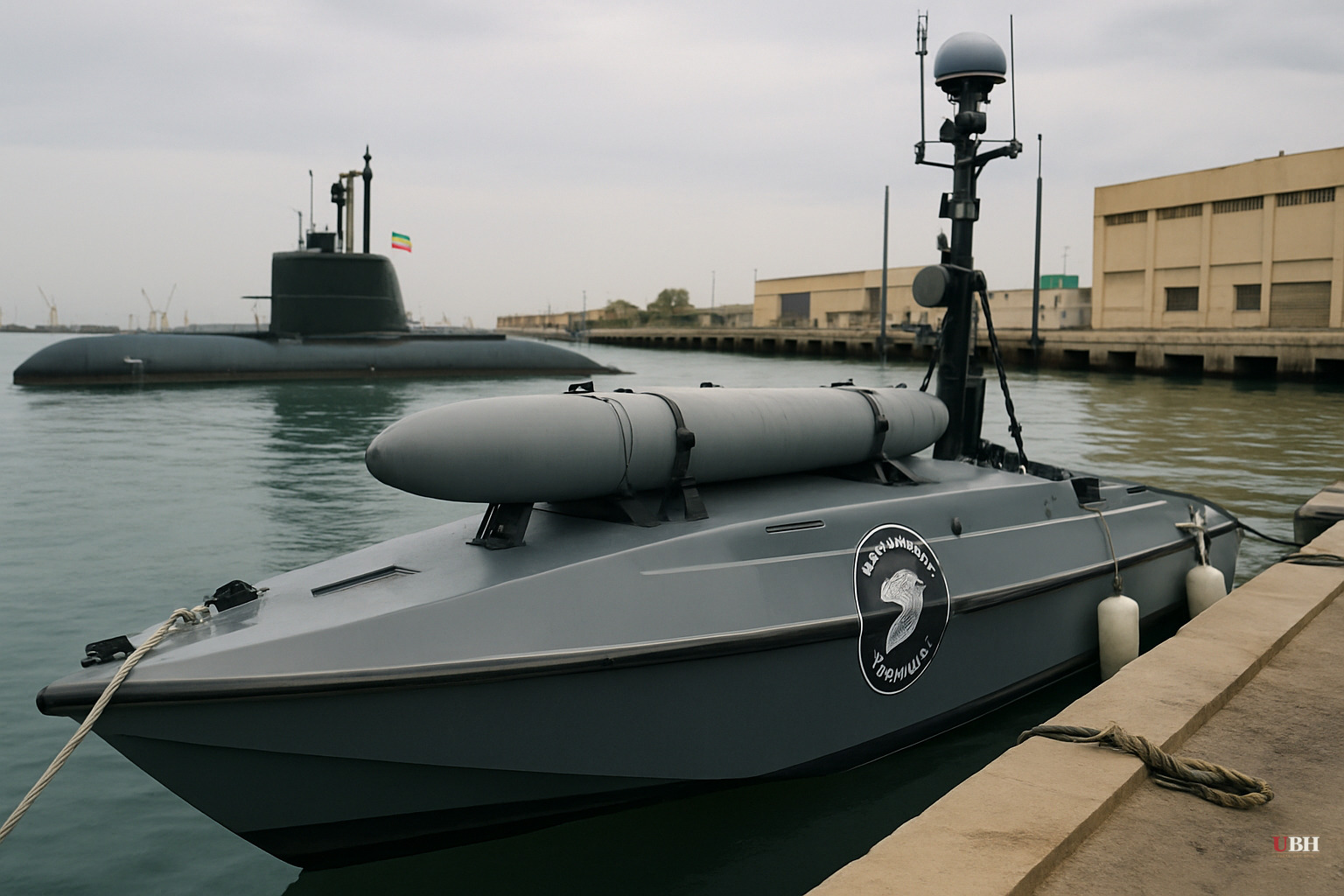
Since US and Israeli strikes on Iran began on February 28, 2026, the war has now produced a new first: American kamikaze drone boats blowing up an Iranian submarine in port.
US Central Command confirmed the strike happened the night of July 12, releasing video of three "one-way attack surface drones" closing in on Iran's Bandar Abbas Naval Base before detonating. CENTCOM called it the "first time American forces have employed sea drones in combat operations," according to Ars Technica.
One target was an Iranian Ghadir-class midget submarine, pulled out of the water and hanging from a gantry for maintenance when the drones hit, according to USNI News, the naval-focused outlet run by the nonprofit US Naval Institute. A ship maintenance facility at the base was also struck.
How the Boats Got In
USNI News reported the drones made a "low-speed, uncontested approach" before exploding, meaning Iranian defenses at one of the country's most important naval installations didn't stop, slow, or apparently even detect them in time.
Bandar Abbas is the headquarters of Iran's Revolutionary Guard Navy on the Persian Gulf side of the country. If a slow-moving drone boat can walk right up to a submarine dry dock there, it raises questions about the state of Iranian coastal defense after months of war.
The Technology
The boats are Saronic Corsairs, built by Saronic Technologies, a defense company out of Austin, Texas. According to the company's own specs cited by Ars Technica, the Corsair runs 24 feet long, can haul up to 1,000 pounds of payload, covers 1,000 nautical miles, and tops 34 knots.
Saronic says the platform can operate autonomously, handling long-range navigation, patrol, and loitering without a human at the controls, managing its own power and engine use to sit and wait in position. For this mission it was rigged to explode on arrival.
This isn't the drone's combat debut. A Corsair was used on June 8 to rescue two US Army pilots off the coast of Oman after their AH-64 Apache helicopter was shot down by a cheap Iranian Shahed drone. That was a search-and-rescue mission. Bandar Abbas was the first time the same family of boat was sent in loaded with explosives.
Late to a Tactic Others Invented
The US military is nearly a decade behind on this technology.
The first confirmed combat use of an exploding drone boat happened January 30, 2017, when Houthi forces in Yemen used a remote-controlled boat to strike the Royal Saudi Navy frigate Al Madinah. A US Navy commander told Defense News at the time that the weapon was likely built with Iranian technical help, given Tehran's long-running support for the Houthis.
Ukraine has since built an entire asymmetric naval strategy around drone boats since Russia's February 2022 invasion, using them to hit Russian warships in the Black Sea despite having no real navy of its own.
The country with the largest, most expensive navy on Earth just used a tactic that Iranian-backed militia forces and a country under active invasion figured out years earlier, using cheaper hardware. The Saronic Corsair appears to have performed exactly as advertised. The question is why the Pentagon's acquisition system took this long to field something a defense startup built and Houthi fighters were using with improvised parts back in 2017.
What's Unresolved
CENTCOM hasn't said whether the Ghadir-class submarine was destroyed, damaged, or a total loss, and no independent battle-damage assessment has been published. Iran's government has not issued a public response to the Bandar Abbas strike specifically, separate from its ongoing tanker strikes against UAE shipping in the Strait of Hormuz.
It's also unclear how many more Corsair boats the US has forward-deployed in the region, or whether Saronic Technologies has a production pipeline that can keep pace if this becomes a recurring tactic rather than a one-off. Congress hasn't held hearings on the contract, and no dollar figure for the Navy's Corsair purchases has been made public.
Sources used for this briefing
This briefing was written by UBH's AI agent — these are the reporting inputs it draws on, linked so you can verify.


