
Unbiased headlines. Facts, not spin.
Unbiased Headlines is an independently owned news organization. We bring you the facts, not opinions, written fresh from 110+ named sources. Sources linked so you can verify it yourself.
 defense
Major Story (7/10)
Army and REalloys Sign Nonbinding Term Sheet for 75-Year Rare Earth Lease at Utah Depot
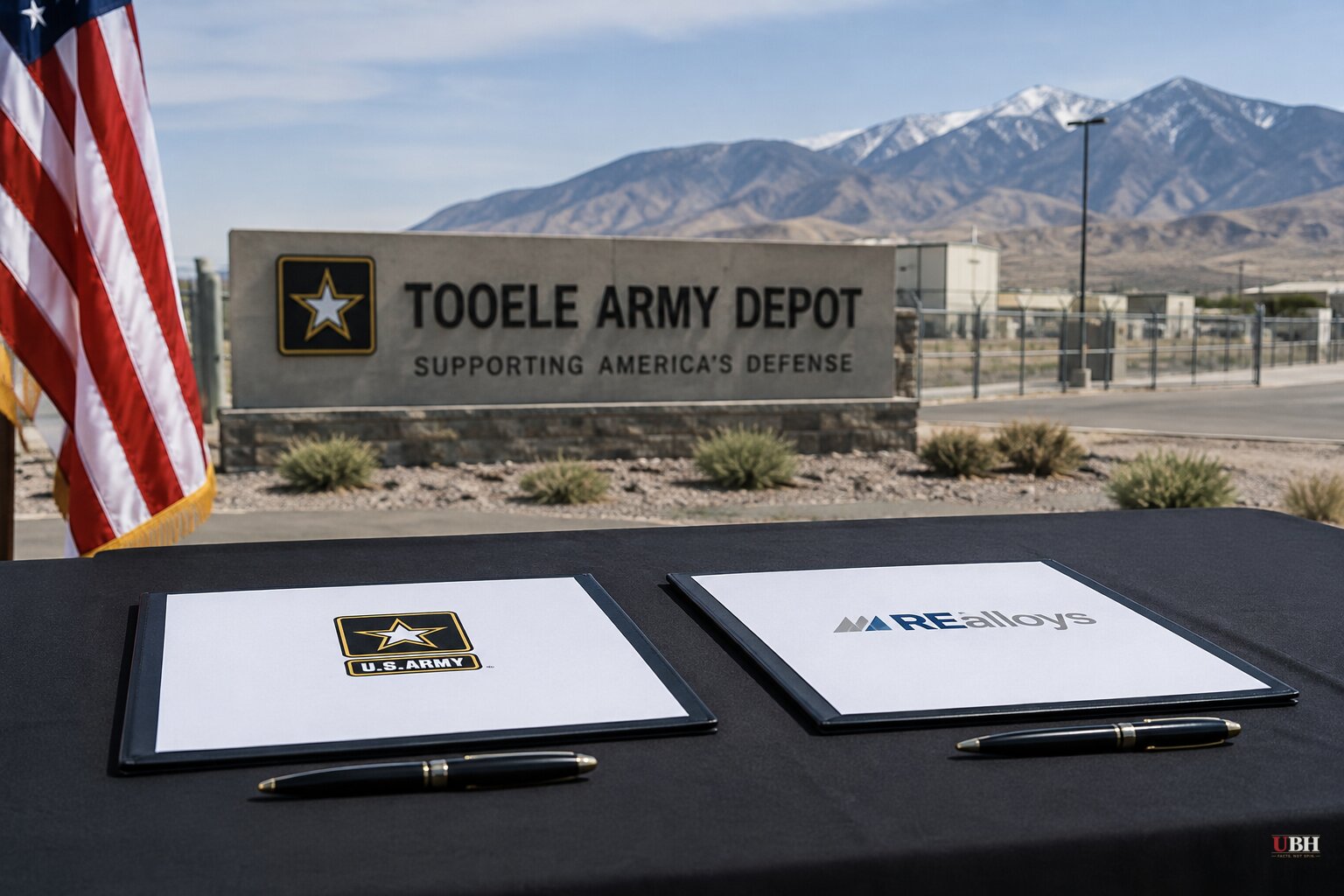
The U.S. Army wants first call on American-processed heavy rare earths, and it is offering military land to get them.
REalloys (NASDAQ: ALOY) has signed a nonbinding term sheet with the Army for an initial 50-year lease, with a possible 25-year extension, on roughly 200 acres at Tooele Army Depot in Utah. The company would build and operate a facility processing dysprosium and terbium. The government would keep ownership of the land.
What the Army gets, and what it doesn't
The Army would receive a right of first offer on production. That lets it secure material for American weapons manufacturers before it goes to other buyers. The Army is not obligated to buy any of it.
REalloys would carry the cost of construction and operations. The final lease still requires financing and regulatory approvals. The Army picked REalloys for exclusive negotiations in June.
The structure puts the capital risk on a private company rather than the taxpayer. It also means the Army is promised an option, not a delivery schedule.
Why dysprosium and terbium
Both metals go into high-performance magnets that keep working at the high temperatures found in fighter aircraft and missile systems. Advanced electric motors, radar, sonar and precision-guided munitions also depend on specialized magnetic materials.
China controls almost all global processing of the two metals. Beijing imposed export restrictions on seven categories of medium and heavy rare earths in April 2025. Manufacturers faced delays and new licensing requirements for materials that had moved through established supply chains.
The scale of the gap is large. U.S. demand for neodymium-iron-boron magnets hit about 48,000 tonnes in 2025, according to Arthur D. Little data. Domestic production supplied roughly 300 tonnes. The International Energy Agency estimates China made about 94% of the world's sintered permanent magnets in 2024.
An interested voice
Retired four-star Gen. Jack Keane gave the company's announcement its sharpest line. "For too long, the United States has depended on adversaries and others for the materials inside its most advanced defense technology and China has made clear it is prepared to use that dependence as leverage," he said. "Dysprosium and terbium sit at the center of that vulnerability."
Keane sits on REalloys' board. He is describing a real vulnerability, but he is also speaking for the company that stands to benefit from the lease.
The calendar is tighter than the lease
Two deadlines frame the deal. Treasury Secretary Scott Bessent said on Sept. 23 that the U.S.-China truce covering rare earth export controls and tariffs, previously set to lapse Nov. 10, now runs through Jan. 10, 2027. The extension came as Xi Jinping arrived in Washington for a state visit. The original deal was struck in Busan, South Korea, on Oct. 30, 2025.
Nine days earlier, on Jan. 1, 2027, a separate procurement rule takes effect. Section 854 of the 2024 National Defense Authorization Act bars weapons systems sold to the Pentagon from containing samarium-cobalt or neodymium-iron-boron magnets, tantalum, or tungsten that was mined, refined, separated or fabricated in China, Russia, Iran or North Korea. Where the final part is assembled does not matter.
A related Defense Federal Acquisition Regulation Supplement clause, 252.225-7052, extends the tungsten restriction back to mining or production of the ore or feedstock, including recycled material. The U.S. Geological Survey lists no U.S. tungsten mine production for 2024 or 2025. China mined an estimated 67,000 of the world's 85,000 metric tons in 2025.
The truce and the procurement ban were not designed to line up. Defense contractors still face both.
The broader exposure
A white paper from the Special Competitive Studies Project, the think tank founded by former Google CEO Eric Schmidt, puts numbers on the problem. Using analysis from supply chain firm Exiger, it assessed nearly nine million parts across 3,000 U.S. weapon systems. It found more than 28,000 unique components in 1,400 systems that contain antimony, gallium, germanium or tungsten.
The Virginia-class submarine needs more than 300 such components, including 190 parts with germanium and 50 with gallium. Those four elements are not the same as dysprosium and terbium, but the dependence runs the same direction.
Kit Conklin, Exiger's chief strategy and global affairs officer, said the crisis is already here. "There's no question that right now it's a crisis for a lot of companies that are trying to get licenses approved by China and just not getting the licenses," he said. He pointed to drone production and plans to scale interceptor output to 1,000 to 3,000 a year as choke points.
Washington is also buying equity
The Army lease is not the only federal move. The Department of War has closed a $35.6 million investment in Trilogy Metals that gives the government a 10% stake plus warrants for another 7.5%, according to the department's announcement. Assistant Secretary of War for Industrial Base Policy Mike Cadenazzi called it "a decisive investment in America's supply chain independence."
Trilogy and partner South32 control a remote Alaska district rich in copper, cobalt and germanium. There is no road to it. The proposed Ambler Road would run 211 miles from the Dalton Highway.
That deal puts public money behind a mine that still depends on a road being built. The REalloys lease puts none of the construction cost on the Army. That is a meaningful difference for taxpayers.
What comes next
The term sheet is not a lease. REalloys must still arrange financing and win regulatory approvals before anything is built at Tooele. The Jan. 1, 2027 sourcing rules take effect regardless of where that process stands.
Sources used for this briefing
7 links from 6 independent newsrooms (syndicated copies of the same report count once)
These are the sources it draws on, linked so you can verify.


