
Unbiased headlines. Facts, not spin.
Unbiased Headlines is an independently owned news organization. We bring you the facts, not opinions, written fresh from 110+ named sources. Sources linked so you can verify it yourself.
 economy
Major Story (8/10)
Event date: October 12, 2026 ·
US Made 300 Tons of Rare Earth Magnets Against 48,000 Tons of Demand, With Pentagon Ban 74 Days Away
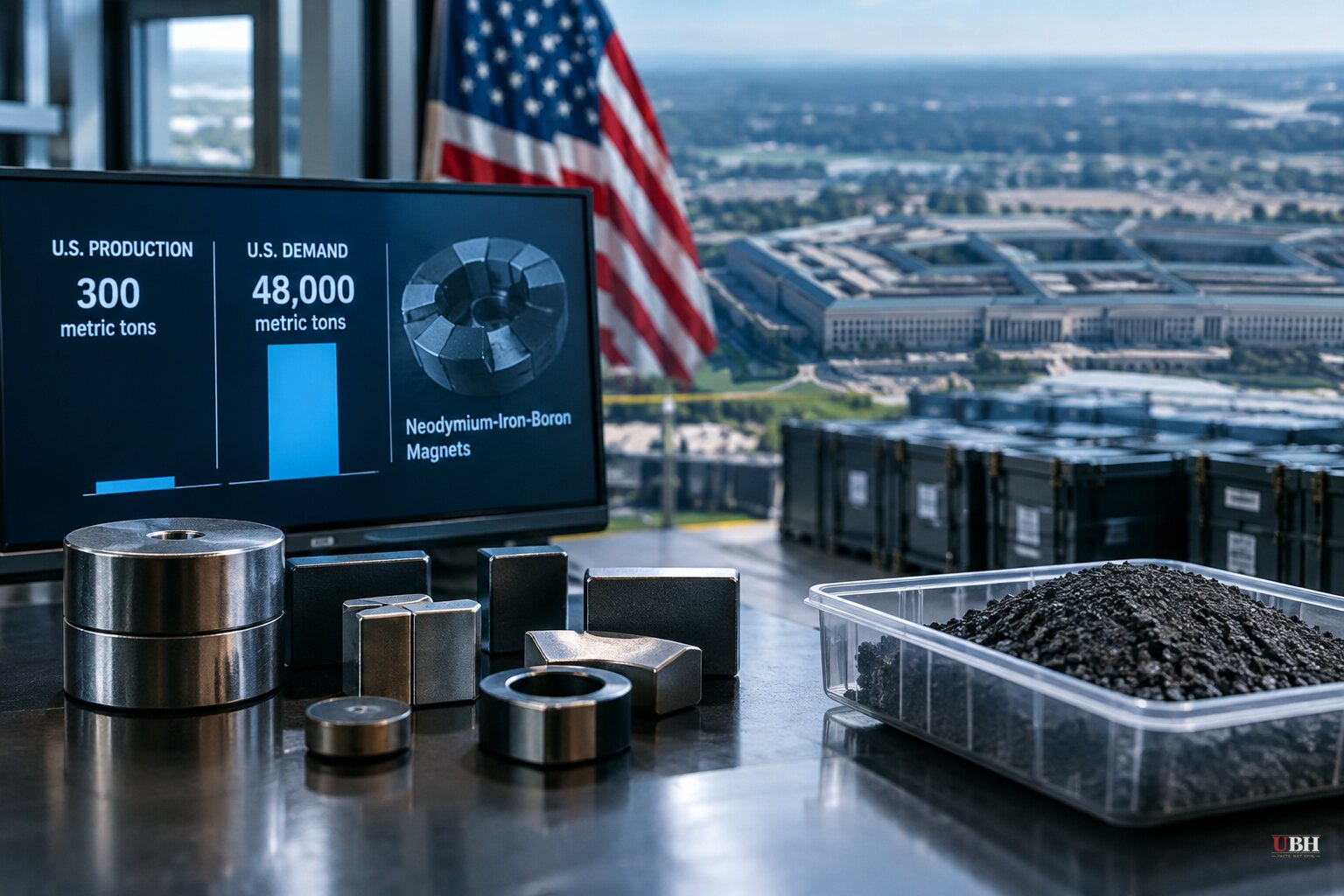
The United States consumed roughly 48,000 metric tons of neodymium-iron-boron (NdFeB) permanent magnets in 2025 and produced about 300 tons at home. Those are estimates from Arthur D. Little, later reported by Reuters. They put domestic production at about 0.6% of demand.
China supplies more than 90% of the world's rare earth magnets. The Pentagon is about to make that a compliance problem.
The Jan. 1 deadline
The Defense Department's DFARS rule has long barred Chinese magnets from the weapons it buys, but it covered only the final manufacturing steps. Starting Jan. 1, 2027, it covers the whole chain, from mining the ore to the finished magnet.
If any step happens in China, Russia, Iran or North Korea, a contractor cannot deliver that magnet to the Pentagon. Makers of missile guidance systems, drone motors and fighter jets will have to document origin back to the ore.
The White House has also narrowed the escape hatch. A July executive order directs the Pentagon to stop granting routine waivers once the deadline hits. It also says that failing to qualify a domestic source is not, on its own, proof that none exists.
That is about 10 weeks from today, Oct. 19.
Beijing's leverage
In October 2025, China announced export rules that would largely deny licenses to companies with ties to foreign militaries, including America's. Any request to use rare earths for military purposes would be automatically rejected. Even magnets made in third countries would need Beijing's approval.
The trade truce that paused those measures is short. The late-September summit between Xi Jinping and President Donald Trump extended it by only two months, and rare earths remain unresolved in the talks, according to Voice of America. OilPrice.com's analysis puts the date China's toughest rules could return at Jan. 10, nine days after the Pentagon ban begins.
Anders Corr, writing in a commentary for The Epoch Times, argues that China cut rare earth exports ahead of the September summit and did the same to Japan over the summer. He puts China's share of heavy rare earth output at about 95% and says roughly $1.2 trillion of the U.S. economy depends on rare earths. Those are his figures, not government data.
What Washington is building
The government is spending heavily. The Center for Strategic and International Studies counts $7.6 billion in U.S. non-equity investment in rare earth and magnet projects between 2025 and June. The Wall Street Journal, citing White House officials, reported on Sept. 27 that 180 projects had been initiated. In February, Washington launched a stockpile program modeled on the Strategic Petroleum Reserve, aiming for a 60-day emergency supply of minerals such as gallium and cobalt.
Taxpayers are also becoming shareholders. Hertha Metals broke ground on a roughly $100 million plant in Conroe, Texas, funded by a $133.65 million Series A that included $65 million in equity from the U.S. government. The plant targets 10,000 metric tons a year of steel-grade and magnet-grade high-purity iron.
NdFeB magnets are about 70% iron by weight, and an estimated 94% of the high-purity iron for them is made in China, according to the company. Hertha reached 99.95% purity at its pilot plant in August. Its commercial plant is expected online in late 2027, with magnet-grade iron starting in early 2028.
Jennifer Jett, Chief of Staff to the Under Secretary of War, Economic Defense Unit, called the deal a "disciplined equity structure" that safeguards taxpayer resources.
REalloys (NASDAQ: ALOY) says it is building a heavy rare earth chain outside China, from processing in Saskatchewan to metal-making in Ohio. CEO Lipi Sternheim said the company wants to qualify North American dysprosium, terbium and other materials for defense and industrial magnets. The company expects its first high-purity material from Saskatchewan as early as the fourth quarter of 2026.
How fast is fast enough
The timeline is disputed. Peter Navarro, the White House senior adviser for trade and manufacturing, said on Sept. 25 that the U.S. could be self-sufficient in rare earth magnets, with surplus to export, within six to 18 months.
Analysts generally estimate five to 10 years, according to VOA. Chia-Wei Jui, director of a research center at the Taiwan-based China Technical Consultants Inc. Foundation, questioned Navarro's figure. He still told VOA the U.S. is "absolutely moving in the right direction," and noted Japan cut its dependence on Chinese rare earths from 92% in 2010 to below 60%.
The motor problem
The 48,000-ton figure is not all magnets bought by American factories. A commentary in Investor News notes that much of it arrived inside imported motors, compressors, vehicles and appliances. Its author argues that magnet plants alone do not make a supply chain if the motors and products that use them are built overseas. The piece says the Commerce Department reached a similar conclusion, finding that a viable domestic magnet industry depends on enough of the downstream products also being made in the U.S.
The Pentagon's rule targets defense supply chains, a narrower market than the full 48,000 tons. Whether qualified non-Chinese heavy rare earth material reaches contractors before Jan. 1 is still open. REalloys' fourth-quarter target and Hertha's 2028 magnet-grade iron timeline show how little of the new capacity will be running by then.
The waiver policy is the other open question. The July order tells the Pentagon to stop granting routine waivers once the ban takes effect, and contractors that cannot document a non-Chinese source will have to say what they plan to do instead.
Sources used for this briefing
7 links from 6 independent newsrooms (syndicated copies of the same report count once)
These are the sources it draws on, linked so you can verify.


