
Unbiased headlines. Facts, not spin.
Unbiased Headlines is an independently owned news organization. We bring you the facts, not opinions, written fresh from 110+ named sources. Sources linked so you can verify it yourself.
 economy
Major Story (7/10)
Event date: October 17, 2026 ·
India's September Crude Import Bill Reaches $15.4 Billion, Up About 47% From a Year Ago, on a 7% Rise in Volume
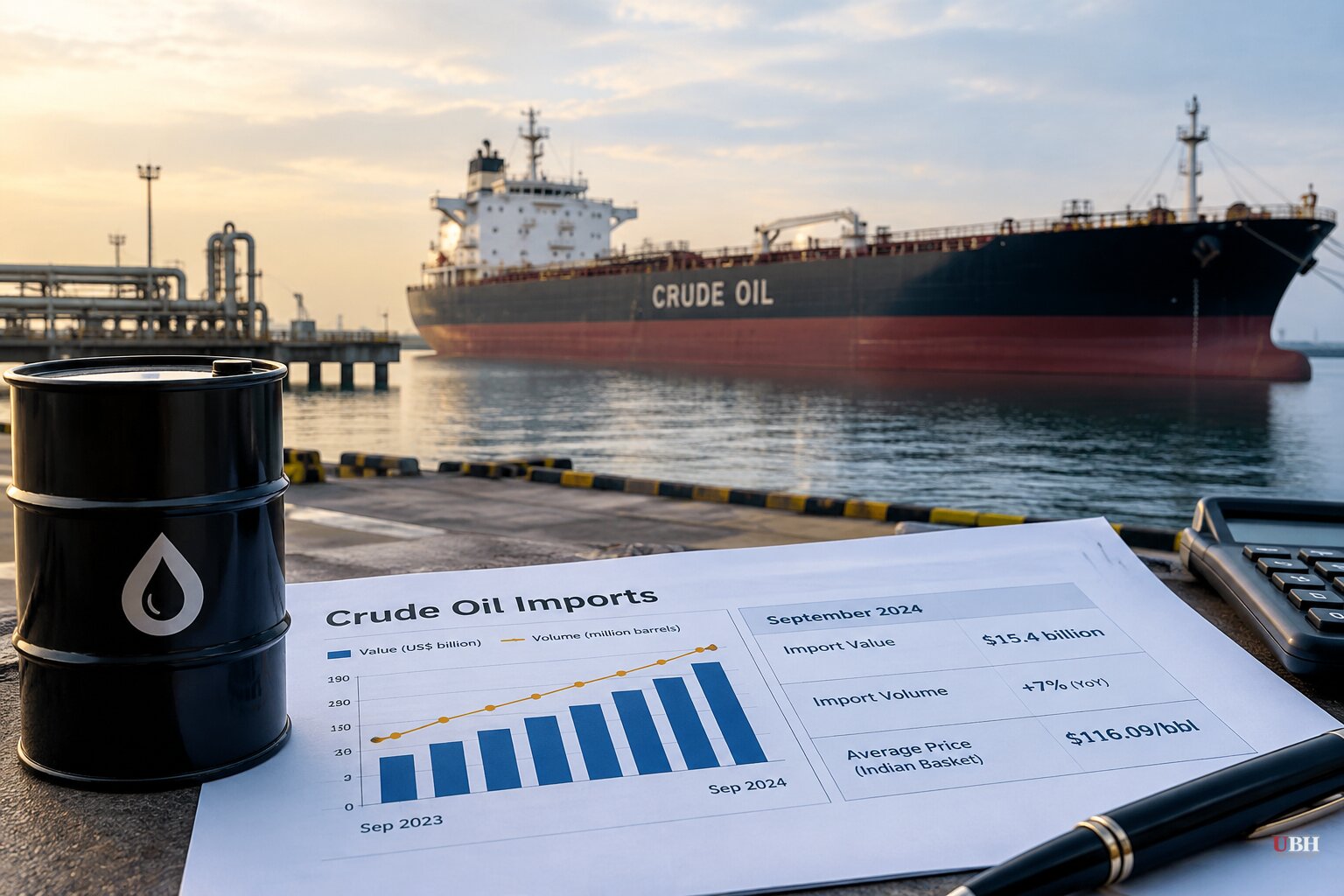
India bought 7% more crude in September than a year ago and paid about 47% more for it. Price did the damage, not appetite.
Provisional data from the Petroleum Planning and Analysis Cell (PPAC) show India imported 21.7 million tonnes of crude in September, up from 20.3 million a year earlier. The bill came to $15.4 billion, against $10.5 billion in September 2025. The Times of India put the year-on-year rise at 46%, The Hindu at 47%.
The price gap
The Indian crude basket averaged $116.09 per barrel in September. A year earlier it was $69.61. In August 2026 it was $90.19.
The basket hit a monthly peak of $130.19 on Sept. 15. Brent averaged $116.77 for the month, up from $90.84 in August and $68.02 in September 2025.
Measured against August rather than a year ago, the Hindustan Times reports the bill rose 31.6% in a single month, to $15.4 billion from $11.7 billion, while volumes rose 14.2%, to 21.7 million tonnes from 19 million tonnes.
Over April through September, the first half of India's 2026-27 fiscal year, volumes were nearly flat: 122.7 million tonnes against 121.8 million. The bill jumped to $90.6 billion from $61.9 billion, a 46.4% rise by the Hindustan Times' calculation.
That half-year window includes the surge in global oil prices after shipping through the Strait of Hormuz was disrupted, according to the Hindustan Times' reading of the PPAC figures.
The wider energy bill
LNG followed a different pattern. Volumes fell 8.5% to 2,957 million standard cubic metres from 3,233 million, but the LNG bill stayed flat at $1.2 billion.
India's net oil and gas import bill, which counts crude, products and gas minus product exports, rose roughly 40% to $13.4 billion from $9.6 billion. For April to September it rose 35% to $81.1 billion from $60.2 billion.
Petroleum product exports fell 24.2% to 4.7 million tonnes in September. Revenue from those exports still rose about 20% to $4.8 billion, which cushioned the net figure.
Russian crude and a revocable waiver
The price spike landed in the middle of a Washington decision that matters directly to Indian refiners. President Donald Trump signed the Lindsey O. Graham Sanctioning Russia and Iran Act on Sept. 18. It authorized tariffs of up to 100% on goods from the five largest buyers of Russian crude and gas, plus sanctions on Russia's shadow fleet of tankers.
Late on Friday, Oct. 16, a day before the 30-day enforcement deadline, Trump issued an executive order waiving the law's "sanctions, restrictions, and duties." The waiver has no expiry date. The president or the secretary of state can withdraw it whenever they choose.
It is not specific to India. China, the second-largest buyer, could benefit too.
Ship-tracking data show India took about 1.82 million barrels a day of Russian crude in September, against about 1.49 million for China. Kpler expects India's October imports at 1.8 to 1.9 million barrels a day. That is well below the June peak of 2.6 million and July's 2.57 million.
Russian Urals crude traded at an average discount of $23 a barrel to Brent in September, according to Swarajya. Analysts quoted by Business Standard expect refiners to keep buying at close to current levels.
Industry executives, speaking anonymously to the Hindustan Times, said refiners began cutting Russian purchases before the bill became law. They put the drop at about a third since July. Replacement barrels from the U.S., West Africa, South America and traditional West Asian suppliers cost more, they said, partly because of freight and insurance.
Those executives and industry experts told the paper the waiver is only temporary relief. In their view, the secondary sanctions have been deferred, which leaves Trump free to use the law against India and China at will. They also said it offers no long-term assurance for India's energy security or for its trade talks with Washington, where New Delhi wants a tariff edge over competing exporters.
October is not easing
The basket averaged $122.01 per barrel for October so far, above September's $116.09. It stood at $119.39 on Oct. 15.
Brent has climbed to about $110, its second straight weekly gain, according to Times Now. Eurasia Group analysts raised their odds of an intensified conflict to 65% from 35%. "The standoff status quo is no longer sustainable for the US," they wrote.
Washington is trying to bring prices down. The U.S. offered up to 17 million barrels from the Strategic Petroleum Reserve on Friday. On Oct. 9 the Treasury permitted the sale and import of Russian diesel into global markets, including the U.S., until April 7, 2027.
The diesel move has run into resistance at home. U.S. lawmakers have introduced legislation to block a proposed arrangement involving Russian diesel releases.
CNN reports that an increase in attacks on tankers and oil infrastructure over the past week, with Iran and its Houthi allies blamed, has pushed oil and diesel prices higher. Kpler data cited by CNN show oil and fuel transits through the Strait of Hormuz have fallen to 54% of pre-war levels over the past seven days, after having almost fully recovered a few weeks earlier. Times Now, by contrast, describes Hormuz shipments as having recovered toward pre-war levels. The two accounts differ on how disrupted traffic is right now.
The pain is not confined to India. U.S. consumer prices rose more than expected in September. Gasoline rose 9.1% on the month and is more than 34% above a year ago, according to the Consumer Price Index data CNN cited. Moody's Analytics estimates the Iran war costs the average American household $2,000.
What to watch
India's October import bill will show whether the $122 basket average pushes spending past September's $15.4 billion. The larger open question is the waiver. Trump signed the Graham Act on Sept. 18 and suspended its penalties on Oct. 16, and the order leaves him free to reinstate them. Delhi's refiners and trade negotiators are planning around that.
Sources used for this briefing
7 links from 7 independent newsrooms (syndicated copies of the same report count once)
These are the sources it draws on, linked so you can verify.


