
Unbiased headlines. Facts, not spin.
Unbiased Headlines is an independently owned news organization. We bring you the facts, not opinions, written fresh from 110+ named sources. Sources linked so you can verify it yourself.
 economy
Major Story (7/10)
Event date: October 14, 2026 ·
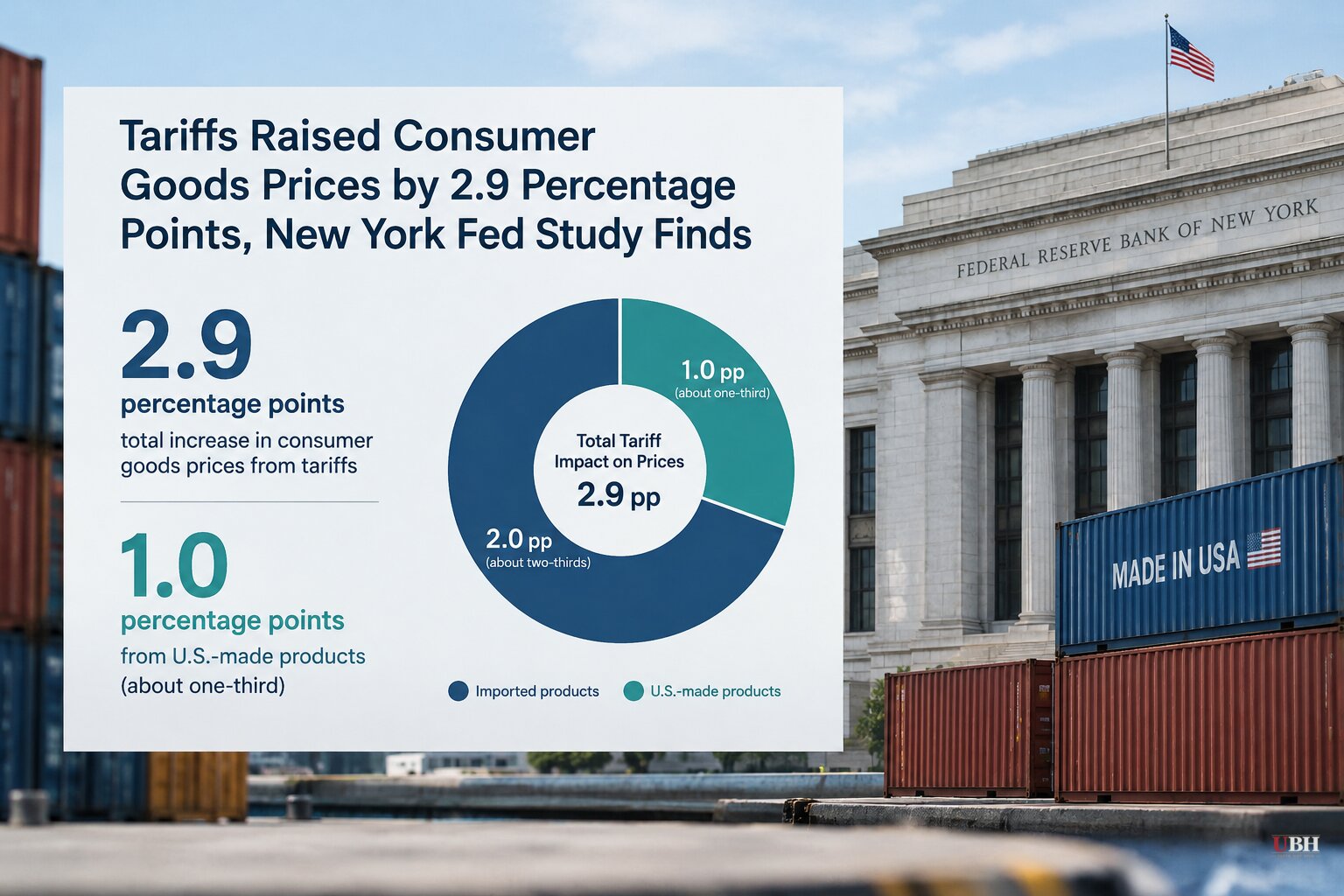
New York Fed Study Finds Tariffs Added About 2.9 Points to Goods Prices, One-Third From U.S.-Made Products
Since the September CPI report showed inflation at 3.7%, two new data points have sharpened the picture: a New York Fed study on who pays for tariffs, and an AP-NORC poll showing how voters grade the president on prices.
What the New York Fed found
Researchers at the Federal Reserve Bank of New York estimated that tariffs added about 2.9 percentage points to prices across the consumer goods they studied. Without the tariffs, they found, prices across those goods would have fallen last year and into early 2026. Instead, they rose.
The finding that stands out: the damage was not confined to imports. The researchers estimated about two-thirds of the tariff-related increase came from imported goods and roughly one-third from products made in the United States.
The research also found that tariff-related price increases can take up to a year to fully reach consumers, particularly when American manufacturers face higher costs for imported materials and components. The researchers estimate the inflationary impact of existing tariffs has largely peaked, but they expect consumer goods prices to remain higher than they otherwise would have been.
Economists had warned about this for years. Measuring it was harder, because trade policy kept shifting and companies chose differently on whether to absorb costs or pass them on.
The White House response
White House spokeswoman Taylor Rogers did not dispute the research directly. She told Fox News Digital that "President Trump's America First trade agenda is reshaping the international economic order to reduce our trade deficit, revitalize American manufacturing, and deliver lasting benefits to our workers, farmers and producers."
Rogers added that the administration maintains foreign exporters, who depend on access to the U.S. market, will ultimately bear the cost of tariffs.
The New York Fed study measured prices paid on the goods Americans buy. The administration's argument is about who ultimately absorbs the cost, and the two have not been reconciled.
Scott Lincicome of the Cato Institute told Fox News Digital that consumers may not see significant relief while tariffs remain. "What we know is that the tariffs have increased prices a bit," he said. "What we don't know is whether the prices will stay where they are or go up even a little bit more as companies finally cave and start passing on more of the tariff costs onto consumers." He also called it "a double whammy for American consumers" because energy prices spiked on top of the tariffs because of the Iran war.
September CPI: energy did the damage
The Bureau of Labor Statistics said the Consumer Price Index rose 0.6% in September on a seasonally adjusted basis, after a 0.4% gain in August. Over 12 months, the all-items index rose 3.7% before seasonal adjustment.
The progressive group Groundwork Collaborative, in its analysis of the data, said gasoline jumped 9.1% in September alone, accounted for over half the monthly increase, and is up 34% from a year ago. It put core CPI, which excludes food and energy, at 0.33% for the month, the largest monthly rise since April.
White House National Economic Council Director Kevin Hassett said on Fox Business that the energy shock is "really the headline story" in the report. A White House official told Fox News Digital that "President Trump is bringing inflation down after it was astronomically high under Biden," and pointed out that food prices were unchanged in September. The BLS confirms the food index was unchanged after rising 0.1% in each of the two prior months.
House Democratic Caucus Chair Pete Aguilar called the Trump economy "a total failure." Democratic Whip Katherine Clark said "Inflation remains too high, as families struggle to afford the basics."
Voters are not buying it
The AP-NORC poll released Thursday found 82% of Americans disapprove of Trump's handling of cost-of-living issues, with 17% approving. The poll also showed 65% of Americans blamed Trump's policies for high prices more so than factors beyond his control, compared with 44% for Biden just before the 2022 midterm elections.
Historical comparisons are rough. George W. Bush hit 77% disapproval on the economy in a CBS News/New York Times poll after the 2008 financial crisis. Jimmy Carter peaked at 74% in 1980 in the same pollster's survey. CNN, which compiled the comparisons, noted that disapproval of Trump on the Iran war stands at 73% in its own poll.
Groundwork says consumers' views of current economic conditions are at an all-time low. Its Alex Jacquez blamed "the president's war in Iran and reckless tariffs." That is a progressive advocacy group's assessment. Groundwork also says the Fed's latest meeting minutes pointed to tariffs, higher energy costs and the war with Iran as drivers of persistent inflation.
The Fed is next
Groundwork says the Fed raised interest rates last month for the first time in three years and that most officials anticipate another increase by the end of the year. The Federal Reserve's next rate decision is scheduled for Oct. 28, and the September CPI was the last inflation report before it.
Groundwork also claims Trump is promising a $5,000 "Trump dividend" if Republicans hold Congress, and says he never delivered the DOGE and tariff checks he promised last year.
Higher borrowing costs would land on the same households already paying more for gasoline and goods. Whether the Oct. 28 decision brings another hike will be a key economic data point for voters ahead of the midterms.
Sources used for this briefing
6 links from 4 independent newsrooms (syndicated copies of the same report count once)
These are the sources it draws on, linked so you can verify.


