
Unbiased headlines. Facts, not spin.
Unbiased Headlines is an independently owned news organization. We bring you the facts, not opinions, written fresh from 110+ named sources. Sources linked so you can verify it yourself.
 economy
Major Story (7/10)
Event date: October 16, 2026 ·
TSMC Posts Record Q3 Profit of NT$763 Billion and Raises 2026 Outlook, but Shares Slip
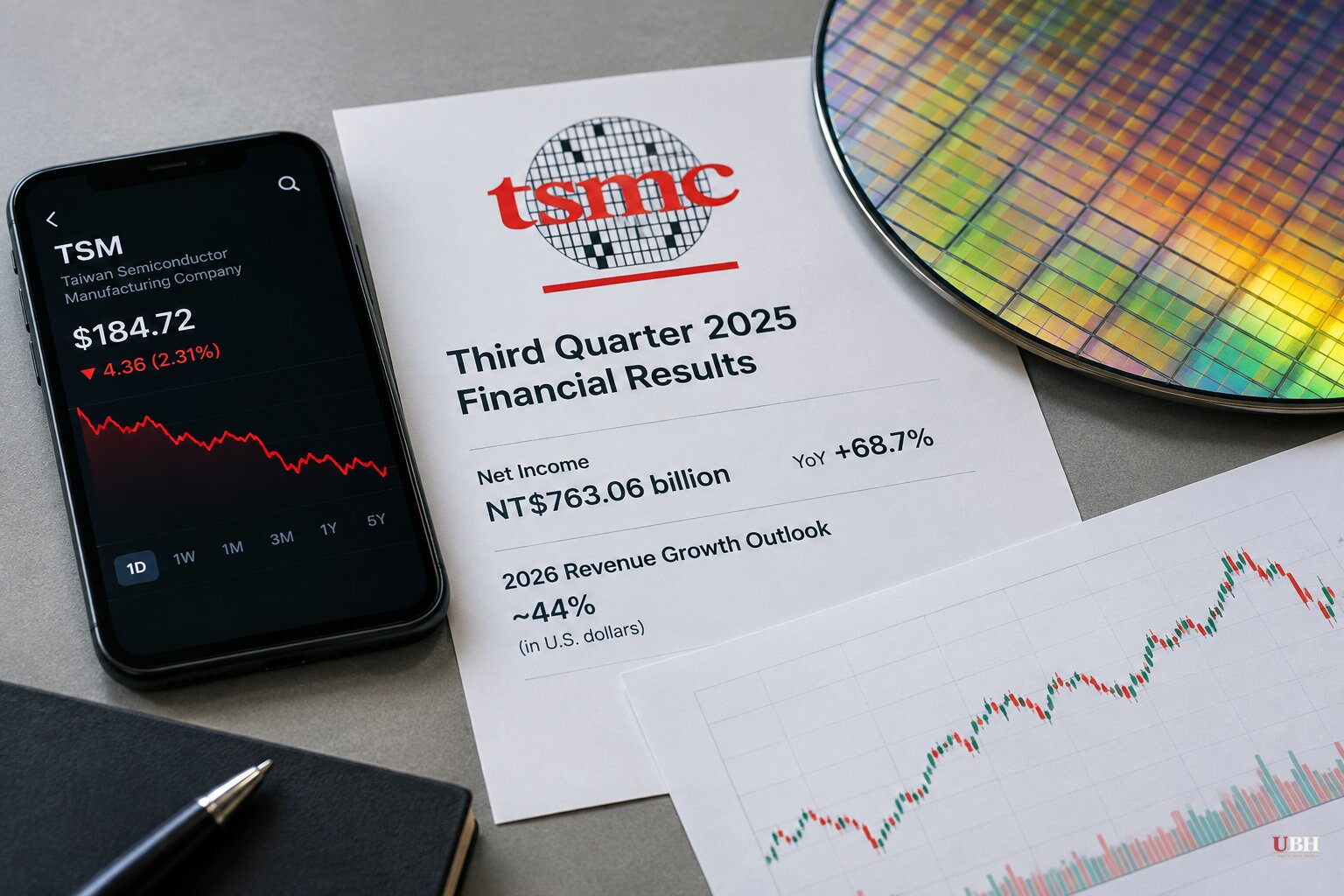
TSMC had a monster quarter. Its stock still went down.
On Thursday, Oct. 15, the world's largest contract chipmaker reported third-quarter revenue of NT$1,494.24 billion, about $46.72 billion. That is up 50.9% from a year earlier in Taiwan dollars and 17.6% from the second quarter. In U.S. dollar terms, the company put the year-over-year increase at 41.2%.
Net income hit NT$763.06 billion, about $23.59 billion. That is a record for the sixth straight quarter, up 68.7% from a year ago and 8.0% from the second quarter.
The numbers
Diluted earnings came to NT$29.43 per share, or $4.60 per U.S.-listed ADR. Analysts had expected about $4.46, and revenue beat a consensus of roughly $45.7 billion.
Gross margin was 66.4% and operating margin was 58.7%. The operating margin topped the 56% to 58% range TSMC had guided for the quarter.
Gross margin did slip 1.3 percentage points from the second quarter's 67.7%. The company blamed margin dilution from the early ramp of its 2-nanometer (N2) technology.
High-performance computing, the category covering AI accelerators and data center processors, made up 68% of net revenue, up from 57% a year earlier. Smartphones were 21%.
By process, 3nm chips were 33% of wafer revenue, 5nm were 28%, 7nm were 10% and 2nm were 8%. Chips at 7nm and below made up 79% of wafer revenue.
TSMC did not disclose 2nm wafer volumes or yields.
Guidance and spending
TSMC expects fourth-quarter revenue of $52.3 billion to $54.3 billion, a gross margin of 65% to 67% and an operating margin of 56.5% to 58.5%. Those margin figures assume an exchange rate of 31.8 New Taiwan dollars to the dollar.
Full-year 2026 revenue is now forecast to grow about 44% in U.S. dollars, up from a prior forecast of more than 40%.
Third-quarter capital spending was $13.84 billion. TSMC said spending over 2026 to 2028 will rise substantially compared with the prior three years. It plans to expand 3nm capacity in Taiwan, with output from that expansion expected in the first half of 2028, and has committed an additional $100 billion to Arizona.
Chief Financial Officer Wendell Huang said the company expects fourth-quarter business "to be supported by continued strong demand for our leading-edge process technologies, including the steep ramp-up of our 2-nanometer technology."
CEO C.C. Wei was bullish on AI demand. "We observe increasing AI demand fueled by the rising adoption of agentic AI as we transition from chatbot to AI assistance," he said, adding that recent developments are "very positive to AI's long-term demand outlook."
Why the stock fell anyway
TSMC's U.S.-listed shares were down about 2.2% Thursday afternoon after dropping more than 5% at one point, according to The Motley Fool's market recap. The week was ugly for AI names. The VanEck Semiconductor ETF was down 8.2% for the week as of Thursday afternoon, and CoreWeave had fallen 17.6%.
The Motley Fool pointed to worries about rising interest rates, circular financing deals and competition from China as weights on the AI trade. It also noted that Wei flagged pressure on consumer and price-sensitive end-market segments.
Management also expressed caution about 2027, citing broader economic uncertainties. That sits awkwardly next to Wei's view that there is no sign of a slowdown in AI infrastructure demand.
A strong quarter did not offset a skittish market. Thursday's trading bore that out.
Memory is the other bottleneck
TSMC is not the only AI supplier running hot. Memory chips are in short supply worldwide as makers shift capacity to the high-bandwidth memory (HBM) that AI processors use.
The Center for Strategic and International Studies said in a September report that a gigabyte of HBM takes about four times the factory space of a gigabyte of standard DRAM. That leaves less room for phones and computers.
Apple raised Mac and iPad prices in June. On its July earnings call, the company described a "100-year flood" in memory pricing.
Micron, the only U.S.-based HBM maker, makes about 50 to 60 percent of its chips in Taiwan. On Oct. 7, the union at its Taoyuan plant said 1,994 of its 2,258 eligible members voted to authorize a strike. That was 99 percent of the 2,012 ballots cast, and Taiwanese law requires approval from more than half of all members.
The union wants 15 percent of Micron's operating profit paid through a permanent formula rather than one-time bonuses.
Micron said it respects employees' legal rights and will keep engaging with its unions in good faith. Taiwan's Ministry of Labor said it respected the vote and urged Micron to put clear proposals on the table.
Micron's Taiwan executives said on Oct. 1 that memory supply in 2027 and 2028 will be even tighter than this year, and that most of next year's HBM output is already sold.
What to watch
A strike at Taoyuan, which mainly makes DRAM, would hit a tight market. The bigger exposure is Taichung, Micron's largest Taiwan site. About 11,000 of its roughly 12,300 workers belong to a different union that could also vote to strike if mediation fails, according to Taiwan People News. A second advanced packaging plant there was set to begin HBM production in mid-October.
On TSMC's side, the checkpoints are specific. They are whether fourth-quarter revenue lands inside the $52.3 billion to $54.3 billion range, how fast 2nm climbs from its 8% share of wafer revenue, and whether management's 2027 caution firms up when it reports next.
Sources used for this briefing
7 links from 7 independent newsrooms (syndicated copies of the same report count once)
These are the sources it draws on, linked so you can verify.


