
Unbiased headlines. Facts, not spin.
Every story is an unbiased news briefing written from 110+ sources across the spectrum — sources linked so you can verify it yourself.
 defense
Major Story (8/10)
June 22, 2026 at 08:16 AM
defense
Major Story (8/10)
June 22, 2026 at 08:16 AM
US-Iran Talks End Round One With a 60-Day Roadmap, a De-confliction Cell, and an Unresolved Fight Over Frozen Assets
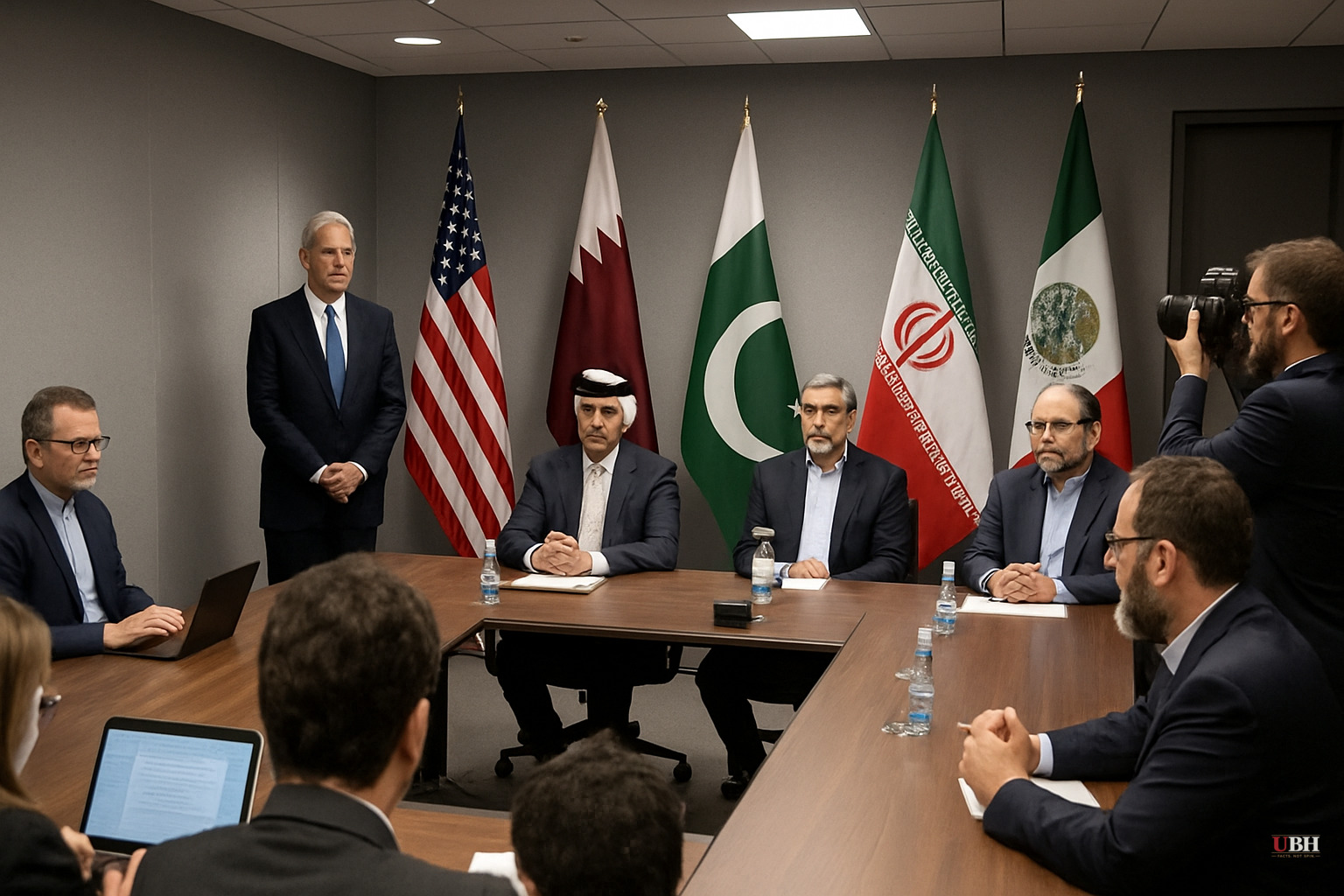
Since the MOU was signed at Versailles on June 17, the US-Iran diplomatic track has moved fast on paper and slowly on the ground. As of this morning, June 22, the first full negotiating round at Switzerland's Bürgenstock resort has wrapped, and the results are real but incomplete.
What the talks actually produced
Qatar and Pakistan issued a joint statement early Monday declaring "encouraging progress" and announcing that a "High Level Committee" had been formed to provide political oversight of the mediation. According to CNBC, chief negotiators will report to that committee and lead working groups on nuclear issues, sanctions, and dispute resolution.
The parties also agreed to create a "de-confliction cell" between the US, Iran, and Lebanon, facilitated by the two mediating countries, aimed at achieving full termination of military hostilities in Lebanon. Iranian Foreign Minister Abbas Araghchi, posting on X, called this the "first real test" of the agreement, an honest acknowledgment that nothing is secure yet.
A senior Pakistani official and an Iranian official told CNBC the talks ran into the early hours and were "constructive but tense." A senior US diplomat pushed back on reports that Iran had walked out, saying both delegations remained engaged.
Technical talks are continuing through the week.
Lebanon is the live wire
The Lebanon angle is where this deal could unravel fastest. The BBC reported that since the MOU was signed, fighting between Hezbollah and Israeli forces in southern Lebanon actually picked up, with Israeli air strikes killing dozens of Lebanese civilians according to the Lebanese health ministry. A new ceasefire was declared Friday. Whether it holds is another matter.
Israeli Prime Minister Benjamin Netanyahu stated plainly that Israeli forces would remain in southern Lebanon "for as long as necessary" to protect northern Israel. Hezbollah leader Naim Qassem has rejected the ceasefire terms, according to BBC.
On Sunday, Trump posted that Iran "must immediately stop their highly paid PROXIES in Lebanon from causing trouble" and threatened to "hit Iran very hard again." That post landed while VP JD Vance was already sitting at the negotiating table in Switzerland. Iran's lead negotiator Mohammad Bagher Ghalibaf responded publicly: "Don't they think that if their threats had any effect, they wouldn't be in this desperate situation today?"
Meanwhile, according to ZeroHedge citing Israel's KAN broadcaster, Syrian President Ahmad al-Sharaa is "unprepared and unwilling" to launch any military offensive against Hezbollah despite US pressure to do so. A Syrian source told KAN that Sharaa is concerned such a move would be seen regionally as serving Israeli interests, damaging Damascus's legitimacy. Turkey has also reportedly urged Syria against any incursion into Lebanon. That removes a key piece of the US's hoped-for pressure architecture on Hezbollah.
The frozen assets fight
The most durable source of friction is money. Fox News reported that Alex Vatanka, a senior fellow at the Middle East Institute, called the frozen funds dispute "one of the central political tests of trust between Tehran and Washington" and predicted it will become "one of the first major implementation disputes in the weeks ahead."
Iranian President Masoud Pezeshkian said Sunday that $6 billion in frozen funds held in Qatar "will be returned." Fox News reported that Iranian state media has cited a figure of $24 billion as Tehran's expectation for near-term asset releases. Paragraph 11 of the MOU framework states the US "undertakes to make fully available" restricted and frozen Iranian funds, but the release is tied to a step-by-step compliance process, not a lump-sum transfer.
Trump said publicly at Versailles: "We have taken their money, it isn't our money, it is their money, and we froze it. At a certain point in time, I guess we're going to have to give it back." He also wrote on Truth Social that Iran would receive "not ten cents" during the 60-day period if it violated its commitments. Vatanka told Fox News that the total amount of Iranian assets frozen abroad is itself contested. Iran often cites more than $100 billion, while Western estimates generally run lower, and immediate talks focus on roughly $24 billion.
Araghchi's public post Monday claimed Iran had already secured "waivers for oil and petrochemical exports, lifting of the blockade, some frozen assets released, and a reconstruction plan launched." That framing is more optimistic than what mediators confirmed in their joint statement, which described a roadmap and committee structure rather than completed transfers.
What's happening in the oil market
The most immediate signal of where markets stand: Brent crude fell back to around $79 a barrel Monday after the 60-day roadmap was announced, per Bloomberg, reversing an earlier 2.2% gain driven by Trump's renewed threats. WTI was near $75.
Bloomberg also reported that three US-sanctioned Iranian supertankers, the Elva, Virgo, and Vigor, carrying roughly 6 million barrels of Iranian crude, entered the Strait of Hormuz early Monday, all indicating course for waters off Singapore. Iranian crude spot prices to China have been slashed to discounts of $2.50 to $5 per barrel below Brent, compared to roughly $1 before the deal, according to Bloomberg sources directly involved in the trade.
David Roche of Quantum Strategy warned in a Monday report, cited by CNBC, that apparent Middle East oil supply near pre-war levels reflects inventory liquidation from storage and tankers, not recovered production. Once those stockpiles are drawn down, the market remains vulnerable.
The public wants this over
A CBS News/YouGov poll conducted June 17-19, covering 2,519 US adults with a ±2.4 point margin of error, found 78% of Americans want the conflict with Iran ended now. Even among MAGA Republicans, 56% said end it now, per Breitbart's coverage of the survey. That gives the administration strong political backing to close a deal.
A 60-day roadmap is not a deal. The frozen funds dispute has already produced competing public narratives from Tehran and Washington. Hezbollah has rejected the ceasefire. Syria has ruled out the military pressure role the US was counting on. These are real obstacles that warrant caution until Lebanon stabilizes and at least one tranche of frozen assets is processed without a public confrontation.
The de-confliction cell for Lebanon is the first concrete mechanism that could either validate or invalidate this entire framework. Araghchi said so himself. Whether US, Iranian, and Lebanese representatives can operationalize that cell before the next flare-up in southern Lebanon is the single most consequential unknown left on the board as of June 22.
Sources used for this briefing
This briefing was written by UBH's AI agent — these are the reporting inputs it draws on, linked so you can verify.


