
Unbiased headlines. Facts, not spin.
Unbiased Headlines is an independently owned news organization. We bring you the facts, not opinions, written fresh from 110+ named sources. Sources linked so you can verify it yourself.
 energy
Major Story (8/10)
U.S. Exporters Shipped $230 Million in Fuel to Cuba Under the 'Blockade' as Trump Adds Sanctions and Floats Force
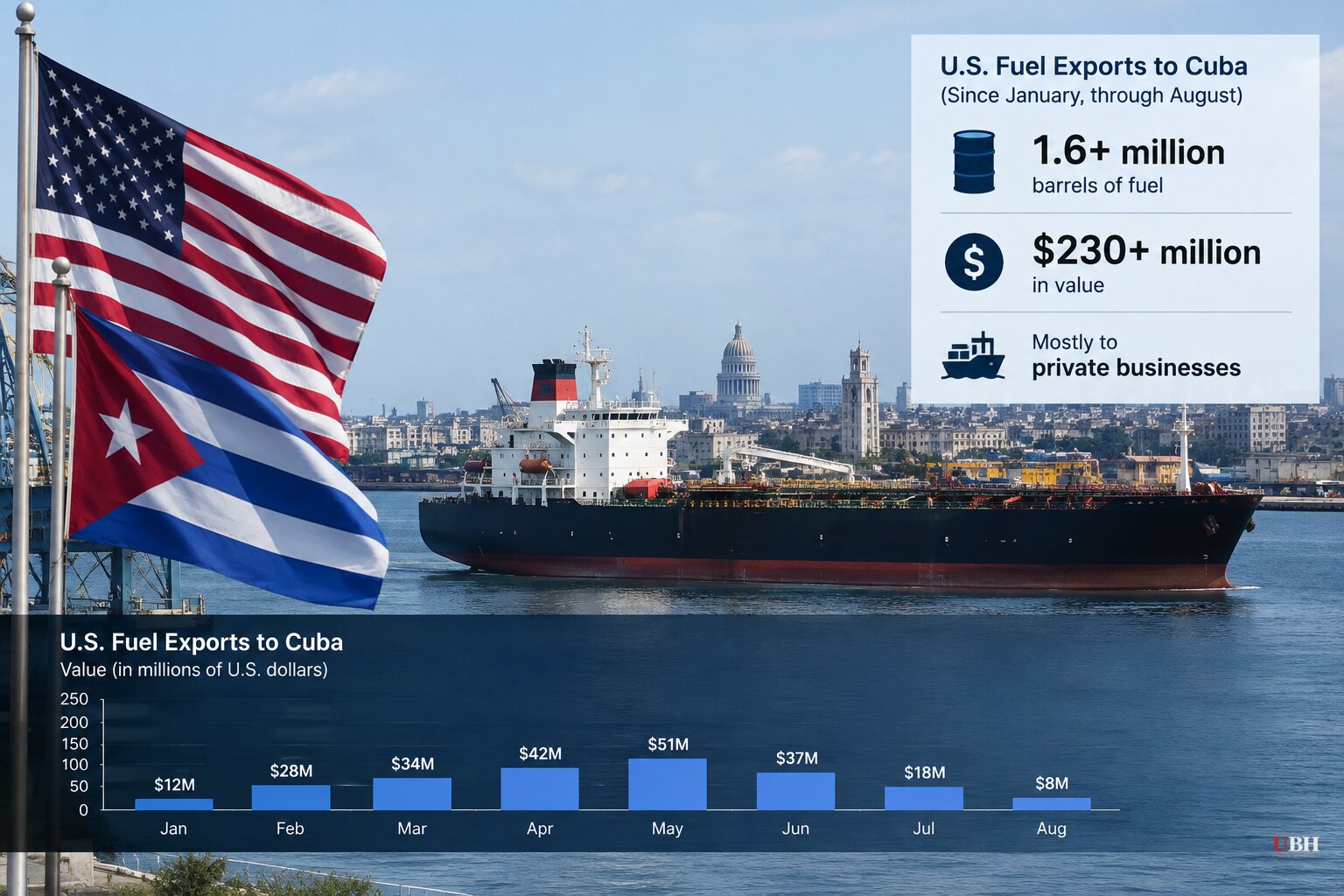
The U.S. oil embargo on Cuba has produced a strange result. American exporters are now the island's main fuel supplier.
A Wall Street Journal analysis of trade data found that U.S. ports shipped more than 1.6 million barrels of fuel to Cuba, worth over $230 million, through August, according to U.S. Census Bureau figures. That is despite what President Trump called an "ironclad energy blockade" that began in January.
Only one oil tanker, from Russia, has docked in Cuba since then. By May, the Communist government said it had run out of fuel oil and diesel.
How the fuel gets in
The Trump administration began allowing U.S. fuel sales to private businesses on the island weeks after the embargo started. Dozens of mostly south Florida companies now export gasoline and diesel, according to the trade data platform ImportGenius. Most shipments leave from Port Everglades, Jacksonville and Houston.
Some exporters told the Journal that profit margins topped 50% earlier this year. Competition has since cut into that.
The fuel is visible on the ground. "Right now we are seeing a lot of cars and trucks driving in our streets because we have gasoline and fuel that's imported from the U.S.," said Oniel Díaz Castellanos, who runs a business consulting service in Cuba. A few months ago, he said, "our streets were absolutely empty."
Most Cubans still get electricity only a few hours a day. Household generators, fed by U.S. fuel, keep food from spoiling and fans running in the heat.
Some of that fuel reaches the very government Washington is trying to squeeze, according to the Journal's reporting.
Havana's complaint
Cuba's deputy minister for foreign trade and investment, Carlos Luis Méndez, called the arrangement "ironic." He told the Journal that Washington appears intent on making Cuba dependent on U.S. fuel, which he called "completely unacceptable."
A White House spokeswoman declined to respond to that allegation. She said the administration is seeking a "fundamental change" in Cuba. The Treasury Department did not respond to a request for comment.
The policy logic is visible in the structure. Fuel to private businesses is allowed. Fuel to the state and its military-linked companies is the target. Small businesses are taking over sectors once reserved for state enterprises, including distribution of food and basic goods, as the state economy suffers its worst crisis since the Soviet collapse.
It is unclear whether that line will hold in practice. Federal agencies have announced the seizure of 90 fuel shipments allegedly headed from the U.S. to a sanctioned Cuban entity, which indicates enforcement is happening on at least some of the flow.
The Nov. 5 sanctions
On Thursday, Nov. 5, Secretary of State Marco Rubio announced sanctions on ten targets, eight entities and two individuals, and identified five vessels as blocked property. The designations fall under Executive Order 14404, which Trump signed May 1, 2026.
The targets include:
- Caroil Transport Marine Ltd., a Cyprus-based company that manages Cuban-flagged tankers. It was previously sanctioned in 2019 under Venezuela-related measures.
- Petroleos Maritimos del Caribe S.A. (Petromarca), a Cuban shipping company.
- Tentacool Commercial Inc., a Panama-based company that is the registered owner of the tanker Gloria C.
- Internacional Maritima SA, the Cuba-based owner of the crude tanker Esperanza.
- Guillermo Faustino Rodríguez López-Calleja, whom the State Department linked to a network of offshore shipping companies moving Cuban crude and petroleum products.
- Any Rodríguez Lastres, designated as an adult family member of Ania Guillermina Lastres Morera, the president of GAESA, the military's business conglomerate. Lastres Morera was already under sanctions.
The vessels are the Esperanza, Gloria C and Maria Cristina, managed by Caroil, and the Emilia and Lourdes, managed by Petromarca. Three were already on earlier Venezuela-related lists. Emilia and Gloria C are new additions.
The State Department also designated two China-based companies, China National Electronic Import and Export Co. (CEIEC) and Beijing H&C Technologies, for allegedly exporting military equipment to Cuba in 2026. The fact sheet says CEIEC contracted this year with Sociedad Mercantil Duna S.A. to supply components for equipment used by Cuba's Ministry of Revolutionary Armed Forces.
A new Treasury determination opens the door to sanctions on foreign persons operating in Cuba's marine, manufacturing, electronics and technology sectors. Foreign shippers and service providers now carry added exposure. The State Department said existing authorizations for humanitarian trade, including food and medicine, stay in place.
"The United States will not tolerate subversive communist networks in our hemisphere," Rubio wrote on X. He said the Cuban regime "relies on a web of state-owned enterprises, joint ventures, and offshore intermediaries to keep its systems running."
How we got here
The squeeze traces to Jan. 3, when a U.S. military operation captured Venezuelan leader Nicolás Maduro. Washington then restricted oil shipments to Cuba, cutting off the subsidized Venezuelan crude that had been the island's main economic lifeline.
On May 20, Raúl Castro was indicted in the United States on murder charges.
Trump on force
In a radio interview today, Nov. 12, Trump told Hugh Hewitt: "I want to get Cuba done before I leave." His term ends in January 2029.
He called Cuba "essentially a failed, you know, place, nation, whatever you want to call it." Asked whether he would be comfortable with a limited military campaign, perhaps a week long, he said, "I would certainly consider that, yes."
He added that Rubio, whose parents are from Cuba, "would love to do that."
Trump has given no timeline beyond "before I leave." That leaves a policy with two tracks running at once. One is sanctions on Cuban tankers and military suppliers. The other is a growing stream of American fuel that is sustaining the island's private economy. Whether the administration tightens the fuel exemption for private businesses, or tries to replace it with something else, is the decision that will show which track it considers primary.
Sources used for this briefing
5 links from 5 independent newsrooms (syndicated copies of the same report count once)
These are the sources it draws on, linked so you can verify.


