
Unbiased headlines. Facts, not spin.
Unbiased Headlines is an independently owned news organization. We bring you the facts, not opinions, written fresh from 110+ named sources. Sources linked so you can verify it yourself.
 energy
Notable (5/10)
Event date: November 10, 2026 ·
Supreme Court Justices Sound Skeptical of North Dakota Landowners' Bid for Legal Fees From Pipeline Company
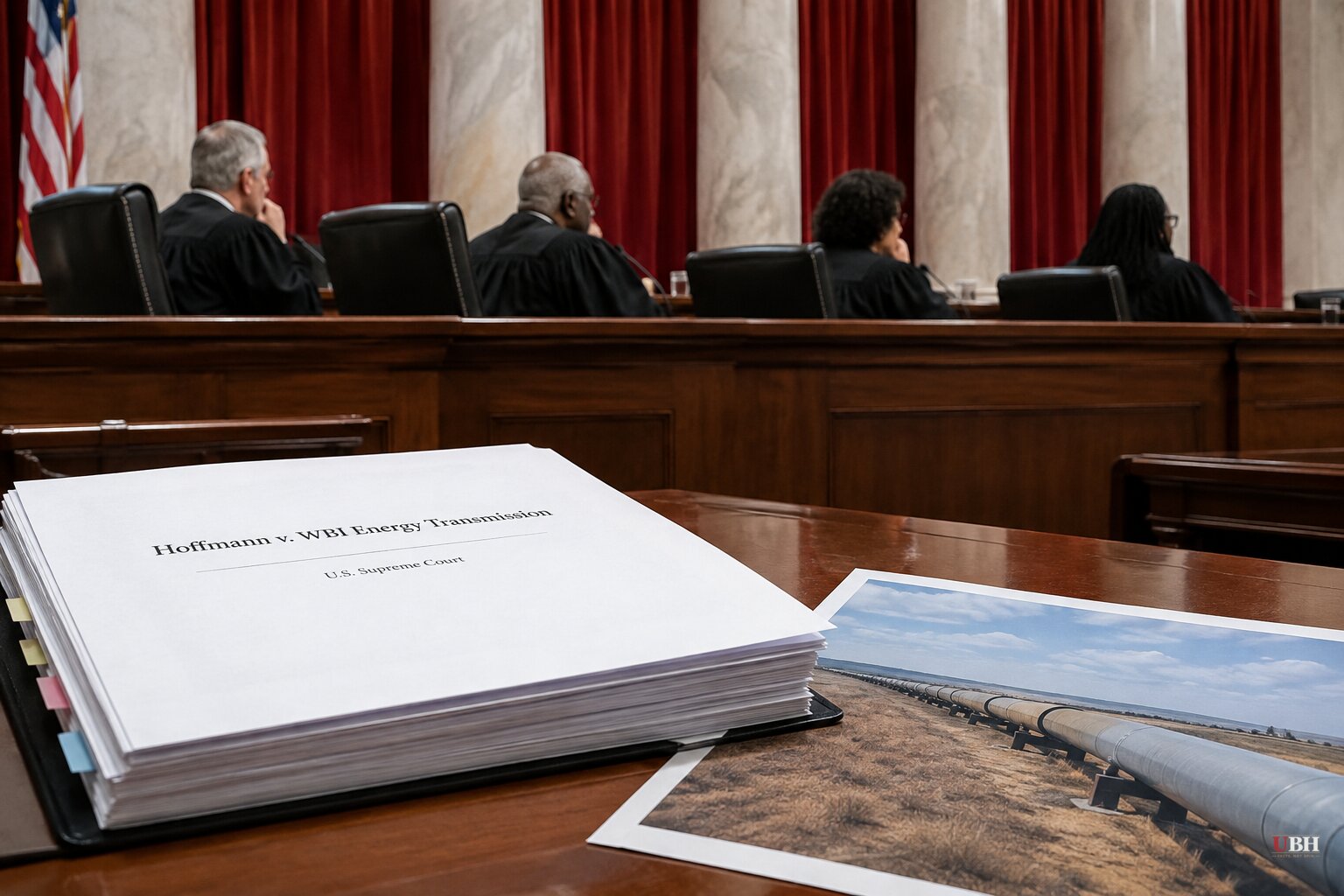
The U.S. Supreme Court heard a fight on Monday, Nov. 9, over who pays the lawyers when a private pipeline company takes ranchland under federal eminent domain power. The justices did not sound persuaded by the landowners.
The case is Hoffmann v. WBI Energy Transmission, Inc. The Court has not ruled.
How a land dispute became a fees case
In 2018, WBI Energy Transmission told North Dakota rancher Leonard Hoffmann and other landowners that it planned to take an easement across their ranchland for a natural gas pipeline. WBI is a private company, but it holds a federal certificate that lets it exercise eminent domain under the Natural Gas Act.
The Institute for Justice, which represents the landowners, says WBI first offered about half the market value of the property. The owners challenged the number and took the dispute to court. The parties eventually reached a settlement over the value of the property.
That settlement did not resolve who covers the owners' legal costs. The federal district court in North Dakota held that state law governs the question and ordered WBI to reimburse them. The award came to $383,375.76 in attorneys' fees and litigation expenses, according to SCOTUS Analytics.
The Eighth Circuit reversed in March 2025. It ruled that federal law, not state law, governs compensation in these cases, reasoning that a private company exercising eminent domain powers under the Natural Gas Act stands in the position of the federal government. The landowners then took the question to the Supreme Court.
The landowners' argument
Robert McNamara, the Institute for Justice's deputy litigation director, argued for the owners. His core point: the Natural Gas Act lets private companies ask courts for forced sales of land, but says nothing about which substantive law sets what the land is worth.
"That silence matters because, on its own, authorizing companies to file condemnations does nothing to preempt state laws defining the measure of compensation," McNamara told the justices.
He conceded that state law would not apply if the United States took land in its own name. But he said nothing in the statute extends the federal government's sovereign immunity to private companies, "and that means they don't have it."
The landowners also argue, with some support in lower courts, that North Dakota law requires more compensation than the federal Constitution does, and that this well might include attorneys' fees.
What the justices said
Justice Clarence Thomas, who is normally more receptive to property rights arguments, opened with doubt. He asked whether delegating federal eminent domain power means the delegation "brings with it state law trappings of just compensation."
Chief Justice John Roberts went further. "It seems to me it's just a more efficient process to have a private developer get the land under the same terms as the federal government without having to pay the attorneys' fees that the state wants to insist on," he said. When McNamara held his ground, Roberts added: "I don't understand why this isn't an easy case."
Justice Sonia Sotomayor pressed a different line. She said McNamara was trying to separate the right to take land from the right to compensation, and cited an 1893 decision calling the two "inseparably connected."
Justice Ketanji Brown Jackson challenged his premise that state law is the default and must be displaced by an express act of Congress. If that were so, she asked, why did Congress bother to import state law explicitly in a condemnation statute passed in 1946, a year before the Natural Gas Act?
Justices Brett Kavanaugh and Amy Coney Barrett pressed McNamara on the same point, taking it as self-evident that the 1946 statute importing state law suggested that a 1947 statute silent on the topic calls for the baseline federal rule.
The justices came at the question from different angles. Few of them appeared to accept the landowners' reading.
The property-rights objection
Not everyone watching thinks the justices have it right. Damon Root, writing in Reason, called McNamara's argument "much stronger" than Roberts and Thomas seemed to find it.
Root asked whether a private company that is treated as a full proxy for the federal government should have to point to a clear and unambiguous federal grant of that power. He also asked why any textual gap should favor the company rather than the owners whose land was taken.
"The point of the Just Compensation Clause is to cabin the government's eminent domain power, not to loosen it," Root wrote. He acknowledged that this looked like a minority view at the Court.
The opposing view, as the justices framed it, is that the federal government would not owe these fees if it condemned the land itself. A private developer acting under the same federal authority should get the same terms. The Eighth Circuit adopted that position, and the U.S. government has supported WBI's position at the Supreme Court.
What is left
The amount at issue is small by pipeline standards. But the rule would apply to landowners facing a federally certified interstate gas pipeline. It decides whether they can recover legal costs under their own state's law, or whether they bear them after the value of the land is settled.
The fight over the land's value is already over. What remains is whether the $383,375.76 award stays erased. SCOTUSblog's Ronald Mann wrote that the argument "left little doubt about how the justices will resolve this one," and that it has "all the earmarks of a straightforward unanimous affirmance." If the Court affirms the Eighth Circuit, the owners who had to sue to get paid for their land will absorb the cost of suing.
Sources used for this briefing
7 links from 5 independent newsrooms (syndicated copies of the same report count once)
These are the sources it draws on, linked so you can verify.


