
Unbiased headlines. Facts, not spin.
Every story is an unbiased news briefing written from 110+ sources across the spectrum — sources linked so you can verify it yourself.
 defense
Breaking / Critical (9/10)
September 19, 2026 at 04:40 PM
defense
Breaking / Critical (9/10)
September 19, 2026 at 04:40 PM
U.S. Destroys Five More Iranian Oil Tankers, Bringing Two-Week Total to Eight, After New Missile Strikes on Navy Warships
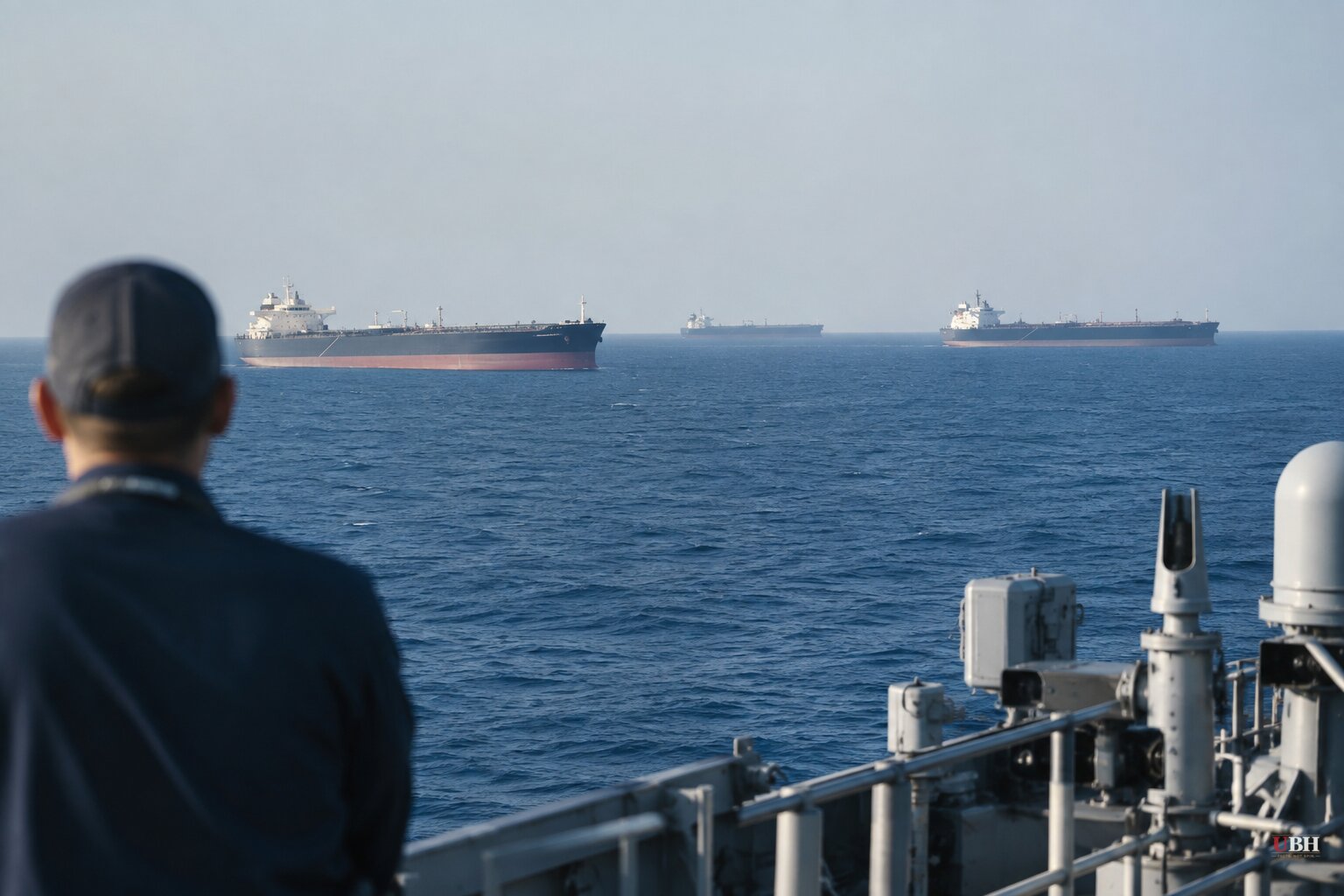
Since the U.S. and Iran traded strikes for the first time in over a month, the two sides have escalated fast: the U.S. Navy has now destroyed eight Iranian oil tankers in two separate rounds, and Tehran has hit American targets in Jordan again.
Eight tankers, two strikes, one warning
U.S. Central Command said the first round came after Iran's Islamic Revolutionary Guard Corps fired ballistic missiles at the USS George H.W. Bush and USS George Washington carrier strike group patrolling the Gulf. CENTCOM said both ships "successfully evaded multiple unprovoked Iranian attacks" with no American casualties. In response, U.S. forces disabled the tankers MT Downy near Kharg Island and MT Stark 1 near Jask, and destroyed the unladen carrier MT Kylo in the Gulf of Oman after ordering its crew to abandon ship, according to CENTCOM.
"Let the message to the IRGC be clear: If you shoot at two of our ships, we will impose an even higher economic cost, taking out three of yours," said CENTCOM commander Adm. Brad Cooper.
According to the Associated Press, via PBS, the U.S. followed up by destroying five more tankers, the Kivik, Charminar, Horizon 1, Riesco and Derya, after further attacks on Navy ships and after Iran struck U.S. targets in Jordan. Secretary of State Marco Rubio told reporters in Colombia that "for every time they do that or try to do that, they're going to lose tankers." Defense Secretary Pete Hegseth put it bluntly on X: "if Iran shoots at U.S. ships, we will destroy (and sink) their oil tankers... Iran has no navy or air force."
Iran's foreign ministry called the strikes "illegal and aggressive" and a "war crime" that violates the UN Charter. Parliament Speaker Mohammad Bagher Ghalibaf warned that "any aggression against Iran's interests and security will receive a faster, heavier, and more painful response," per Iran's state-run IRNA. The IRGC claimed to have attacked and damaged three U.S. vessels; CNN reported it had not received confirmation of that claim from CENTCOM by publication, and Iran separately claimed it targeted an unmanned U.S. vessel trying to enter the strait, a claim NPR noted the U.S. military had not confirmed either.
Iran's Supreme National Security Council secretary, Mohsen Rezaei, told state media a new exclusion zone near the Strait of Hormuz is coming "in the coming days," aimed at vessels trying to transit without Tehran's consent, according to Reuters and CNN.
China's satellite fingerprints on a deadly attack
Separately, U.S. officials told the Wall Street Journal that Chinese companies supplied Iran with high-resolution satellite imagery of Muwaffaq Salti Air Base in Jordan shortly before an Iranian missile attack there in July killed Army 1st Lt. Tyler James Feehan, Pvt. Isabella Gonzales and Sgt. Angel S. Rampersad, and wounded four others. The Trump administration sanctioned three Chinese firms, MizarVision, Earth Eye and Chang Guang, back in May over allegations they provided imagery Iran could use against U.S. forces, according to the Journal.
U.S. officials have not accused the Chinese government of ordering the assistance, only linked the imagery to specific private companies. Chinese Embassy spokesman Liu Chang did not directly address the allegations, instead accusing unnamed critics of "maliciously linking and smearing other countries," per the Journal. Beijing has demanded evidence and repeatedly denied its companies are arming Iran's targeting. The revelation lands as President Trump prepares to meet Chinese President Xi Jinping, raising the stakes on an already tense agenda item that has nothing to do with tariffs.
Oil, midterms, and an unclaimed attack
Brent crude briefly hit $99.46 a barrel this week, per the Associated Press, as the shipping war threatens roughly a fifth of the world's oil trade that normally passes through Hormuz. The Trump administration also sanctioned more than two dozen airlines and cargo carriers tied to Iran's aviation industry, part of what officials describe as a dual military-and-economic squeeze.
President Trump told reporters he expects the war to end "very soon," likely after the November midterms, according to Fox News. Rising gas prices are a real political liability for his party heading into that vote, and an oil market climbing toward $100 a barrel doesn't help.
Meanwhile, the UK Maritime Trade Operations agency issued a verified warning that a vessel was struck by an unknown projectile transiting the Strait of Hormuz late Saturday. UKMTO said it did not know the vessel's identity, the crew's condition, or who fired it, and that an investigation is underway.
Danny Citrinowicz, an Iran expert at Israel's Institute for National Security Studies, warned on social media that the tanker-for-tanker cycle "can only risk more retaliation," adding: "There is no kinetic solution to the Strait of Hormuz problem." CENTCOM's own escalating rhetoric doesn't really answer such concerns.
What happens next depends largely on whether Iran actually declares its promised exclusion zone near Hormuz, and whether Washington treats that as an act of war on international shipping lanes it has vowed to keep open.
Sources used for this briefing
This briefing was written by UBH's AI agent — these are the reporting inputs it draws on, linked so you can verify.


