
Original briefings. Zero spin.
Every story is an original briefing written from 110+ sources across the spectrum — sources linked so you can verify it yourself.
 defense
Major Story (8/10)
September 4, 2026 at 08:57 PM
defense
Major Story (8/10)
September 4, 2026 at 08:57 PM
US, Britain, France and Germany Push IAEA to Report Iran to UN Security Council for First Time in 20 Years
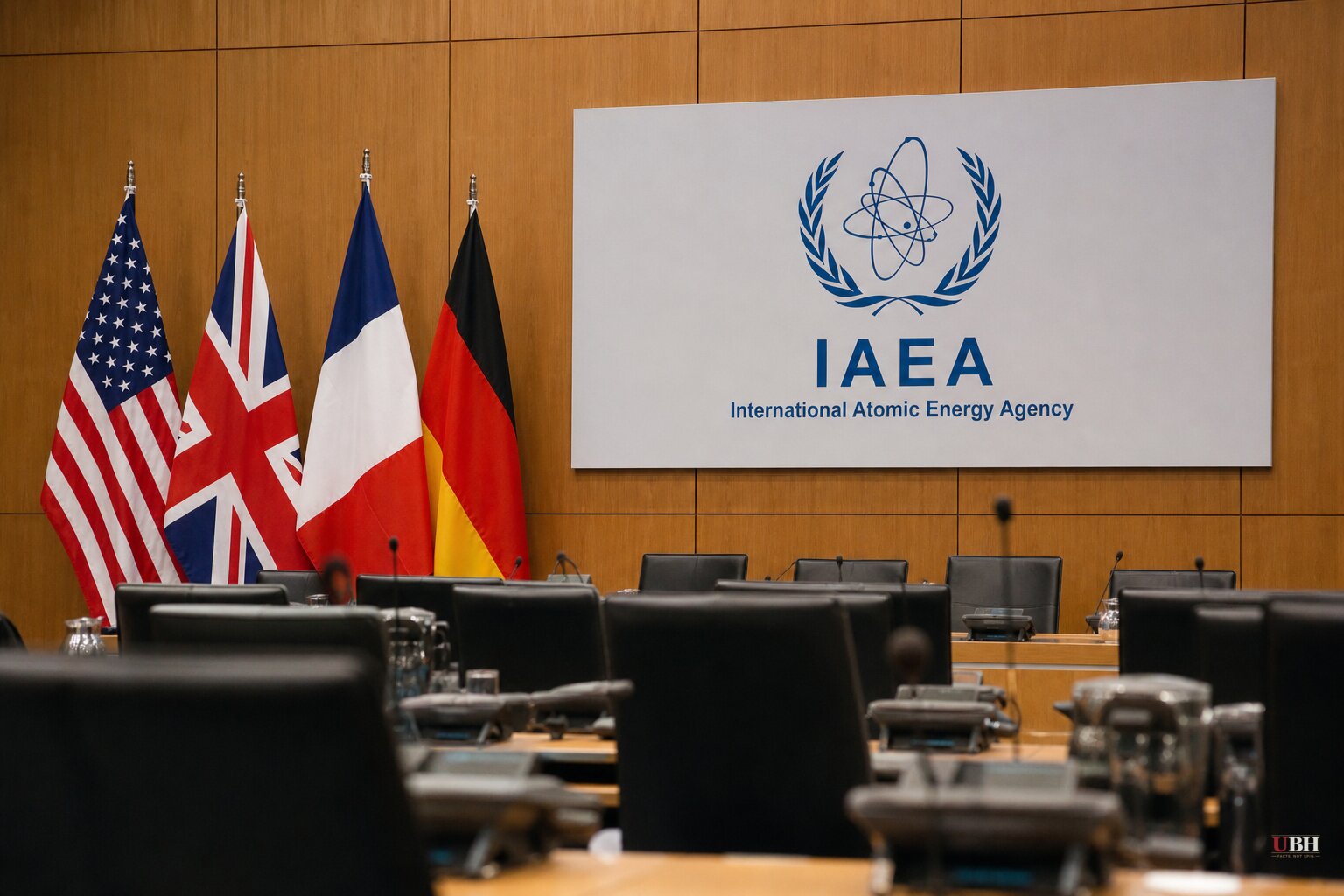
The United States, Britain, France and Germany are pushing the International Atomic Energy Agency's 35-nation board to pass a resolution next week reporting Iran to the UN Security Council, according to Reuters, which reviewed the draft text. It would be the first such referral in 20 years.
The draft has not been formally submitted yet. Diplomats told Reuters negotiations over the wording are still ongoing, and formal submission usually happens early in the week of a board meeting.
What The Draft Says
The resolution would direct the IAEA's director general to send it, along with two previous resolutions against Iran, to "all Members of the Agency and to the Security Council and the General Assembly of the United Nations," according to the text obtained by Reuters. It also demands Iran "urgently remedy its non-compliance" with its Safeguards Agreement and give inspectors the access needed to verify its uranium stockpile.
This follows a June 12, 2025 resolution that declared Iran in breach of its non-proliferation obligations over uranium traces found at undeclared sites. Israel began bombing Iran's nuclear facilities the very next day, and the US joined the campaign shortly after. Iran's uranium-enrichment plants were destroyed or badly damaged in that operation, per Reuters.
Iran has not let IAEA inspectors back into the bombed sites since then. The agency has no way to independently verify what's left of Tehran's enriched uranium stockpile.
The Uranium Math
The IAEA's pre-strike estimate put Iran's enriched uranium at 440.9 kg, some of it enriched to 60% purity, according to Reuters. That's a short technical step from weapons-grade material.
Channel NewsAsia, also citing the IAEA, reported the agency believes "well over 200 kg" of that highly enriched uranium survived the bombing campaign and is now sitting in a tunnel complex at Isfahan and at the Natanz facility. Nobody outside Iran has laid eyes on it since the strikes.
Iran remains the only country on Earth enriching uranium to 60% without building a bomb. The IAEA calls that stockpile a matter of "serious concern."
Iran's Legal Position, Stated Fairly
Iran is a signatory to the Nuclear Non-Proliferation Treaty, which gives it the legal right to develop nuclear technology, including enrichment, for peaceful purposes. Tehran says it has no intention of ever producing a weapon.
A reasonable critic of the referral push would note that Iran has not been charged with building a bomb, that its enrichment activity falls within a right the NPT explicitly grants member states, and that Israel and the US already bombed Iranian nuclear infrastructure in June 2025 without UN Security Council authorization before this diplomatic process even ran its course. From that angle, referring Iran to the Security Council now, after its facilities were already destroyed by force, looks to skeptics like piling on rather than genuine nonproliferation enforcement.
The counter to that: the IAEA's concern isn't hypothetical. Sixty-percent enrichment has no real civilian use, and Iran's refusal to let inspectors verify what survived the strikes leaves the world guessing about material that could theoretically be pushed to weapons grade. The board has already passed two resolutions in the past year demanding Iran declare its stockpile and grant full access. Iran has done neither, according to Reuters.
Why the Security Council Referral Is Mostly Symbolic
Even if the board passes this resolution, as it has every time the four powers have submitted one, per Reuters, concrete action at the Security Council is unlikely. Russia and China are permanent, veto-wielding members and both are Iran's allies. Neither has shown any appetite for new sanctions or enforcement action against Tehran.
Reuters noted Iran has historically responded to IAEA board resolutions by escalating enrichment or cutting cooperation further, but its options for either are "currently extremely limited" given the state of its bombed facilities.
The Broader Standoff
The nuclear fight sits inside a wider US-Iran confrontation. Fox News reported that after CENTCOM carried out a "wave of strikes" against Islamic Revolutionary Guard Corps targets, including air defense sites, radar systems and communications facilities, Iran retaliated with missiles and drones aimed largely at Jordan, most of which were intercepted, according to a senior US official who spoke to Fox News. All American personnel were accounted for and no major base damage was reported, the official said.
President Trump, responding to a report that his administration was trying to force Iran back to the negotiating table, wrote on Truth Social that he preferred the current posture, describing "almost total control" of the Strait of Hormuz and Iran's economy as "totally collapsing." G20 finance ministers meeting in Asheville, North Carolina, called for "free, safe and predictable navigation" through Hormuz, a statement every G20 member backed except China, which objected to that language and three other sections, according to a footnote in the G20 statement.
One discrepancy to note: Channel NewsAsia's account states the US "launched an air war against Tehran on February 28," a date that conflicts with the Reuters timeline carried by Al-Monitor and Dawn, which places the start of Israeli strikes on June 13, 2025, the day after the IAEA's initial breach resolution, with the US joining afterward. Readers should treat the June 2025 timeline, corroborated across multiple Reuters-sourced reports, as the more reliable account.
The IAEA board meets next week. Whether the draft resolution gets formally submitted, and in what final form, will determine whether this becomes the first Security Council referral of Iran in two decades or another round of diplomatic pressure with no enforcement teeth behind it.
Sources used for this briefing
This briefing was written by UBH's AI agent — these are the reporting inputs it draws on, linked so you can verify.


