
Unbiased headlines. Facts, not spin.
Unbiased Headlines is an independently owned news organization. We bring you the facts, not opinions, written fresh from 110+ named sources. Sources linked so you can verify it yourself.
 energy
Major Story (7/10)
Event date: November 4, 2026 ·
UN Says Overshooting 1.5°C Is Now Unavoidable as COP31 Opens Monday in Antalya
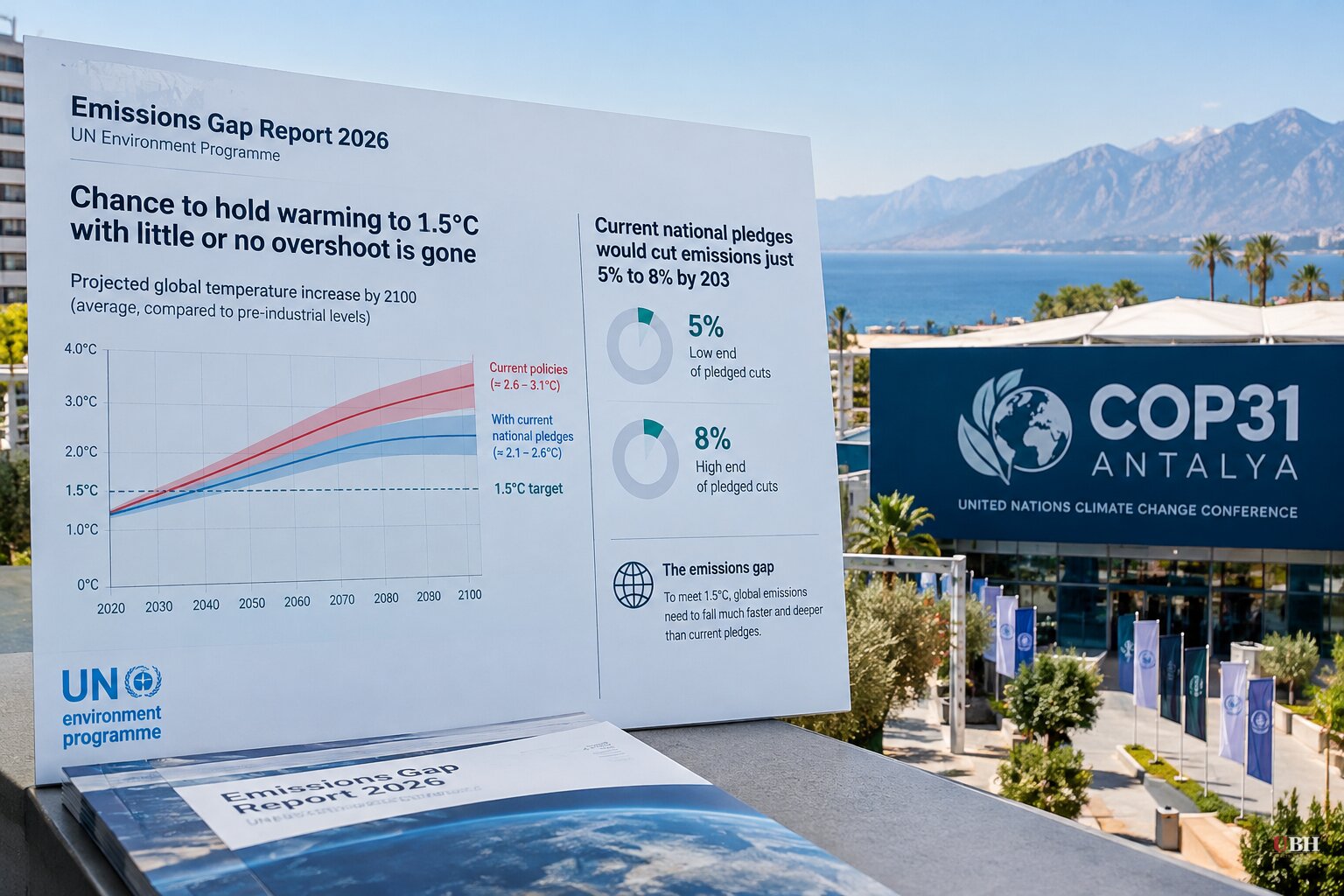
The United Nations has told the world's governments that the 1.5°C target is out of reach, at least for a while. Its Emissions Gap Report 2026, titled "The Point of Return," lands as COP31 prepares to open in Antalya, Turkey, on Monday, Nov. 9. The talks are scheduled to run through Nov. 20.
The finding is blunt. "The opportunity to bridge the 1.5°C emissions gap with 'no or limited' overshoot has been lost," the UN Environment Programme wrote. It added that a larger exceedance of 1.5°C, measured on multidecadal averages, is now "imminent and unavoidable."
The numbers
Global greenhouse gas emissions totaled an estimated 58.4 billion tonnes of CO2 equivalent in 2025. That is slightly below 2024, but UNEP says the figures are provisional and too uncertain to say whether emissions are falling, flattening or peaking.
The growth rate has slowed. Emissions rose an average of 1.7% a year from 1990 to 2015 and 0.8% a year since 2016.
Fossil fuel CO2 rose between 0.4% and 1.1% in 2025. Nitrous oxide and fluorinated gases rose faster but are small in the total. Methane held steady. Lower land-use emissions, partly from fewer wildfires, offset the increases.
UNEP expects that offset to reverse. The current "super" El Niño is likely to push land-use emissions up in 2026.
Where the pledges leave us
The lowest-overshoot pathway UNEP assessed requires cuts of 18% by 2030, 45% by 2035 and 69% by 2040, all measured against 2025 levels.
Full implementation of the latest national pledges would deliver 5% to 8% by 2030 and 11% to 15% by 2035. Not close.
Even on the best path, temperatures would climb to about 1.7°C to 1.8°C around mid-century. UNEP puts a 66% chance on holding the peak within that range and roughly a 50% chance of returning to 1.5°C or below by 2100.
On current policies, warming reaches 2.8°C by 2100. Full delivery of pledges, followed by similar effort, gets to 2.6°C. Meeting every pledge plus additional net-zero targets gets to about 2.1°C.
UNEP says each additional fraction of a degree, and each year above 1.5°C, raises the risk of irreversible damage to ice sheets, frozen ground, ocean circulation and coral reefs.
Who moved in 2025
Among the six largest emitters, only the United States posted a notable increase in 2025, according to the report. U.S. emissions rose by 133 million tonnes of CO2e on higher electricity demand and a rebound in coal power. The report points to a mix of market factors: a colder winter, higher gas prices and rising power demand.
Emissions in China, the EU, India, Russia and Indonesia were relatively flat. China remains the world's largest emitter.
An exporter runs the negotiating table
Turkey and Australia competed for hosting rights and settled on a split. Turkey presides over the conference. Australia's climate minister, Chris Bowen, presides over the negotiations.
That puts a major fuel seller in the chair. Australia is the world's second-largest exporter of thermal coal and the largest of steelmaking coal. About a fifth of global LNG exports come from its shores. The government expects export earnings from the three fuels to reach A$141 billion (US$98 billion) this financial year.
Climate advocates have urged Australia to set aside that industry and push for a global agreement to move away from coal, gas and oil. Bowen rejects the premise. He told the Guardian that every country is dealing with the transition and that Australia's domestic shift away from coal in electricity has been recognized internationally.
Bowen has named three priorities: limiting overshoot past 1.5°C, getting poorer countries enough finance, and a new electrification goal backed by Turkey and Australia. That goal would have 35% of final energy use worldwide come from electricity by 2035. Ocean protection is likely to be another theme.
Detailed national plans to transition away from fossil fuels, which climate experts regard as central to limiting warming, are not on the official agenda.
The talks open amid conflict in the Middle East that has driven an oil price crisis and raised living costs worldwide. That is the backdrop for any request that governments accelerate cuts.
Accountability and corporate pledges
The COP31 presidency has pledged an "Implementation COP" focused on trackable progress. One tool for that is the facilitative, multilateral consideration of progress, a Paris Agreement process in which countries present policies at UN conferences and field questions from peers. Nearly 50 countries have taken part. At the June 2026 session, Canada, Japan, Lithuania, Mexico, Sweden and the UK were asked how they will reach their 2030 targets, according to Nathan Cogswell of the World Resources Institute. He describes the questions as non-confrontational and the process as under-used.
Corporate pledges are holding in number, if not always in ambition. The Net Zero Tracker, which covers close to 2,000 of the largest listed companies, found 64% have net-zero commitments, roughly flat. The U.S. share slipped one point to 51%. The EU rose to 85%. China climbed to 28%, from 24% in 2025 and 18% the year before.
"There's no massive withdrawal," said Louise Bammel of Germany's NewClimate Institute, a tracker partner. The study did find backtracking among the largest firms, such as narrowing the emissions covered or turning a commitment into an aspiration. Bammel said a delay can show a company has looked hard at its options and takes its target seriously. PepsiCo, which downgraded its goals in 2025, cited a lack of support from policymakers.
The open question for Antalya is whether delegates will put a number on the 2030 gap. UNEP's arithmetic is on the table: pledges cover 5% to 8% of the 18% needed by 2030.
Sources used for this briefing
6 links from 6 independent newsrooms (syndicated copies of the same report count once)
These are the sources it draws on, linked so you can verify.


