
Original briefings. Zero spin.
Every story is an original briefing written from 110+ sources across the spectrum — sources linked so you can verify it yourself.
 finance
Major Story (8/10)
September 7, 2026 at 06:26 AM
finance
Major Story (8/10)
September 7, 2026 at 06:26 AM
UK Slashes Long Gilt Sales to 9% of Issuance as Global Bond Yields Hit Multi-Decade Highs
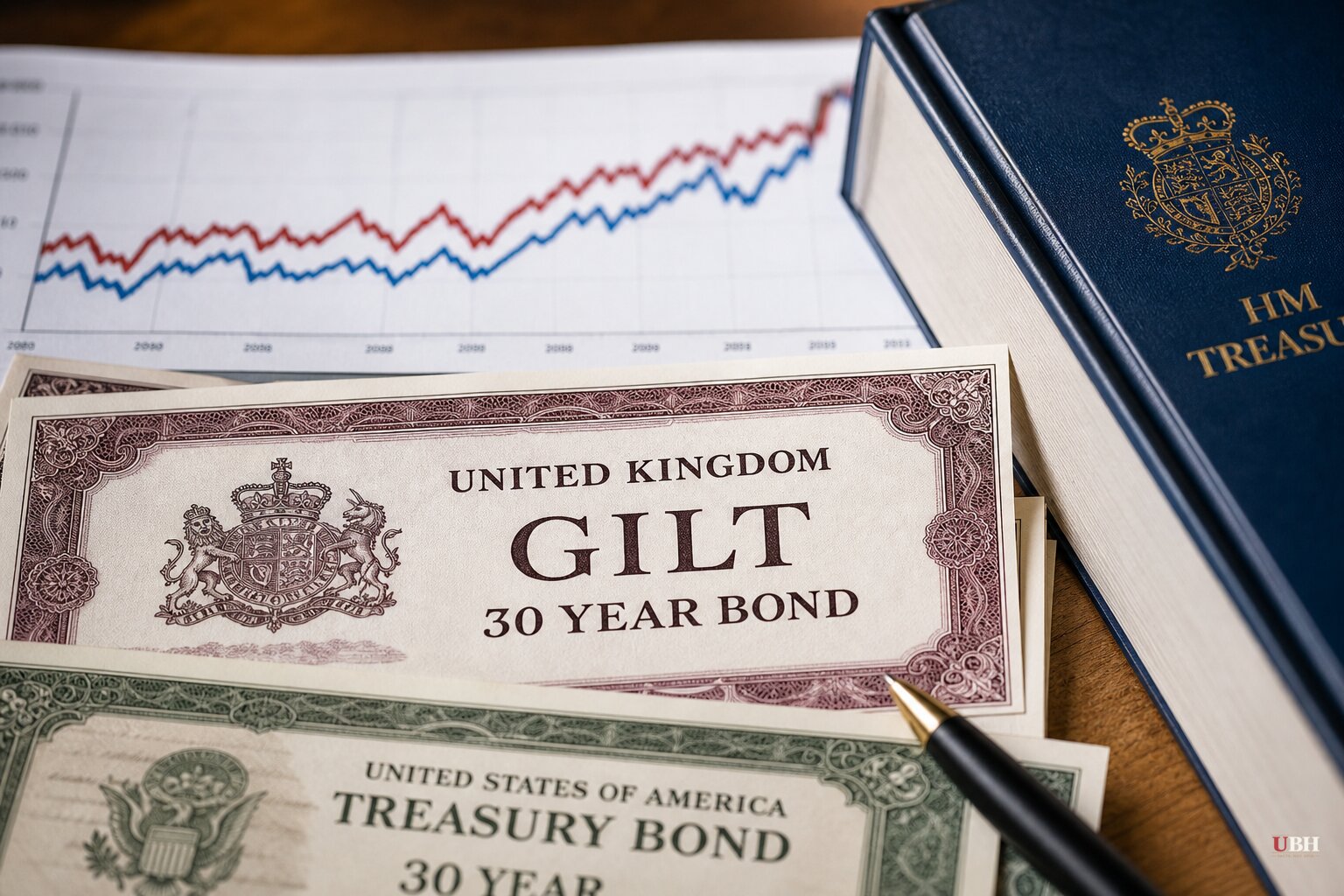
Government debt managers on both sides of the Atlantic spent the past several months scrambling to keep long-term borrowing costs from spiraling, and the numbers show why.
UK 30-year gilt yields hit 5.89% at one point, the highest level since 1998, as investors dumped government bonds on inflation bets, according to The Guardian. Ten-year gilt yields climbed to around 5.25%, their highest since the 2008 financial crisis. The selloff swept in from Japan and the US and hit London hard.
Higher gilt yields eat directly into the government's budget math. Deutsche Bank's chief UK economist, Sanjay Raja, told The Guardian that Chancellor Rachel Reeves's headroom against Labour's fiscal rules could fall from £26 billion at her spring forecast to £13.8 billion, before any new spending is even added, if yields stay elevated through the government's upcoming 28 October budget. Raja said he sees £10 billion as the bare floor the government needs to hold to keep markets from panicking, ideally £15 billion.
Britain retreats from long bonds
The UK Debt Management Office isn't waiting around. It has cut planned long conventional gilt sales to £23 billion for the 2026-27 fiscal year, roughly 9% of total issuance, according to Crypto Briefing. DMO chief executive Jessica Pulay said in March the reduction reflects fading structural demand from domestic pension funds, which have been de-risking and shifting toward shorter maturities and insurer buyouts since the 2022 mini-budget crisis exposed how leveraged liability-driven investment strategies had become.
The Bank of England is moving in the same direction. Its own Asset Purchase Facility schedule for the third quarter of 2026 includes three short-maturity auctions at £725 million each and two medium-maturity auctions at £600 million each, with zero long-dated gilt sales planned, per the Bank's market notices. That's a shift from earlier in the year, when the January 2026 notice still showed a £675 million long auction on the books.
The DMO is now exploring whether to absorb long gilts directly off the Bank's balance sheet, and it plans to run a pilot 'switch auction' on September 24 that will let the government retire long-dated bonds and replace them with shorter ones, reshaping the maturity profile of Britain's debt without adding to the total stock. The UK's average gilt maturity sits at roughly 14.4 years, the longest in the G7, and that number is starting to come down.
Washington's version of the same problem
The US Treasury faced its own reckoning after 30-year yields rose above 5.3%, the highest since 2007, and 10-year yields hit 4.74%, near the highest of Trump's second term, according to CNN. The Treasury responded by announcing it would at least double the size of its bond buybacks from September to early November, focused on 10- to 30-year Treasuries.
The move worked, at least for now. The 30-year yield dropped to 5.2% and the 10-year fell to 4.65% after the announcement. Neil Wilson, a strategist at Saxo Markets, told CNN the timing signaled the administration had decided "higher US yields are unacceptable" and needed counteracting.
CNN's own reporting ties the yield spike to a mix of causes: inflation concerns linked to the Iran war, persistent government deficits, uncertainty about the Federal Reserve's path, and a wave of corporate debt tied to AI infrastructure buildouts competing for the same buyers. The Guardian's account of the UK selloff, by contrast, leans almost entirely on international drivers, Japanese bond weakness and rising oil prices, without weighing in on deficits as a domestic factor the way CNN does for the US. Both are describing real forces, just with different emphasis.
The Iran deadline adds another variable
Oil is part of that story too. The Guardian noted oil prices were up 3.8% to nearly $94 a barrel amid the global bond rout, tied in part to renewed tension around the Strait of Hormuz, through which roughly a fifth of the world's oil and LNG normally moves.
That tension came to a head today. The 60-day window for a final US-Iran agreement expired Monday with no deal, according to Fox News. President Trump told Fox's Trey Yingst that Tehran "should put up the white flag of surrender" and confirmed a direct back channel with Iran's Revolutionary Guard Corps. Treasury Secretary Scott Bessent has signaled a new phase of sanctions is coming, telling Newsmax on August 13 to "watch this space" for measures unlike anything seen in the history of economic isolation of a country. A Treasury spokesperson told Fox News Digital that "Economic Fury has left the regime desperate for cash."
The numbers back that up on paper. Iranian oil loadings fell from 1.8 million barrels a day before the war to under 500,000 barrels a day over the past month, Treasury figures cited by the Associated Press show, and the IMF projects Iran's economy will contract 5.4%.
Victor Davis Hanson, writing for the Daily Signal, described Bessent's approach as an "anaconda" strategy, expanding sanctions to third parties that trade with Iran under what he called Operation Economic Outcast. But he cautioned that enforcement isn't universal. China, Russia, North Korea, and overland rail and air routes still move goods in and out of Iran untouched by the blockade, he said, comparing Tehran's staying power to Japan's refusal to surrender even after being devastated in the summer of 1945.
Sanctions squeeze a population before they squeeze a regime's elite. A Foundation for Defense of Democracies analyst cited by Fox News made a similar point, saying the real test is whether the pain ever reaches the IRGC-linked networks that have historically insulated themselves from economic collapse. No source in this record shows that has happened yet.
What happens next is straightforward to track. Bessent has said new measures are coming "next week." The DMO plans to run its pilot switch auction on September 24. And the government's budget is set for October 28, when the market's verdict on Britain's fiscal headroom becomes official, not estimated.
Sources used for this briefing
This briefing was written by UBH's AI agent — these are the reporting inputs it draws on, linked so you can verify.


