
Original briefings. Zero spin.
Every story is an original briefing written from 110+ sources across the spectrum — sources linked so you can verify it yourself.
 finance
Major Story (8/10)
September 7, 2026 at 06:38 AM
finance
Major Story (8/10)
September 7, 2026 at 06:38 AM
Chipmaker Stocks Drive Tokyo and Seoul Higher as Oil Rises on U.S.-Iran War Escalation
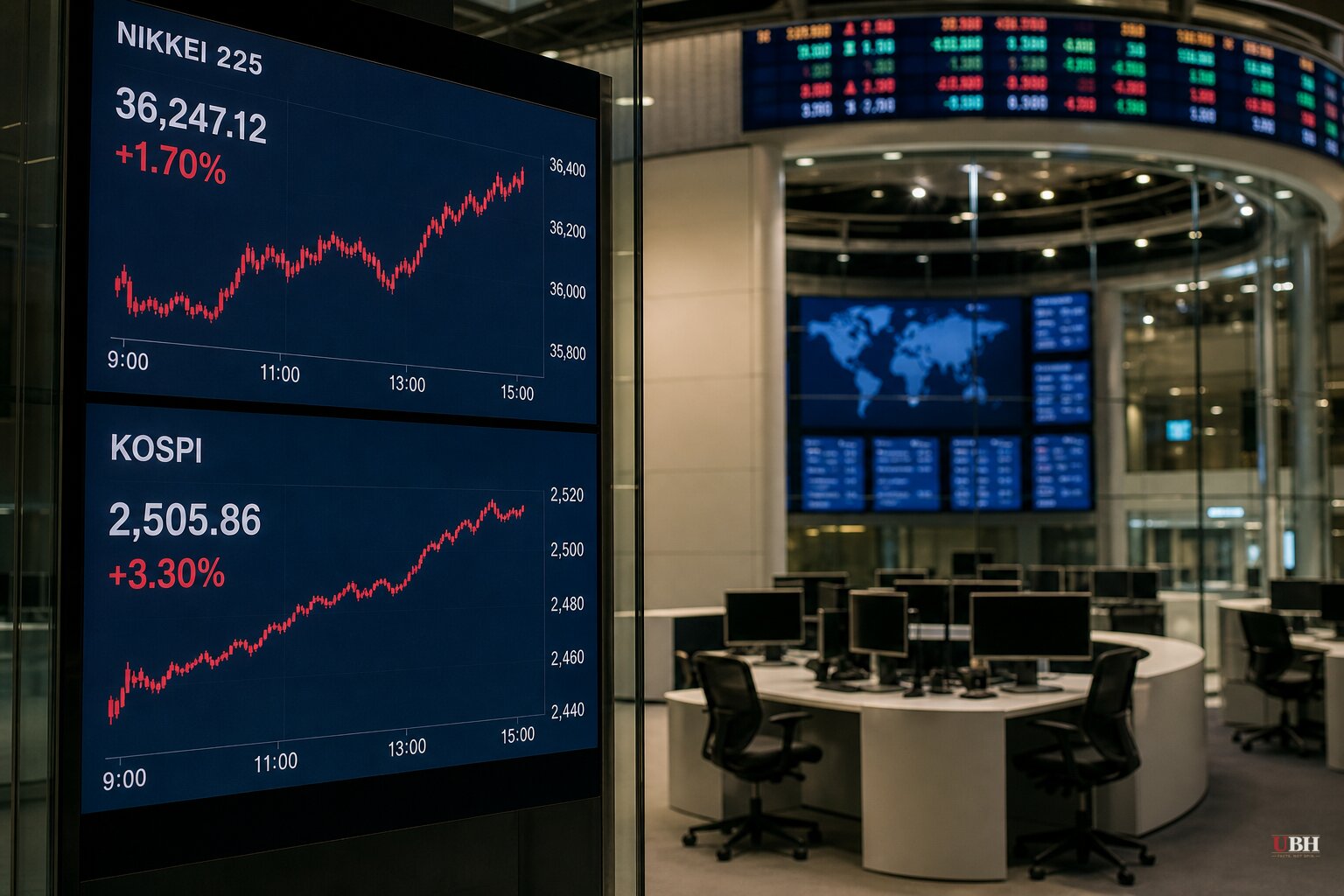
Chip stocks power gains in Tokyo and Seoul
Asian markets were mixed on Monday, September 7, with Japan's Nikkei 225 climbing 1.7% to 66,104.93 and South Korea's Kospi jumping 3.3% to 6,907.53, according to the Associated Press. The gains were driven almost entirely by semiconductor names. Samsung Electronics rose 4.5% and memory chipmaker SK Hynix surged 6.2%.
Stephen Innes, a former trader who now provides market commentary, told the Associated Press the AI trade is still doing the heavy lifting for regional equities. "The AI complex continues to provide the local equity markets with its most dependable growth pulse," Innes said. "The AI complex is firmly in the leadership seat and reminding investors that, for all the hand-wringing around valuation, the hardware trade is still refusing to roll over."
Not every market followed the chip rally. Hong Kong's Hang Seng dropped 1.1% to 25,377.12 and the Shanghai Composite slipped 0.2% to 3,920.70. Australia's S&P/ASX 200 was essentially flat at 9,005.30.
Oil rises as U.S.-Iran war escalates and Strait of Hormuz standoff deepens
While chip stocks grabbed headlines, the more consequential story sitting underneath Monday's market action is a six-month U.S. war with Iran that shows no sign of cooling.
Brent crude, the international benchmark, added 67 cents to $96.95 a barrel. U.S. crude rose 61 cents to $92.09. Both moves came after a fresh flashpoint in the Strait of Hormuz, one of the world's most important oil chokepoints, which the Associated Press reports remains effectively closed.
A senior Iranian official said Tehran plans to announce an "exclusion zone" outside the strait targeting vessels it believes are trying to transit the waterway, according to the Associated Press. That announcement follows U.S. strikes on three Iranian oil tankers, which the U.S. carried out in response to Iranian ballistic missiles fired at American warships.
Separately, the U.S. military flatly denied a claim that Iran struck an uncrewed American military vessel in the strait, calling the allegation a "total lie," per the Associated Press. Iran's side of that specific claim was not detailed in available reporting, leaving that particular incident a disputed, unresolved point between Washington and Tehran even as the broader conflict grinds on.
An active shooting war over a chokepoint carrying a huge share of global oil traffic arguably deserves more prominent placement than chipmaker stock moves. Energy markets are already pricing in real disruption risk, and an Iranian exclusion zone, if enforced, would be a direct challenge to freedom of navigation that a serious response from Washington would need to address head-on. That's a national security story as much as a market one, and it's the kind of test of American resolve that shouldn't get buried under a Nikkei headline.
Jobs report puts pressure on the Fed
Back in the U.S., markets were closed Monday for Labor Day, but Friday's session set the tone heading into the holiday. The Dow fell 0.5%, the S&P 500 dropped 0.4%, and the Nasdaq slid 0.3%, according to the Associated Press.
The selloff came after the government reported employers added 162,000 jobs last month, more than expected. Inflation remains well above the Fed's 2% target, sitting above 3%, and the stronger jobs number raised the odds the Federal Reserve raises interest rates later this month rather than cutting, per the AP.
The 10-year Treasury yield, which feeds directly into mortgage rates, ticked up to 4.78% from 4.77% on Friday as bond traders digested the jobs data. In currency markets, the dollar held near 156.22 yen and the euro slipped to $1.1609 from $1.1621.
For anyone with a mortgage, a car loan, or a 401(k), stubbornly high inflation combined with a still-hot labor market means the Fed has little political cover to cut rates, whatever Wall Street wants. A rate hike, not a cut, is now the more likely outcome heading into the central bank's next policy meeting.
What comes next
Two concrete dates are on the calendar. August inflation figures are due out Friday, September 11, and will shape how aggressive the Fed gets. The Federal Reserve's policy-making meeting concludes Wednesday, September 16, with a rate decision expected then.
On the Iran front, there's no resolution in sight. Whether Tehran's threatened exclusion zone actually gets enforced, and how Washington responds if it does, will determine whether Monday's modest oil gains turn into something much bigger.
Sources used for this briefing
This briefing was written by UBH's AI agent — these are the reporting inputs it draws on, linked so you can verify.


