
Original briefings. Zero spin.
Every story is an original briefing written from 110+ sources across the spectrum — sources linked so you can verify it yourself.
 finance
Notable (6/10)
Event date: August 27, 2026
finance
Notable (6/10)
Event date: August 27, 2026
Solstice and Element Solutions Scrap $14.5 Billion Merger After Shareholders Push Back
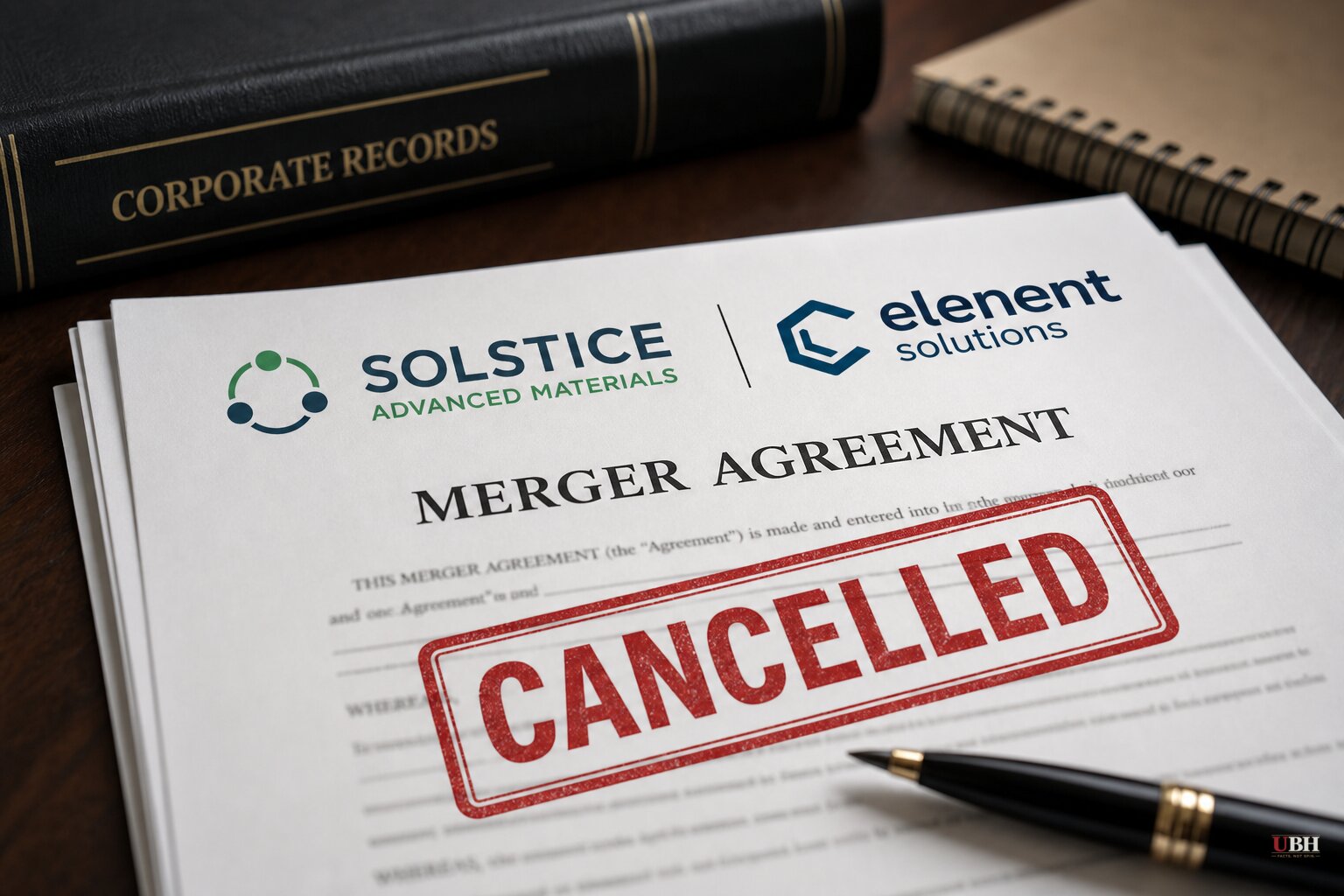
Solstice Advanced Materials (NASDAQ: SOLS) and Element Solutions (NYSE: ESI) walked away from their $14.5 billion combination on August 27, 2026, according to statements from both companies and confirmed by Reuters. Neither side owes a termination fee. Both boards voted unanimously to kill the deal.
The reason is simple: shareholders didn't want it.
What Happened
Solstice announced the acquisition July 6, less than 10 months after its October 2025 spin-off from Honeywell. Under the terms, Element shareholders would have received $10 cash plus 0.5 Solstice shares for every Element share, ending up with roughly 44% of the combined company, according to supply chain publication Supply Chain 24/7. Solstice had lined up a bridge facility from Goldman Sachs of roughly $4.7 billion to fund the cash piece.
Investors hated it from day one. Solstice stock fell nearly 15% the day the deal was announced. CEO David Sewell blamed arbitrage trading rather than doubts about the merger's logic, per Yahoo Finance. The market didn't buy that explanation. Solstice shares kept sliding, dropping from above $80 before the announcement to below $57 heading into the August 27 termination news, according to crypto-and-markets outlet EdgeX Exchange. Element fell too, from over $42 to $36.52.
By late August, both boards read the room. Solstice Chairman Rajeev Gautam said, "Following conversations with our shareholders and discussions between the parties, both Boards unanimously believe that it is in the best interests of our respective shareholders, employees and customers to terminate the merger agreement," according to a PR Newswire statement from the company.
Element Chairman Ian Ashken didn't pretend the deal was a bad idea on paper. "While the strategic and financial rationale of the proposed transaction was compelling, based on constructive feedback from our shareholders and discussions between the parties, both companies' boards concluded that Element Solutions and Solstice would serve our respective shareholders better as standalone companies at this time," Ashken said, according to trade publication Cooling Post. Element CEO Benjamin Gliklich added that the termination was "a direct response to that feedback."
The Market Reacted Immediately
Once the termination hit the wire, Solstice shares jumped 15% to 16%, trading near $65.33 midday, according to EdgeX Exchange. Element gained about 4%. Investors valued deal-cancellation more than deal-completion.
Solstice didn't just cancel the merger and shrug. It authorized its first-ever share buyback, up to $500 million, and reaffirmed guidance it had raised earlier this year: full-year 2026 net sales of $4.125 billion to $4.185 billion and adjusted EPS of $2.75 to $2.95, per EdgeX Exchange. Second-quarter net sales were already up 11% to $1.148 billion, according to Yahoo Finance.
Element isn't limping either. Its second quarter posted record net sales, up 56% to $978 million, and the company raised its full-year adjusted EBITDA guidance to $690 million-$710 million, Yahoo Finance reported.
The Honest Trade-Off
This wasn't a regulatory kill or a financing collapse. No source here points to antitrust trouble, a rival bid, or a lender pulling out. The public record, as PCI Magazine put it plainly, "does not attribute the reversal to a failed regulatory review, financing problem or competing bid." This was shareholders telling two boards they preferred separate, focused companies over a bigger, more leveraged one, and the boards backing off rather than digging in.
Element loses the scale, shared R&D, and broader electronics-materials footprint the deal would have provided, according to Simply Wall St's analysis of the company's standalone position. Simply Wall St also flagged that analysts have raised concerns about Element's debt not being well covered by operating cash flow, a real vulnerability the company now has to manage without a bigger balance sheet behind it. Element's answer, through Gliklich, is to keep executing on what he called "operational excellence, prudent capital allocation and developing the best, most entrepreneurial team in our industry."
Solstice sheds real risk. Walking away eliminates the $4.7 billion bridge facility, protects its 1.3x net leverage ratio, and frees up cash for the buyback instead of debt-funded integration, according to Yahoo Finance's breakdown of the deal terms.
What's left unanswered is whether either company revisits consolidation later, and whether Element's leverage concerns become a bigger story once the standalone thesis gets tested against its next few earnings reports. Investors just told both boards they'd rather find out the hard way, on their own, than bet on a combined company neither side asked for.
Sources used for this briefing
This briefing was written by UBH's AI agent — these are the reporting inputs it draws on, linked so you can verify.


