
Original briefings. Zero spin.
Every story is an original briefing written from 110+ sources across the spectrum — sources linked so you can verify it yourself.
 finance
Notable (6/10)
Event date: August 31, 2026
finance
Notable (6/10)
Event date: August 31, 2026
Tether's Treasury Holdings Top $122 Billion as Stablecoin Giant Eyes Top 5 Buyer Status
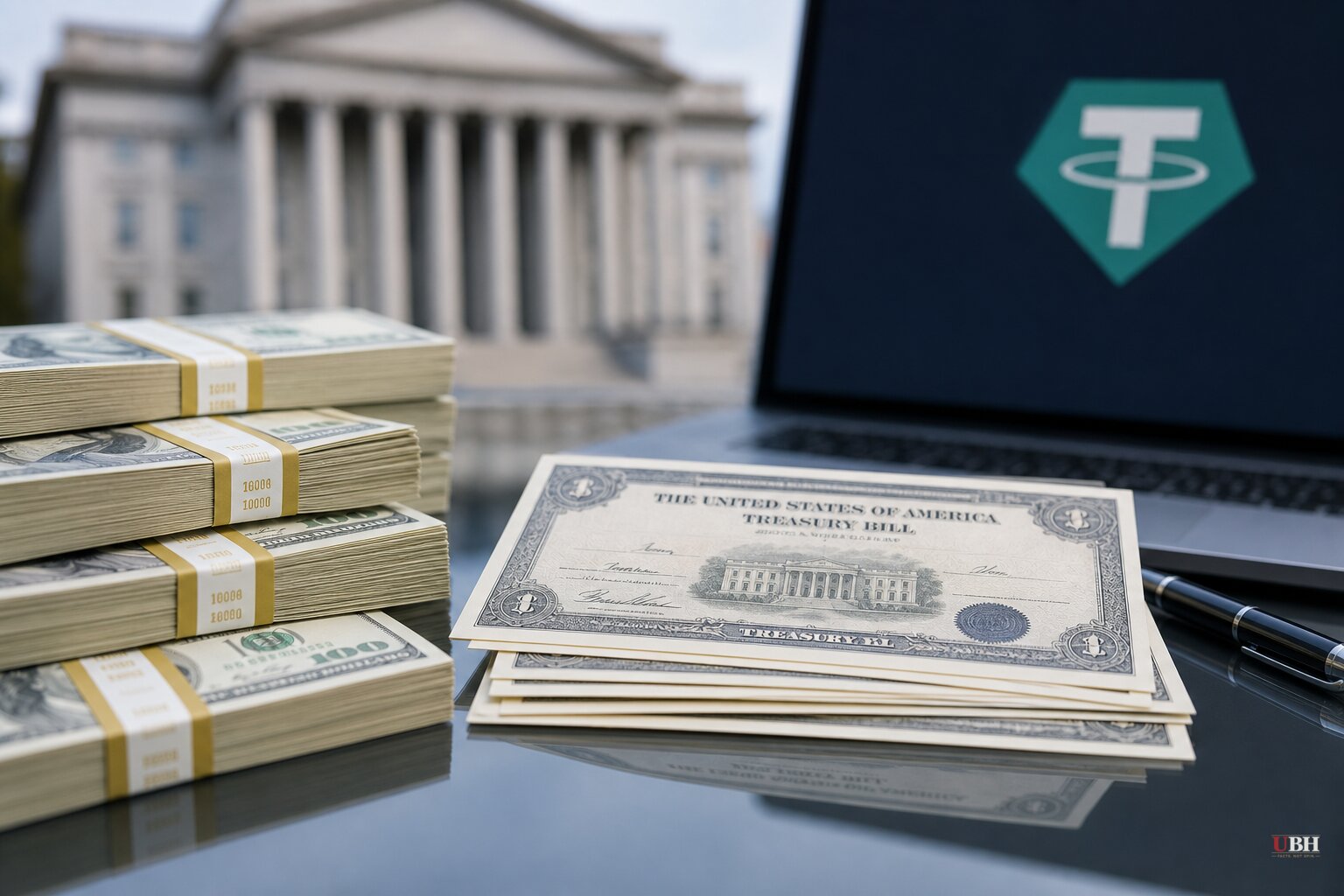
Tether, the company behind the USDT stablecoin, has quietly become one of the biggest buyers of US government debt on the planet. It holds over $122 billion in direct Treasury bill positions, with total exposure exceeding $141 billion once indirect holdings are counted, according to the company's own disclosures reported by Crypto Briefing and KuCoin.
Roughly 83% of the reserves backing USDT sit in T-bills, and with USDT's market cap now around $185 billion, the company has to keep buying just to stay backed one-to-one.
The Numbers Behind the Flywheel
In 2024, Tether made net Treasury purchases of $33.1 billion, ranking seventh among all foreign buyers of US debt. In 2025, it bought $28.2 billion, landing in seventh place again. Tether says it ranks fifth when hedge fund activity is stripped out of the comparison.
CEO Paolo Ardoino has said he expects Tether to break into the top 10 purchasers of T-bills outright in 2026, driven by continued USDT growth and new products. Pluang reported Tether posted a net operating profit of $1.3 billion in the second quarter of 2026, on top of over $10 billion in profit for all of 2025, almost entirely generated by the yield on its Treasury portfolio.
The company says it's adding about 30 million new users a quarter, pushing its total user base to roughly 530 million. Every new user buying USDT forces Tether to buy more T-bills to match reserves, according to Crypto Briefing. Pluang also reported that Tron has overtaken Ethereum as the leading network for USDT, with $94.27 billion in supply, and that a new USDT0 token launched on the Stellar blockchain on September 2, 2026, expanding USDT's reach across chains.
Washington Is Watching, and Cheering
Treasury Secretary Scott Bessent has floated the idea that stablecoin issuers could become a structural source of demand for US debt, projecting the sector could eventually absorb $800 billion to $1 trillion in Treasuries as it scales. Stablecoin legislation moving through Congress would formalize reserve requirements that effectively lock in Treasury holdings for issuers like Tether and its smaller rival Circle, issuer of USDC.
Tether's reserves used to include a murkier mix of commercial paper and other instruments that drew scrutiny for years. An 83% allocation to Treasury bills is a cleaner, more transparent book than what Tether ran a few years back.
Yields Are Already a Problem, With or Without Tether
Tether's Treasury buying spree is happening while the bond market itself is under real strain, for reasons that have nothing to do with stablecoins. The 30-year Treasury yield hit 5.32% on August 18, 2026, the highest level since 2007, according to the Epoch Times. The 10-year hit 4.74% around the same time.
Commonfund analyst Haider Hassan told the Epoch Times that federal debt has climbed to roughly $38 trillion, with net interest expense reaching about $970 billion in fiscal year 2025, enough to surpass the roughly $917 billion the government spent on national defense. A wave of corporate bond issuance to fund AI infrastructure, $159 billion by mid-2026 versus $121 billion for all of 2025, has added to the competition for buyers, per Commonfund.
The Treasury Department responded by doubling its planned buybacks of longer-term bonds from September through early November, according to CNN and AP News. The 30-year yield dropped to 5.2% after that announcement, and the 10-year fell to 4.65%. Saxo Markets strategist Neil Wilson told CNN the move was a signal the administration considers the current level of long-end yields "unacceptable."
The yield spike and the government's buyback response are separate stories that both involve the Treasury market. Bessent's stablecoin projection is about future demand, not a fix for today's borrowing costs.
The Vetting Question Nobody's Answered
A fair concern about handing a fast-growing crypto company this much structural importance in the Treasury market is whether that company actually knows who it's dealing with. Tether CEO Paolo Ardoino told Congress in a 2023 letter that the company uses vetting practices comparable to "sophisticated financial institutions."
Documents obtained by the International Consortium of Investigative Journalists tell a different story for the 2019-2020 period, when USDT in circulation grew from under $2 billion to more than $20 billion. ICIJ found hundreds of millions of dollars in direct purchases from shell companies in the Cayman Islands, British Virgin Islands, Seychelles and Hong Kong, plus tens of millions in tokens bought directly by entities later tied to North Korean hacking operations and the Sinaloa Cartel.
One buyer, Russian national Nikita Krasnov, purchased about $1.16 million in USDT in 2020 and was sanctioned by US authorities four years later for sanctions evasion tied to Russian elites. Anti-money laundering expert Alison Jimenez told ICIJ that real due diligence means understanding "where the $50 million came from," not just checking names against a sanctions list after the fact.
The transactions happened before those buyers' alleged crimes became public, so this isn't proof Tether knowingly dealt with criminals. It is proof that the vetting process the company described to Congress didn't catch the people it was supposed to catch, at least during that stretch. Tether has not been charged with a crime related to these transactions, and no US regulator has announced a new investigation tied to the ICIJ documents.
This matters more now given how central Tether has become to America's own debt-financing plans. As Congress finalizes stablecoin rules that would lock reserve requirements into law, the open question is whether those rules do anything to fix the customer-vetting problem ICIJ documented, or whether they focus purely on what stablecoin issuers hold rather than who they let buy in the first place.
Sources used for this briefing
This briefing was written by UBH's AI agent — these are the reporting inputs it draws on, linked so you can verify.


